Company Real Estate and Succession: Sell Together or Split It Off

The building where the workshop or warehouse operates very often belongs to the same company as the business it houses. When the time comes to sell, a fork appears that owners rarely see coming early enough: hand over the building together with the company, in one block, to the same buyer, or split the two apart, keep the real estate and lease it to whoever takes over the operations. This is not a call you make on a price instinct. It hinges on who can actually finance the purchase, on what tax rules allow and on what timeline, and on what the seller still wants to carry after signing.
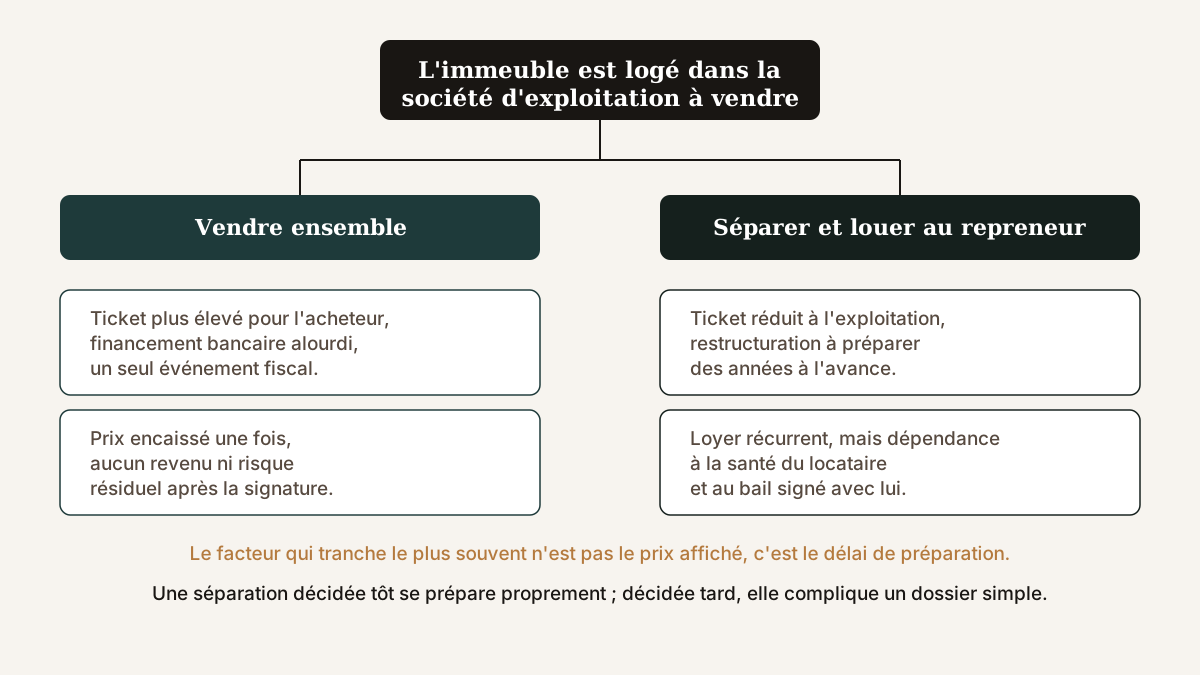
What the building changes for the buyer
An operating building commonly accounts for 20 to 40% of the total asking price for a mid-sized industrial or trade SME, sometimes more when the site has been expanded over decades. That weight changes the nature of the deal for the buyer before the operating business itself even enters the conversation. A manager running an MBO already borrows against the company's future cash flow; asking them to also finance the building doubles the bank ticket and, in practice, rules out a share of internal buyers who would have handled the operating business alone without difficulty. A strategic acquirer, by contrast, sometimes has equity or group cash that absorbs this line without the same crowding-out effect: what disqualifies an MBO does not necessarily disqualify a strategic buyer.
Splitting off the real estate mechanically lowers the amount the buyer has to raise, which widens the pool of solvent profiles. The tradeoff is that the seller stays the owner of an asset whose value, over time, depends on a single tenant: the company they just sold. If it struggles or relocates five years down the line, the building is left on the seller's hands, with no buyer left to guarantee occupancy.
The criteria, side by side
| Criterion | Sell the real estate with the business | Split off: keep it and lease to the buyer |
|---|---|---|
| Ticket for the buyer | Higher, heavier bank financing | Reduced to the operating business, more solvent profiles |
| Seller's income after the sale | None, the price is collected once | Recurring rent, as long as the tenant stays sound |
| Tax at the time of sale | One single tax event to handle | A restructuring to prepare years in advance |
| Seller's residual risk | None once signing is done | Tied to the tenant's health and to the lease |
| Appeal to a strategic buyer | Usually neutral, the group absorbs the asset | Can complicate the offer if the buyer wants everything |
| Existing mortgage note | Transferred with the property in the deal | Stays with the owner, separate from the buyer's loan |
These orders of magnitude vary by sector, region, and the state of the local property market; they point a direction, not a fixed formula.
The timeline tax rules impose
Splitting off a building still sitting inside the operating company is not something you improvise six months before putting the business up for sale. Moving the property into a separate real estate company, or out to the owner's private wealth, is a restructuring that tax authorities scrutinize all the more closely the closer it sits to a transaction: the risk, if the link to the sale looks too direct, is a requalification that treats the move as a realization of the building's hidden reserves, taxed immediately rather than deferred. Swiss practice generally applies a blocking period of around five years for a restructuring to still count as tax neutral: a split decided eighteen months before closing simply has not had time to earn that treatment, and the tax advisor on the file will say so plainly. The risk is not a Swiss peculiarity: in Germany or Austria the rules and periods differ, but moving a building out of a company shortly before a sale can carry a tax cost there too, and it is prepared the same way, years ahead.
The same caution applies to a bundled sale when sizeable distributable reserves remain in the company at the moment the shares change hands: that is, under Swiss law, the territory of indirect partial liquidation, which targets exactly the setups where a cash-like asset changes hands just before or after a share sale. A building leased to a third party, sitting inside the same company as the operating business being sold, can be read that way by the tax administration if it was never separated out ahead of time.
The lease that outlives the sale
Splitting off the real estate is not settled at signing: it locks the seller and the buyer into a landlord-tenant relationship that runs for years after closing. A ten to fifteen-year commercial lease, with a cost-of-living indexation clause and a clearly drafted renewal option, protects both sides far better than a verbal understanding between a seller who has known the buyer for months and assumes there is nothing to put in writing. That same lease should also spell out what happens if the buyer ever wants to relocate the business, or if the company changes hands a second time: a right of first refusal for the tenant, or conversely an early exit clause with compensation, keeps a disagreement over the building from complicating a deal that, by then, has nothing to do with it anymore.
A seller who chooses to keep the building trades a higher price today for a rental income spread over time, less liquid, and a prolonged exposure to the health of their former company. It is a wealth-planning call as much as a deal-structuring one, and it deserves to be worked through with a wealth advisor, not just the lawyer drafting the lease.
Who this suits
Selling the building together with the business fits first when the property has nothing specific about it, a standard warehouse, a workshop that could be replicated elsewhere, and the likely buyer is a strategic acquirer or a group able to absorb the full financing without shrinking the pool of serious candidates. Splitting off makes the most sense the other way round, when the most credible buyer is an MBO or an internal manager whose borrowing capacity stops at the operating business, or when the owner wants a steady income and a lasting stake in a building they often built or expanded themselves. Between these two markers, what tips the decision most often is not the headline price but the timeline: a split decided early is prepared cleanly, one decided in the final months before the sale mostly just complicates a file that could have stayed simple.