No Family Successor? The Realistic Options for Your Company

One son runs his own architecture practice in Basel, the other daughter said no flatly at the last family dinner: once the option everyone assumed would happen falls away, an owner of an SME is left with essentially two paths, not ten. On one side, handing the company to someone who will keep running it, whether that person comes from inside or outside. On the other, exiting without putting a single buyer in charge at all, through a foundation or an orderly wind-down. Everything else, often presented as a list of five or six distinct options, is really just a variant within these two families.
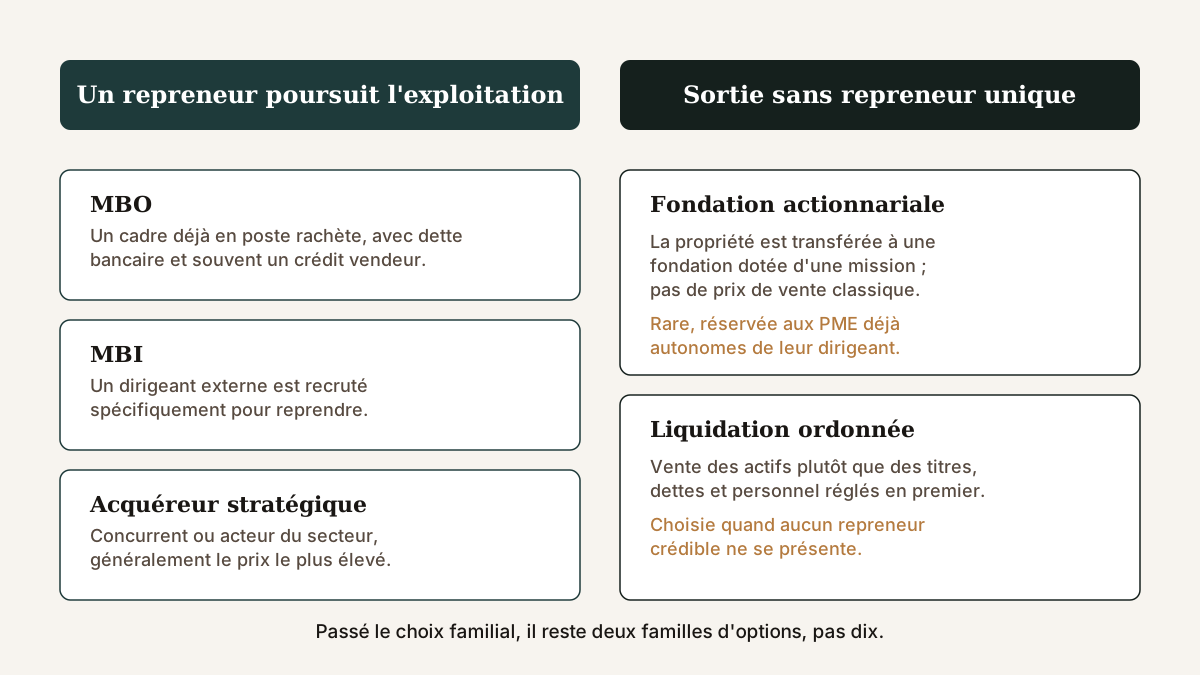
Someone keeps running the business: MBO, MBI, or a strategic buyer
A management buy-out puts one or more managers already on the payroll in charge, backed by a bank loan and often a seller's credit. It is the fastest path to set up when an operations director or a sales lead has already proven themselves, though that only works if they were spotted and groomed years in advance, a point we cover in preparing an internal successor. A management buy-in instead brings in an outside leader recruited specifically to take over: slower to arrange, since you first have to find that person and confirm they understand the trade, but useful when no internal manager wants or can carry the purchase.
A strategic acquirer, often a competitor or another player in the same sector, usually pays the highest price of the three, precisely because it can remove costs neither an MBO nor an MBI can touch, a duplicate site, an overlapping back office. We cover elsewhere how to sequence disclosure with this type of buyer; what matters here is that, like the MBO and the MBI, it is still someone who keeps the business running, with most of the team staying in place. That shared trait is what separates this first family from the second.
Among these three variants, the real question is not which is objectively best, but which fits what the company already has on hand. An MBO assumes a manager able to carry both the debt and day-to-day leadership the day after signing, something you prepare for, not something you improvise once the family says no. An MBI fills the gap when that internal profile is missing, but adds a risk an MBO does not carry: handing the company to someone the staff and clients have never seen at work. A strategic buyer solves that continuity problem since it already knows the trade, at the cost of exposing more information during the process, best managed with a disclosure order set in advance rather than under pressure from a request.
Financing shapes what is actually possible, in both cases
The MBO and the MBI share a constraint a strategic buyer does not face: the buyer borrows against the company's own future cash flow, bank debt, seller credit, sometimes a minority equity investor. That structure, which we detail in how the buyer finances the deal, mechanically caps what the manager or outside leader can offer, compared with a strategic buyer who has equity or synergies to bring to the table immediately. An owner who expects an MBO to match a strategic buyer's price is heading into a negotiation that will not land: it is not the same valuation logic, and expecting otherwise means comparing two families of options on a single criterion when their underlying constraints differ entirely.
Exiting without a single buyer: a foundation or an orderly wind-down
A shareholder foundation exists in Switzerland as in Germany, but stays rare across the SME landscape: ownership is transferred to a foundation carrying a mission, preserving local jobs, funding a cause, keeping the headquarters in the region, which then holds the company under a governance mandate rather than an individual shareholder. The mechanism makes sense for a company already run by a solid operating team independent of the owner, able to function without them from day one; it involves non-trivial setup costs and, in effect, forgoes a conventional sale price since no one is buying out the shares.
An orderly wind-down is the option owners consider least willingly, and yet the most honest one when no credible buyer shows up at a price that covers debts and obligations to staff. Selling the assets, machinery, inventory, the contract book, rather than the company's shares, takes several months but protects the owner from a poorly financed buyout that collapses eighteen months after signing. It also carries a tax consequence worth anticipating with a tax advisor, whatever the country: in Switzerland, for instance, it turns on indirect partial liquidation when distributable reserves remain in the company at the point of exit, a topic we develop in succession and taxes in Switzerland.
The two paths, criterion by criterion
| Criterion | Someone keeps running the business | Exit without a single buyer |
|---|---|---|
| Typical timeline | 6 to 18 months depending on the buyer's profile | 12 to 24 months, often longer for a foundation |
| Who sets the price | Negotiation with an identified buyer | Little or no conventional price (foundation) or asset value (wind-down) |
| Financing | Bank debt, seller credit, sometimes an earn-out | Setup costs (foundation) or wind-down costs |
| Existing team | Usually kept on, transition to manage | Kept under a mandate (foundation) or laid off (wind-down) |
The highest price is not always the right measure: what an exit is worth also shows in what it protects, jobs, commitments made, the trade's continuation.
The choice between these two families rarely comes down to a single number. A company carried by a solid leadership team, with an internal candidate already identified and a client base that does not hinge on one person's personal address book, lends itself naturally to an MBO. A sector going through consolidation, where several players are growing through acquisition, opens the strategic route and its higher price, at the cost of confidentiality that needs finer handling. The absence of any credible buyer, or a business whose value sits mostly in assets rather than ongoing operations, points toward an orderly wind-down. A foundation stays reserved for cases where the mission matters more than the sale proceeds, and where the company can already run without its owner.
None of these paths gets decided in an evening, or improvised after the children say no. The time it takes to prepare an MBO, document a wind-down, or set up a foundation is measured in years rather than months, which pushes the real question earlier than most owners think: the moment they stop waiting for the family's answer and start seriously looking at the other paths. Owners still weighing the family route against these alternatives will find a broader framing in our article on third-party sale, family transfer, or MBO.