AHV contributions after the sale: a seller with no gainful activity still pays

The last payslip of an owner who sells arrives in the month of closing. In Switzerland, the first invoice from the compensation office arrives a few months later, and it comes back every year until reference age. An owner who signs at 58 and does not take another job therefore has seven years of AHV contributions ahead, the state pension scheme, calculated no longer on a salary but on wealth, sale proceeds included. The law knows no early retirement for old-age insurance, only persons with or without gainful activity, and both contribute. What costs money is finding this out afterwards. The mechanism is Swiss; in Germany or Austria the rules differ, but what a former owner without a salary costs in contributions and social cover deserves, everywhere, to be worked out before signing. The timeline below follows the Swiss case milestone by milestone, from the moment the exit date is discussed to the day the office stops writing.
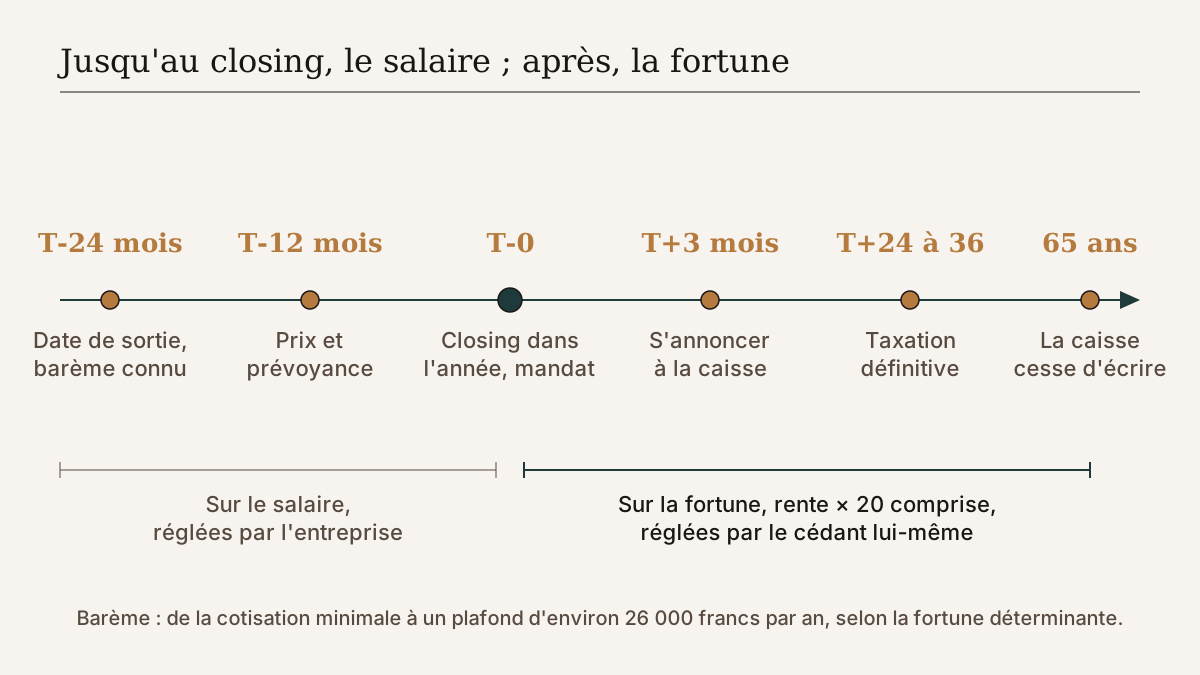
T-24 months: set the exit date knowing the scale
Two years before the sale, the exit date is still discussed in years of life and in order books; the scale for persons without gainful activity deserves a place in that conversation from the start. The rule fits on one line: between 21 and reference age, anyone who does not work contributes to AHV, disability insurance and income compensation on the basis of their wealth, to which annual pension income multiplied by twenty is added. The scale starts at a minimum contribution of a little over five hundred francs a year and climbs, in steps, to a ceiling of around twenty-six thousand francs, reached shortly before nine million of relevant wealth. As an order of magnitude, to be checked against the current scale with your office: four million produce an annual invoice of around ten thousand francs, six million around seventeen thousand, administration fees on top.
For someone who has contributed at the maximum throughout a career, these amounts do not buy a higher pension: they avoid a gap, each missing year reducing the pension by roughly one forty-fourth. An owner of 58 who receives five million faces seven years of contributions which, added up, are a visible fraction of the price. That is not a reason to sell later; sixty-five is not a sale date. It is a reason to put the amount into the table that compares an exit at 58, 61 or 63, next to the expected price and the salary given up.
T-12 months: shape the price and the pension with the base in mind
A year before closing, the price structure is negotiated, and each of its components affects the contribution base. The part paid in cash becomes wealth on the day of transfer. A vendor loan remains a receivable, hence wealth, for its whole repayment period. An earn-out appears in the tax return at its estimated value before a franc of it is received, and the compensation office relies on the tax assessment. Their payment schedule draws the schedule of the contributions, and it is better to know that when signing.
Occupational pension assets are the lever most often ignored. Second-pillar savings left in the pension fund or moved to a vested benefits account are not wealth for AHV purposes as long as they are not paid out; the same savings withdrawn as a lump sum at closing enter the base from the following year. A pension fund annuity, for its part, counts twenty times its annual amount. The choice between lump sum, annuity and deferred payment is therefore made at this milestone, together with the question of a pension buy-in, and not in the year of retirement. Picture an owner of 60 with two million in pension savings and a sale price of three million; a scenario, not a client. Withdrawing the capital at closing lifts the base to five million; leaving it in a vested benefits account until 65 keeps it at three. Over five years, the difference in contributions runs to tens of thousands of francs, without a franc of pension savings lost.
T-0: closing within the year, and what follows closing
The date of closing within the calendar year matters more than people think. The law treats as gainfully active, for a full year, a person who has worked at least nine months at no less than half the usual working time. An owner employed by the company until the end of September is therefore treated as active for the whole year of the sale; the same owner signing at the end of March will be measured against the scale for persons without activity for that year. Between the two lie several thousand francs, for a date usually chosen on other grounds.
The handover mandate that follows the sale obeys the same logic. Staying employed by your own company for six or twelve months at half time keeps the active status for that period. A board mandate at two days a month does not: the contributions deducted from those fees are compared with what you would owe as a person without activity, and if they reach less than half of it, the office claims the difference. A mandate of thirty thousand francs a year therefore does not cover wealth of five million. Either a substantial, lasting mandate, or the invoice; decide which before negotiating the handover clause.
T+3 months: register with the compensation office
Nobody will register you in your place. A person without gainful activity must register with the cantonal compensation office of their place of residence, without waiting for the office to write first. An omission does not make the debt disappear: the office claims it retroactively, over five years, with default interest. In the files I accompany, this is the administrative item most often forgotten after a sale, because no employer takes care of it any more.
It is also the moment to check the couple's position. Each spouse is insured individually, and the couple's wealth is split in half for the calculation. Above all, a married person whose spouse is gainfully active and pays at least twice the minimum contribution is deemed to have contributed. A spouse who keeps a part-time job sometimes exempts the seller from any contribution, and the solution was within reach.
T+24 to T+36 months: the final assessment catches up with the invoice
The first invoices are provisional, calculated on your own estimate of wealth and income. The definitive contribution is only set once the tax authority passes the assessment for the year concerned to the office, which takes two to three years. An earn-out received, a property bought in the meantime: everything that raises taxable wealth joins the base, and the correction arrives with interest if the initial estimate was too low.
Managing the wealth from the sale therefore benefits from a line reserved for these adjustments, and from reporting any significant change to the office rather than waiting for the assessment. An honest estimate costs the same amount, without the interest and without the registered letter.
Until reference age: an early pension does not close the account
The AHV pension can be drawn one or two years early, from 63. Drawing it does not end the obligation to contribute: a person without activity who receives an early pension keeps paying until reference age, on the same base, while bearing the lifelong reduction that comes with early drawing. For a wealthy seller, drawing early often amounts to paying twice.
At 65, the office stops writing. Before that date, request an extract of your individual account: it shows every contribution year since your twenties, and it is the only document that proves there is no gap. What the sale changes, in the end, fits in one sentence: until closing, the company settled these contributions without you thinking about them; afterwards, you are their sole debtor, and the base is what the sale brought you.