Financial buyer, strategic buyer, family office: What each one actually negotiates

A fund, a competitor and a family office do not negotiate the same points when buying an SME. What each profile checks first, and why it matters.
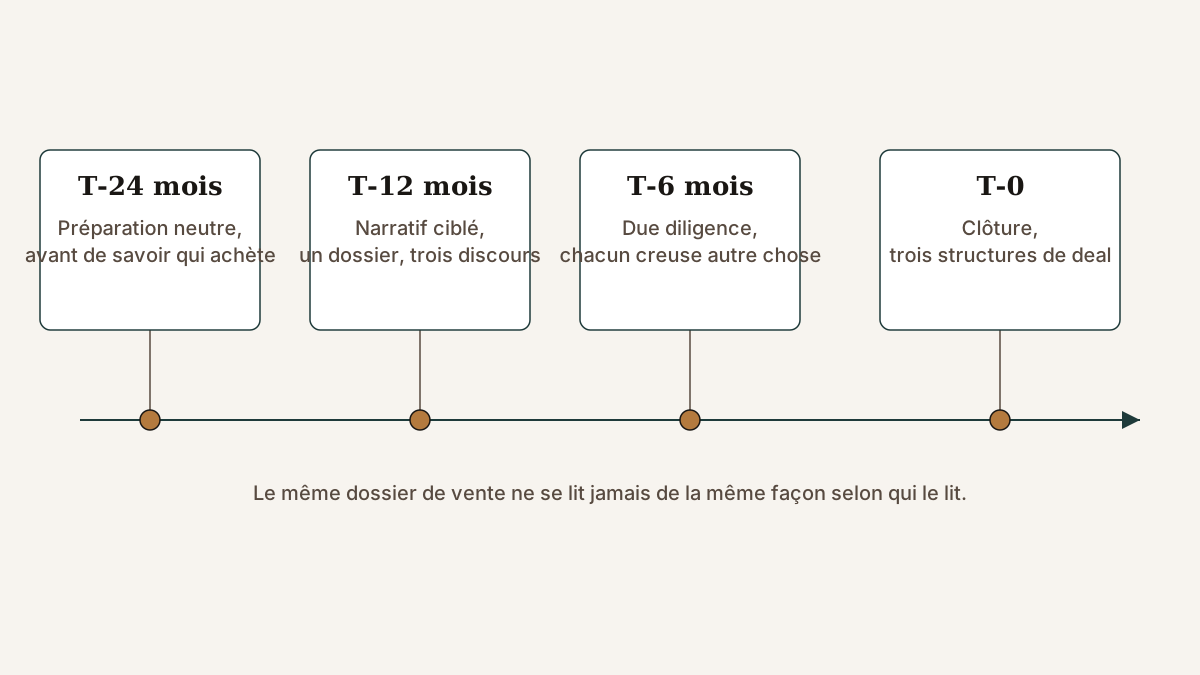
Twenty four months before signing, most owners still do not know who will buy their company: an investment fund, a competitor growing by acquisition, or a family that invests across generations. That uncertainty is not a reason to wait before preparing, it should instead shape every decision made between now and the day the company goes to market. Three buyer profiles dominate the SME succession market today: the financial investor, the strategic acquirer and the family office. None of them reads the same file the same way, and what one demands first often leaves the other two indifferent.
T-24 months: preparing before you know who is buying
At this stage nobody yet knows which profile will show up, and that is exactly what makes preparation tricky: all three read the same company through a different lens. The financial investor values a recurring operating result produced by a team that holds up without the owner, because a fund buys a cash flow, not a founder. The strategic acquirer values complementarity: technical know how, a client portfolio or a territory it does not yet cover, because it buys a missing piece of its own puzzle. The family office values continuity, a readable company culture, a local footprint, because it buys an asset it plans to hold for a long time, sometimes without ever reselling it.
Picture a family owned technical distribution business employing 40 people, whose owner is 55 and starts, without yet knowing who she will sell to, documenting supplier relationships and training a commercial director. That same work serves all three profiles, but not in the same way: it reassures the financial investor about the durability of revenue, it makes the company easier to integrate for a strategic buyer, and it gives the family office proof that governance exists beyond the founder. Twenty four months before a sale, the preparation that counts is the one that speaks all three languages at once, not the one that already bets on a single buyer. It is also cheaper to build this groundwork calmly, over two years, than to improvise it once a due diligence request lands on the desk with a two week deadline attached.
T-12 months: one file, three conversations
Once the process is under way, the information memorandum stays a single document, but the conversation around it changes with the audience. With a financial investor, the discussion centers on how the deal is financed, how much debt the business can carry, and whether the owner stays involved after the sale, often through a seller note or an earn-out that aligns interests over two or three fiscal years. With a strategic acquirer, the conversation shifts to synergies: which costs merge, which clients overlap, how much redundancy risk sits on the teams, a conversation that demands more care around confidentiality since a competitor sees part of your books before signing anything. With a family office, the conversation lingers on subjects the other two barely raise: the company’s mission, the fate of long serving employees, the real holding horizon behind the word, sometimes backed by a shareholders’ agreement that protects governance over ten or fifteen years rather than the two or three of a typical earn-out.
In the mandates I run, the owner who prepares three versions of the pitch, one per profile, moves faster than the one who repeats the same speech to everyone and hopes it fits them all.
T-6 months: due diligence does not dig in the same place
The financial investor spends most of its time on the numbers: quality of earnings, revenue recurrence, how independent the management team is from the owner, because its economic model depends on the company’s ability to service debt without them. The strategic acquirer focuses elsewhere: client portfolio overlap, intellectual property, compatibility of information systems, and often a wider non compete clause than a financial buyer would ask for, fearing you might rebuild the same market from a neighboring structure. The family office asks questions the other two rarely raise: who among the managers stays, what management culture prevails, what becomes of the company’s name. It is often less focused on the last point of margin than the other two, but noticeably more attentive to the stability of the team it inherits.
Back to the technical distribution business from earlier: a fund will look in the accounts for proof the order book holds without the founder, a competitor will check whether the two client portfolios overlap enough to force a choice between similar contracts, and a family office will mostly ask what happens to the twelve technicians if the founder no longer settles internal disputes. A single legal due diligence file serves as common ground for all three, but the order in which each buyer opens it, and the questions asked along the way, give away the profile before it is even announced.
T-0: three closings that do not look alike
Closing itself takes distinct shapes. A buyout by a financial investor typically comes with a leveraged structure, the owner keeping a partial stake, and a deferred payment tied to future performance, a structure that protects the buyer but delays the moment the seller collects the full price. A buyout by a strategic competitor usually closes faster and at a higher headline price, because synergies justify a premium, but it comes with rapid integration, sometimes rough on the teams, a non compete that limits what the seller can rebuild afterward, and often an escrow holding back part of the price for a few months to cover potential seller warranties. A buyout by a family office moves at a slower pace, with more back and forth on future governance, and often lands on a fair price without being the maximum one, in exchange for a promise of continuity the other two profiles rarely state so explicitly.
The right instinct is therefore not to guess in advance which of the three will buy the company, it is to keep, until the first concrete offer arrives, a file and a governance that speak to all three at once. It is often in the clauses of an offer, more than in its headline price, that the profile actually sitting across the table finally reveals itself. Advisors who have sat across the table from all three types tend to read those clauses before the ink is dry; owners on their first sale rarely notice them until the moment has passed to negotiate them any other way.
End of the article.