Private or Business Wealth: The Tax Status That Decides What You Owe on the Sale

In Switzerland, whether the gain from selling your shares counts as private wealth, tax-free, or business wealth, taxed as income, is not decided on closing day. It is built, transaction by transaction, over the five to ten years before the sale, and most owners only raise the question with their fiduciary once it is too late to change anything. The distinction itself is Swiss. In Germany or Austria, the gain on selling a stake in a company is taxed under other rules, but one principle holds everywhere: the tax treatment of a sale is built years before closing.
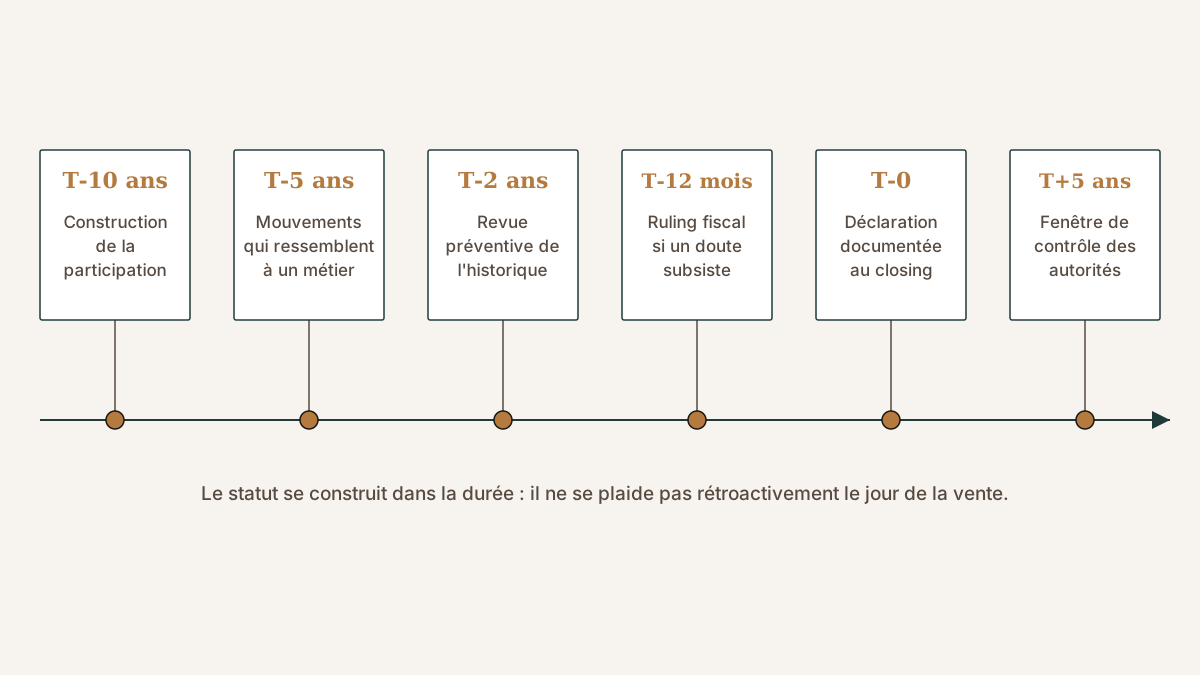
Ten years out: how the shareholding was built
The tax authorities do not only look at the final transaction, they look at how long and how you have held your shares. A stake acquired at the company's founding, held without interruption, financed with equity rather than debt, starts with a favourable presumption of private wealth. A history of successive holding structures, buybacks from other shareholders, and repeated reorganisations builds a harder case to defend, even when each step had a perfectly sound business reason on its own.
Picture a family business taken over in two stages: a minority stake bought at 35, the rest bought out a decade later with a bank loan repaid from the company's own dividends. A common pattern, not an actual client. It almost always stays private wealth, but only if the loan was repaid over a reasonable period and never looked like a leveraged structure renewed again and again.
Five years out: the moves that start to look like a profession
The federal tax authority's guidance on professional securities trading rests on five cumulative criteria: how long the shares were held, the volume and frequency of transactions relative to total wealth, any link to an existing professional activity, the use of borrowed funds to finance purchases, and the use of derivatives. None of these on its own tips an owner into business wealth. It is their combination, across several tax years, that builds or unravels the status.
A professional securities trader status is never argued after the fact, at the moment of the sale. It is read out of five years of bank statements and investment decisions.
In the mandates I run, the trigger is rarely the company sale itself. It is usually side activity carried out in parallel: an owner who, alongside the main business, buys and sells stakes in other companies at a brisk pace, or funds those purchases with credit lines rather than savings. On its own, that behaviour would probably pass unnoticed. Combined with a significant company sale in the same decade, it draws attention to the whole file.
Two years out: reviewing the history before a sale process starts
Before mandating anyone to find a buyer, have a tax specialist, not only the fiduciary who keeps the books, review the capital movements of the past five to ten years. This surfaces any isolated transaction that, seen alongside the coming sale, could weaken the qualification. An earlier reorganisation, shares contributed to a holding company you control at more than 50%, a distribution of reserves followed closely by a buyback: these fall under a related but distinct mechanism, transposition, yet raise the same underlying question. Does the current structure tell a coherent story of private ownership, or a string of transactions that, taken together, look like active management of a professional portfolio?
This review typically takes a few weeks, well within the usual preparation time for a succession, but it needs to happen before a sale timeline is fixed with a buyer, not after. It also gives the fiduciary a chance to gather supporting evidence, loan agreements, board minutes, correspondence explaining the business reason for a given transaction, while the people who made those decisions still remember the context.
Twelve months out: securing the treatment with a ruling
When the review turns up a genuine doubt, the safest path is an advance tax ruling from the competent cantonal authority. Response times vary sharply from one canton to another, from a few weeks to several months depending on how busy the office is, which is why the request should go out well ahead of signing rather than as an emergency once a buyer is found. A ruling does not create a new right, it confirms in writing how the authority will apply existing rules to your specific situation, which removes the uncertainty on a point the buyer's due diligence will almost always raise anyway.
A ruling only protects the situation described in the request. Any significant move between the answer and closing, an additional loan, a last-minute reorganisation, can reopen the question, which is another reason to freeze the capital structure once the ruling request is filed rather than keep adjusting it while waiting for an answer.
Closing day: what the tax return needs to show
The tax return for the year of the sale is not just a matter of declaring the amount received. It needs to come with documentation consistent with the history built up in the earlier stages: proof of equity financing, no repeated buybacks in the months before the sale, a business rationale for every marginal transaction the review flagged. A well-documented file at this stage costs a few hours of exchanges with the fiduciary. A file reconstructed after the fact, under pressure from a contested assessment, costs considerably more.
Five years out: the audit window that follows the sale
The qualification is never final on closing day. Cantonal and federal tax authorities keep, depending on the case, several years to reopen an assessment if new facts emerge: a routine audit, a report, a later transaction that casts the pre-sale period in a different light. Keeping the documentation gathered during the two-years-out and twelve-months-out stages, rather than treating the file as closed once the price is banked, remains the best protection through this window.
Owners who treat this as a last-minute formality tend to discover it when the amount at stake, the sum of an entire career, is also at its highest, with no ten years left to rebuild a track record.