Building a Sale File in Ten Days When the Window Is Short
A buyer who has just confirmed interest rarely gives more than ten working days for a first credible file. The deadline is not arbitrary: it tests whether the business can produce reliable information under pressure, exactly what it will have to do again, harder, once formal due diligence starts after the letter of intent. What ten days genuinely allow, in what sequence, and what is better left for later than improvised.
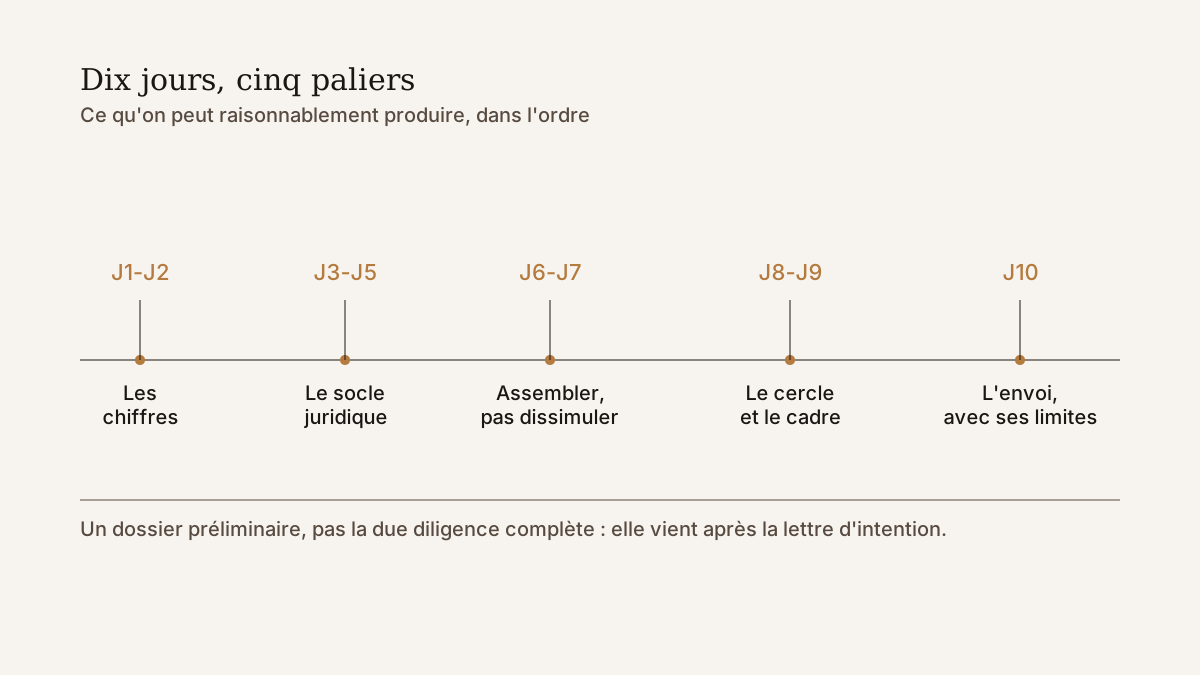
Days 1 and 2: the numbers that cannot be improvised
The financial base comes first, because everything else depends on it and it takes the longest to assemble properly. Three years of annual accounts, a recent interim position if the current year is well underway, and a first pass at normalizing the owner's salary and non-recurring charges, even a rough one at this stage. A simple dashboard, revenue by customer or product line over the last two or three years, usefully rounds this out: it is often the first thing a buyer checks to judge commercial concentration risk.
The fiduciary who keeps the books needs to be involved from day one, not chased on day nine: they know where the entries a buyer will flag immediately tend to hide, a rent paid to a related company, a provision that is not really one. The same groundwork, without the ten-day constraint, is what goes into a fuller financial preparation when the calendar allows for it.
A current commercial register extract, the articles of association and the shareholder register follow right after. These are public or easy to obtain, but their absence when the file goes out signals a disorganization that costs more than the time it would have taken to pull them.
Days 3 to 5: the legal base, sorted by risk
Not everything carries equal weight in a legal file assembled under time pressure. Three categories deserve absolute priority: contracts with the customers who weigh most in revenue, commercial leases and employment agreements for key managers, and the shareholder agreement if one exists, because it can hold a pre-emption or approval clause that changes the timeline of the whole transaction. An ongoing dispute, even a minor one, is best documented honestly rather than risked being discovered later, in far worse conditions for trust.
Everything else, secondary supplier contracts, the full history of assembly minutes, insurance policies, can wait for formal legal due diligence, which will necessarily go further than what ten days allow. Trying to gather everything in five days usually produces a rushed sort rather than a complete file; a narrower, verified base beats a pile of documents nobody had time to check for consistency.
Days 6 and 7: assemble, do not smooth over
At this stage, the temptation is to polish the file so it looks better than it is. It is the costliest mistake in the whole process: an erased figure or a contract left out of the pile almost always resurfaces during due diligence, and it resurfaces in a far worse light than an explanation offered upfront. A margin dip in the last year, a customer who accounts for a third of revenue, a strong dependency on the owner: each of these deserves a line of context rather than a silence that will be noticed.
The assembly itself works best in a simple structure, by broad category, financial, legal, commercial, HR, rather than a chronological pile of files. A one-page note presenting the business, its activity, its key numbers and its three main strengths beats a full information memorandum: that has its place later, once interest is confirmed by this first exchange of documents.
Picture a technical distribution business of about forty people that receives a serious unsolicited offer on a Monday morning: a hypothetical case, not an actual client. Pulling the pieces together by Wednesday, the owner discovers that a margin table by product line has not been updated in eight months, and that a framework agreement with the second-largest customer expired without a formal renewal, even though the trading relationship continues smoothly. The right move is not to hide these two gaps but to flag them, with a date by which they will be closed: that reassures a buyer far more than a file that claims to be flawless and later turns out incomplete.
Days 8 and 9: lock the circle and the frame
Before sending anything, a signed non-disclosure agreement is a must, even with a buyer who is known or recommended: the same logic of opening information circles progressively applies, in a compressed version, to a file built in ten days. This is also the moment to settle who internally needs to know a file is going out: the CFO almost always, the rest of the management team rarely this early. Widening the circle too soon creates a leak risk out of proportion with what ten days of preparation have actually produced.
A final cross-check, by the fiduciary for the numbers and by a lawyer for the most sensitive legal points, closes this stage. It does not replace due diligence, but it prevents a glaring error from undermining the file's credibility on first read.
Day 10: what the file does not claim to be
The file that goes out on day ten is preliminary, and it is better to say so plainly in the cover note than to let the buyer guess. It gives the buyer enough to form a serious intention, not enough to sign without reservation: detailed warranties, thorough contract review and the full data room come after the letter of intent, on a less compressed timeline. Setting that limit at the point of sending protects the negotiation that follows: a buyer who knows what they are getting does not later complain about what was knowingly left out at this stage.
What ten days mostly test is how fast a business can mobilize information it is supposed to already hold. An SME whose numbers, contracts and registers stay current all year clears this deadline without particular strain; one that discovers, while gathering them, that they were two years out of date learns something about itself that the sale only brought forward sooner than expected.