A Year After Selling: What Owners Actually Become

Twelve months separate closing from the point where most sellers finally know, concretely, what they will do with their time. In between lies a year whose shape is invisible from the negotiating table, and just as invisible from the promise of a freer life that everyone repeats around it. What sellers actually go through, month by month, deserves to be looked at squarely before signing, not discovered afterward. What follows maps what tends to happen at each stage, drawn from the pattern I see mandate after mandate.
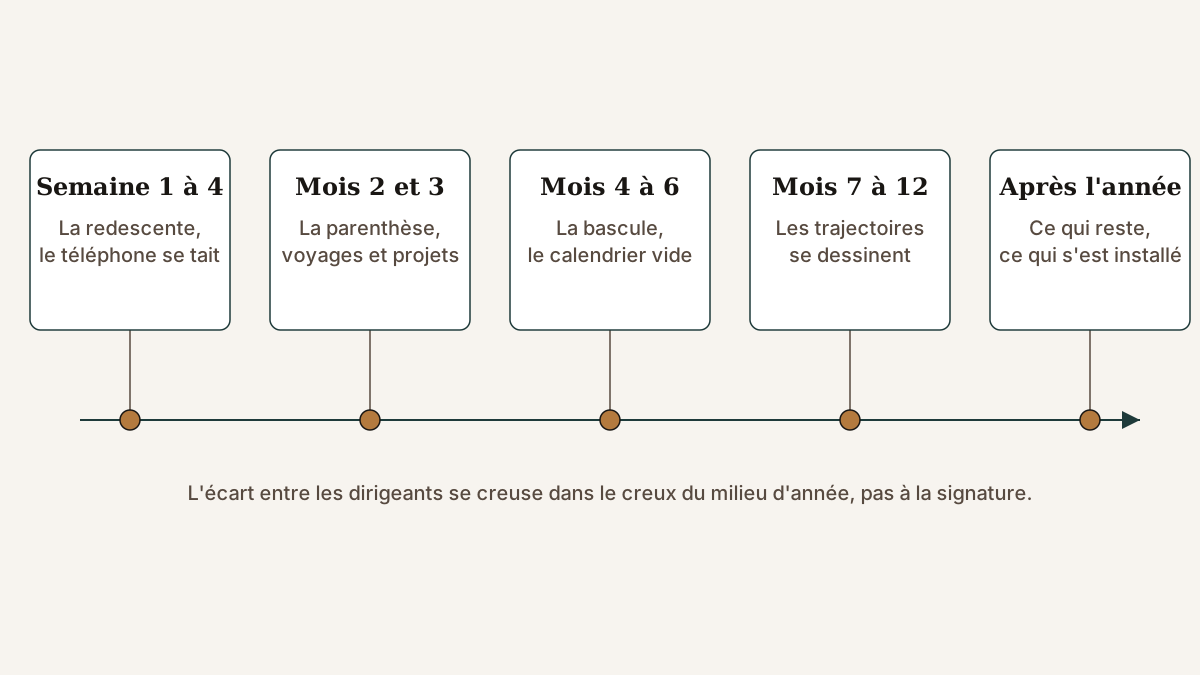
Week 1 to 4: the comedown
The first two weeks still feel like the tail end of a transaction: remaining signatures, transferring bank signing authority, registry filings. The energy of the negotiation still carries the seller, who answers the buyer's emails with the same reflex as the day before closing, sometimes with an eagerness he cannot quite explain to himself. Then, usually between week three and four, the phone goes quiet. No one calls to settle a dispute with a supplier or approve a quote. Employees who, days earlier, sought his opinion now turn to the buyer without a second thought. That silence, more than the amount landing in the bank account, marks the real start of what follows a sale; it often coincides with the point where the identity gap starts to show, before the owner has had time to notice it coming.
Month 2 and 3: the interlude
This stretch looks closest to what everyone around the seller had promised: long-postponed travel, more time with grandchildren, home projects finally started. Sellers often enjoy it sincerely, and rightly so. Some take up a sport dropped twenty years earlier; others rediscover a holiday home barely visited during their working years. The difficulty is not in these weeks themselves but in what they suggest: that this new availability will be enough to fill an entire year. A six-week world trip always ends on an ordinary Tuesday, and it is that Tuesday when the real question starts to surface, usually sooner than anyone around the seller expected.
Month 4 to 6: the turn
This is the quarter when most of the former owners I work with get back in touch, often over a minor administrative matter, mentioning almost in passing that they are looking for something to do. The buyer has found his footing, the contractual handover period is ending or already over, and the calendar that used to fill every week sits empty. Picture a former owner of a forty-person engineering firm, fifty-eight years old, who had planned to figure it out once the sale closed. By May, five months after signing, she described her days as a string of invented tasks to fill the time: gardening, sorting old files, medical appointments moved up out of boredom rather than need. What weighs on her at this stage is neither money nor health, it is the absence of a structure that used to give her days meaning. Couples often move through this phase at different paces, which adds friction at an already fragile moment: the spouse who never left a company keeps their usual rhythm, while the former owner is still looking for his.
Month 7 to 12: the paths that emerge
Past that trough, the patterns I observe fall broadly into four paths, rarely pure, often blended.
- A new board or advisory role. Director, member of an advisory board, or informal mentor to the buyer of another company: this role reuses accumulated experience without carrying its daily operational weight. It is the most common path among owners who sold between sixty and sixty-eight.
- Philanthropy or association work. A foundation, chairing a trade association, passing on know-how through a vocational school: this route appeals mostly to those for whom money was already no longer the main driver of the business.
- A new venture. A smaller company, an active stake in a start-up, sometimes a purchase in an adjacent sector: this path shows up most often among younger sellers, particularly those who sold out of fatigue with an industry rather than fatigue with running a business.
- Active retirement, owned as such. Sport, grandchildren, a holiday home finally lived in half the year: a minority genuinely choose this path, and it works well when it was planned ahead, poorly when it is settled for out of a lack of any identified alternative.
A quieter profile deliberately blends two of these paths: a board seat two days a week, paired with occasional association work, with neither one dominating the calendar. None of these paths ranks above the others. What separates the ones that go well is that the question was asked early, not that the chosen answer was inherently the right one.
After the year: what remains
By the twelve-month mark, the gap between sellers has widened noticeably. Those who had sketched an answer before signing, whether a board seat already lined up, an association commitment already underway, or a retirement planned in detail, get through the mid-year trough with an exit already in sight. Those who had put off the question, assuming it would resolve itself once freed from the demands of running the company, watch it resurface just as the energy of the interlude has run out and nothing concrete has taken its place. Working on this inner readiness before the sale matters as much as the ability to negotiate calmly, which is why it deserves a place next to the tax and legal questions that usually monopolize attention before a transaction.
The best moment to sketch this answer is neither the month after closing nor the trough that follows, but the year before the sale even goes to market, while there is still time to build a board seat, an association role, or a venture rather than stumble into one by default.