Business Succession with a Partner: What to Do When One of You Wants to Sell and the Other Doesn't

This is for the day you realise that you and your partner no longer see the same horizon: one of you is thinking "sell", the other "carry on".
You have four routes, and they're worth examining in this order: the partner who stays buys your stake; you sell the whole company together to a third party; a new partner buys your stake; or you swap roles, keep your shares and write down the date when the question of your shares comes back. Your shareholders' agreement often decides which of those stay open, and if you have none, the articles and your country's default rules do. The first move comes before any of them: tell your partner your horizon out loud, before either of you says the word "sell".
Before the word "sell" is spoken
Take a made-up case, not a client. Two partners run an engineering office of twenty-five people. One is 61 and sees himself there for three more years; the other is 48 and thinks in twelve. Neither has said so. When the younger one turns down an investment "to see how things go", the older one hears a refusal to buy him out, and from then on every meeting is about something else.
-
Say your horizon, in years. "I see myself here in three years, not in ten" is a horizon, not a decision to sell, and it belongs before any talk of price. In the mandates I run, the disagreement that blocks a company is almost never about the price: it comes from one partner deciding in silence and the other finding out at the same time as the bank.
-
Reread the shareholders' agreement and the articles together. The shareholders' agreement is the contract between partners that sets who may sell to whom, at what price, and what happens when one leaves; the articles are the company's basic rulebook. Look for the exit clauses: a right of first refusal (the others buy first), a buyout price method, a drag-along or tag-along clause (whoever sells can take the other along, or must let them follow), a non-compete. What a badly drafted agreement ends up costing is a subject of its own.
-
No agreement? Ask your lawyer what each of you can do alone. Without one, your country's default rules for your company's legal form decide. In my experience, it usually turns out to be less than either partner assumed.
-
Check that you're free to sell your stake to whoever you like. In Switzerland, Germany and Austria, for example, the law lets the articles make a transfer subject to the company's approval, which in a two-partner company comes down to your partner's; elsewhere, ask your lawyer what yours can forbid. In Switzerland, for example, selling a stake in a limited liability company needs the approval of the partners' meeting, which can refuse without a reason unless the articles say otherwise. If it refuses, that same Swiss law lets the partner who wants out ask a court to leave for good cause.
-
Agree on one valuation method before anyone names a figure. Pick one valuer together, write the method down (the one in your agreement, if it has one), and settle that the same figure applies whichever route you take. A price thrown out before the method becomes the starting point of the fight.
-
Find out what the company can finance. A buyout by the partner who stays is usually paid over several years, from the company's profits, a bank loan and sometimes a seller loan, meaning you wait for part of your price. Before you accept one, read what a seller lending to the buyer is exposed to.
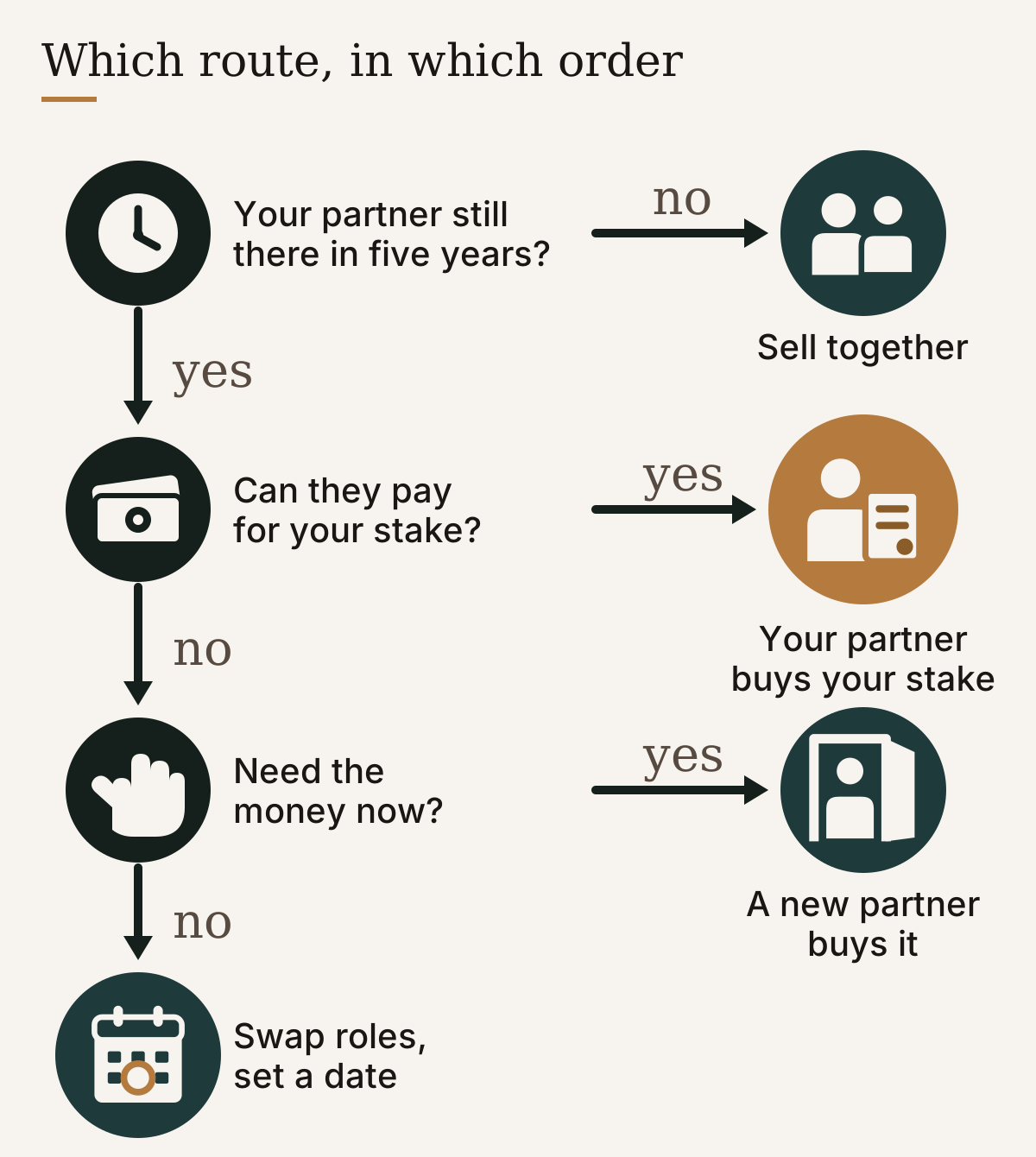
The four routes, in the order to examine them
-
The partner who stays buys your stake. Look at it first, and it stays open if two answers are yes: will the partner who stays still be there in five years, and can they pay for your stake? If both, clients and staff keep the same face at the door and no outsider has to be let in.
-
You sell together. If your partner also plans to leave within a few years, sell the whole company to a third party, side by side. In practice, a buyer pays more for the entire company than for two halves bought separately, and a single stake, minority or half, sells at a discount.
-
A new partner buys your stake. If your partner can't pay and you need the money now, the buyer can be a manager from inside, an outside successor or an investor. The partner who stays has to choose who they'll work beside for years; a minority successor or a financial investor aren't the same kind of neighbour.
-
Swap roles, set a date. If you don't need the money now, you step out of day-to-day management and keep your shares, with their dividends and a seat on the board. A written date says when the question of your shares comes back, or when the stake is sold at the price the method from item 5 gives; without that date, you've only postponed.
What keeps the company moving meanwhile
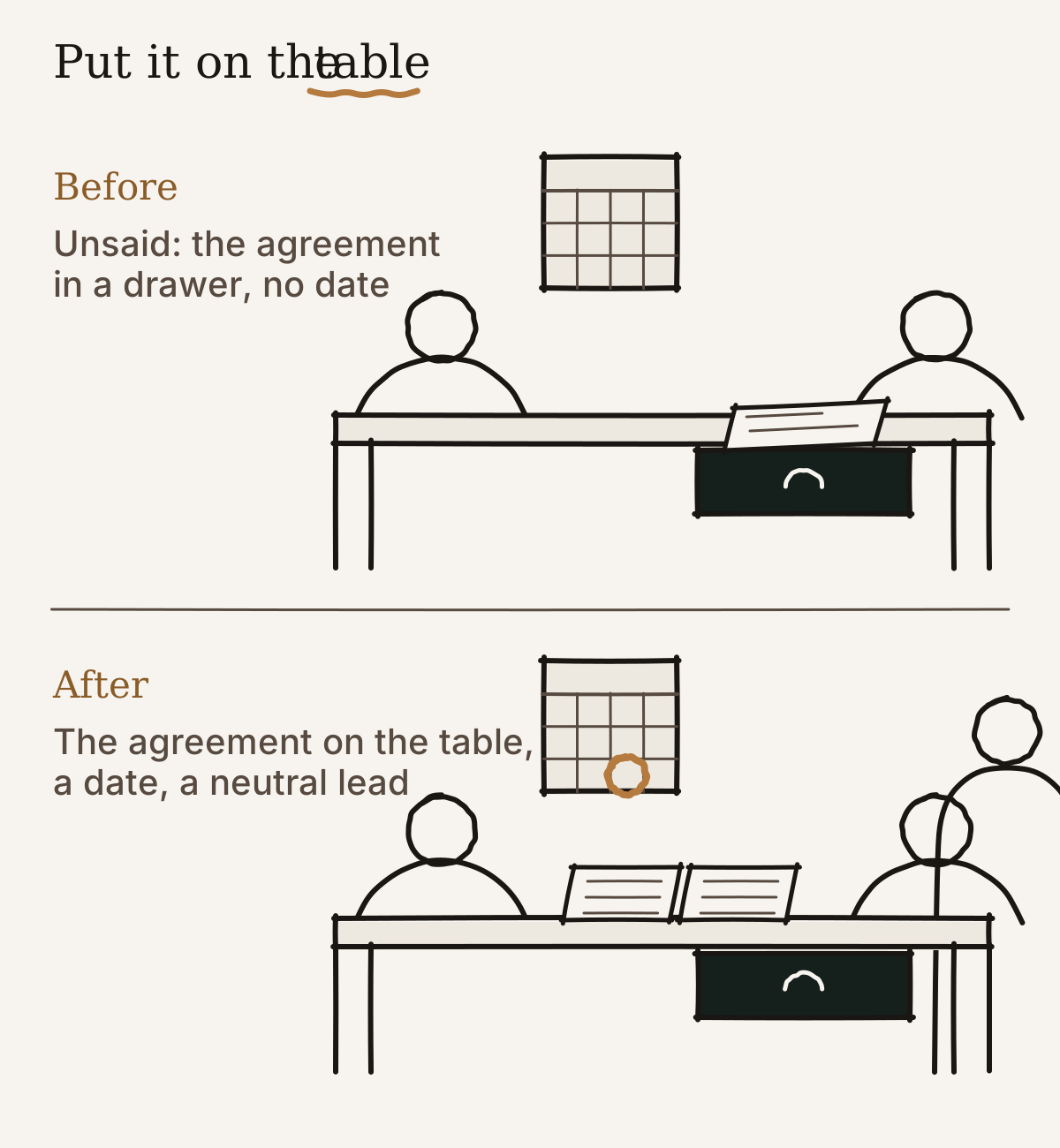
- Put a date on every step. Rereading the agreement, the valuation, the bank's answer, the decision: each one goes on a shared calendar. The date is what stops a disagreement from turning into a deadlock.
-
Have someone neutral run the process. It can't be either of you: in a dispute between partners, whoever ran the process would be party to the conflict, decision-maker and person concerned all at once. You both still decide; you just stop managing your own disagreement as a project, and a first conversation shows whether that role is worth handing over.
-
Decide now what happens if you still disagree. A mediation clause is one answer. In a two-partner agreement, there's also the cross-offer clause, where one partner names a price and the other chooses whether to buy or sell at it; have your lawyer check whether and how it would work for you.
-
Keep the company moving. Investment and hiring decisions can't wait for the two of you to agree. A company on hold shows it, and clients, the bank and candidates notice.
The order of the four routes matters less than when you start looking at them. A partner who names a horizon early usually finds all four doors still open; one who waits for the other to guess often finds a single door left.