Should You Give Your Business to Your Children or Sell It to Them? Decide What You Will Live On First
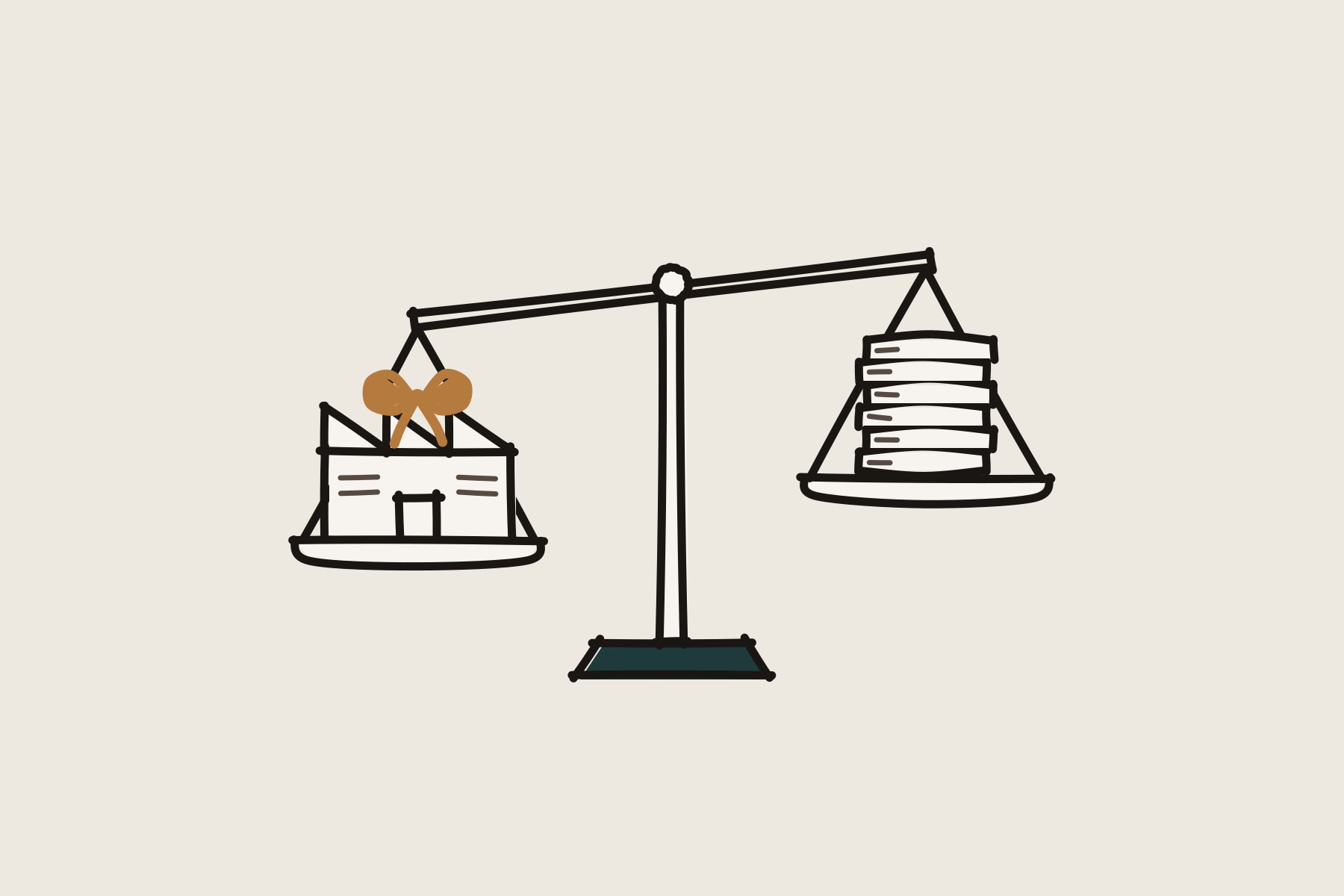
There are two ways to put your company into the hands of the child who will run it. You can give it to them, or you can sell it to them at a price the family agrees on.
Give it if you don't need the price to live on, and if what you own outside the company is enough to give your other children their fair share. Otherwise, sell it, even at a family price, paid over several years out of the company's profits. In the mandates I run, two questions get settled before anyone sees a tax adviser: what will you live on, and what will your other children receive? Tax comes afterwards. It tells you how to do it, not what to do.
What will you live on once the shares are gone?
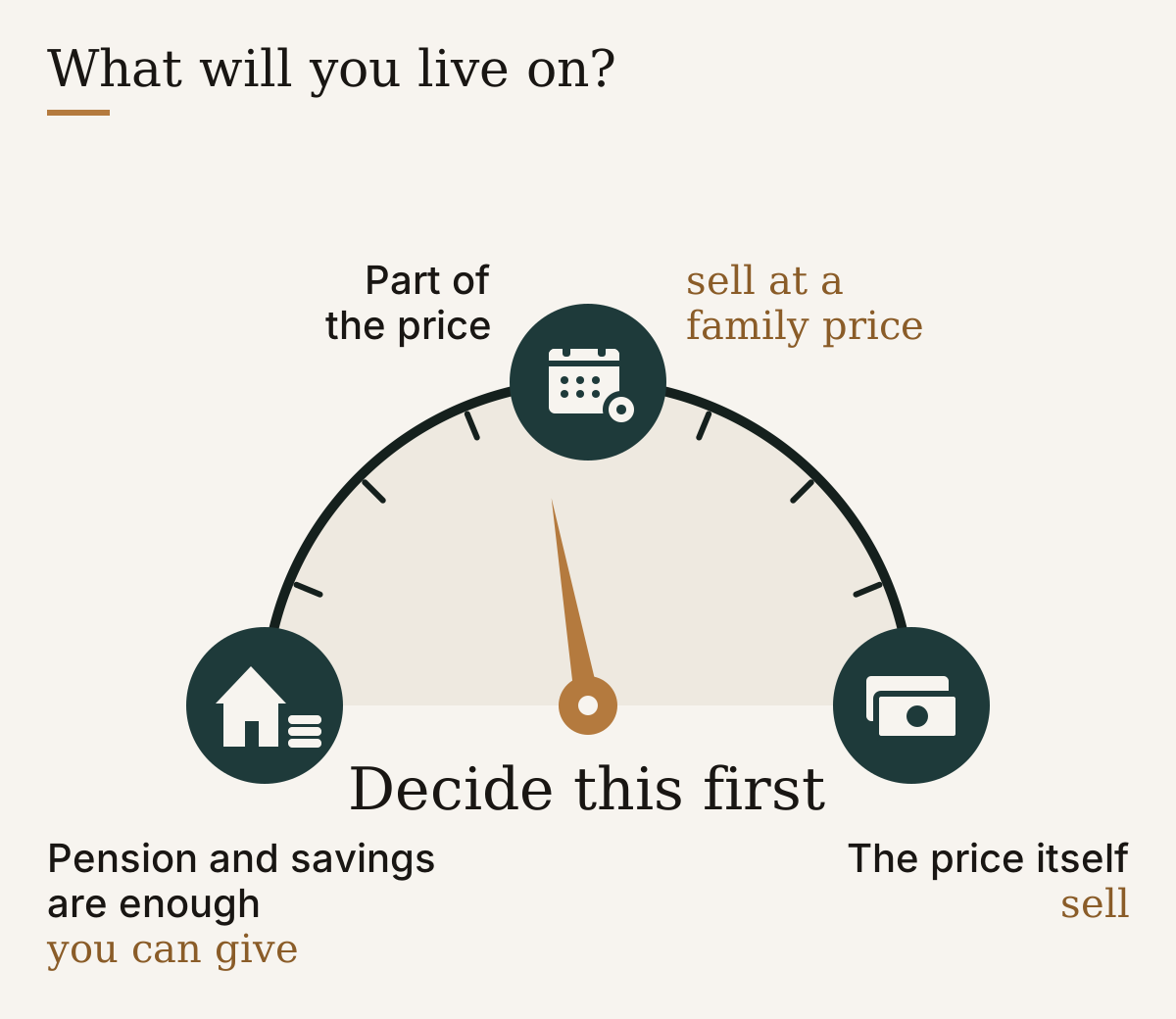
A gift brings no price in. Your income then has to come from elsewhere: pension, savings, rents, a transition salary with an end date. A sale brings the price in, spread over the years your child takes to pay it. So ask plainly: how much of that price do you need? If your pension and savings cover it, you can give. If you need part of the price, you sell at a family price, paid over years. If you need the price itself, you sell.
One arrangement comes up often: you give the shares, keep the building the business works in, and rent it to the company. The rent then does part of a price's work. It has to be a market rent: too high, it drains your child's company; too low, it hands your child a second gift the others will notice.
What will your other children receive?
With a gift, the balance for the others has to come from outside the company: a property, a securities portfolio, a life insurance policy. If that isn't enough, the child who takes over pays the others the difference, an equalisation payment, over time; setting a fair amount when one child takes over has its own article. With a sale, the price joins your assets, shared among all your children later.
A family price sits between the two. Below what a third party would pay, the discount is a gift to one child, whatever the contract is called, and the others will count it as one. Picture the sister who teaches, has never set foot in the paint shop, and hears at a birthday lunch what her brother paid: she won't read the contract's title.
Whether what you gave, or the discount on a family price, is later added back to your estate and shared out with the rest is a question for your notary or lawyer where you live. Ask for how long, and at which value: on the day of the gift, or the day you die. In Switzerland, for example, a business given to a child is, by default, counted in your estate at its value when you die. You can expressly rule that out, but each child still keeps a reserved share, a protected minimum worth half their legal share. A child who receives less can claim it back, lifetime gifts included.
How a sale to a child actually gets paid
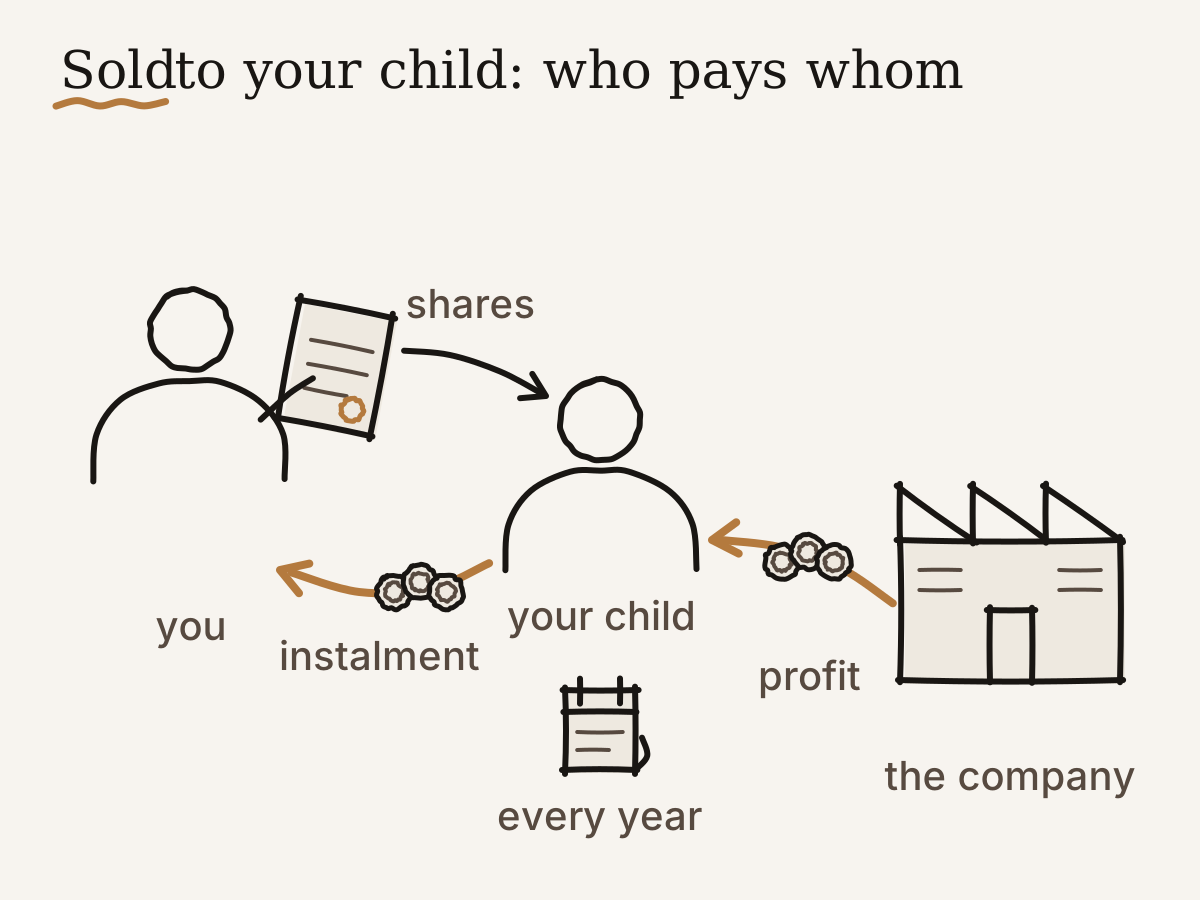
Your child rarely has the price in the bank. They pay it over several years, in my practice most often five to ten, out of the profits the company pays out as dividends, to them or to a company they set up to buy the shares. If you accept instalments yourself, you become your child's creditor: a seller loan, a debt your buyer owes you, and what a seller risks doesn't change inside a family.
What the company can carry sets the family price: the profits it can pay out over those years, minus what it must keep to invest and survive a bad year. The family price often ends up being what the company can pay, rather than what an outsider would offer. Each spring the dividend reaches your child's account, and a few days later the instalment leaves it for yours.
The tax office may look at a family price's discount too. In Germany, for example, gift tax law covers any transfer made for nothing in return, insofar as it enriches the recipient at the giver's cost. So the discount on a family price is treated as a gift for the part your child doesn't pay.
Whether giving a business to a child is taxed, at what rate, and whether a favourable price changes anything: ask your tax adviser where you live. The answer changes between countries, sometimes between regions. You can't guess it from the neighbour who handed over his garage.
How the price is paid can raise its own questions. In Switzerland, for example, take a child who buys through a company they own and pays you from reserves, profits kept from past years. Assume those reserves already existed at the sale, weren't needed to run the business, and are paid out within five years. If you knew or should have known they'd fund the price, that part is taxed as your income instead of a tax-free private gain.
Tax chooses the form: gift, sale, or a mix, part given and part sold, payment spread out, the building kept. It doesn't decide what you live on or what the others receive.
The two routes side by side
| Give it | Sell it to them | |
|---|---|---|
| What you live on | Your other income | The price, spread over years |
| What your other children receive | A balance found outside the company, or an equalisation payment | Their share of the price, later, in your estate |
| What the child who takes over pays | Nothing, or an equalisation payment to the others | The price, over several years, out of the profits |
| Who carries the risk if the company struggles | Your other children, if their balance wasn't settled | You, as your child's creditor |
| What needs valuing | The company, to set the balance | The company, to set the price |
The first two rows do most of the deciding. The fourth is the row families read too late.
Which route suits whom: a joinery, two ways
Take a joinery with twenty-five people, run by two parents aged 64 and 62. Of their three children, only the eldest works there, first at the edge-banding machine, now planning jobs. A made-up case, not a client.
In case A, the parents' house is paid off, their pension is enough, and they own the workshop building privately, renting it to the company. They give the shares to the eldest and keep the building. The other two receive the holiday house and a portfolio, and all three sign the arrangement.
In case B, the same parents own neither the building nor the portfolio, and they were counting on the price. They sell to the eldest at what the joinery can pay over eight years, and that price, shared later, makes up the other two children's part. Same sawdust on the floor; what differs is what the parents own outside the company.
Giving suits the parent whose pension, savings or rents are enough, and who can balance the other children without emptying the company. Selling suits the parent who needs the price, or whose other children can only be balanced with that price. A mix, giving part and selling the rest, or giving the shares and keeping the building, serves when one of the two sums doesn't come out right.
A parent who decides this alone is giver or seller, parent of every child at the table, and project manager at once, and those roles pull against each other. A neutral party running the process, or a family council, keeps them apart while the parent still decides.