Is the Sale of a Business Public Record? What Anyone Can See, and What Stays Private

Will the price get out? Will my clients hear about it from someone else? Can I choose the day people find out? Once a sale gets close, those are the questions owners put to me, usually later than they should.
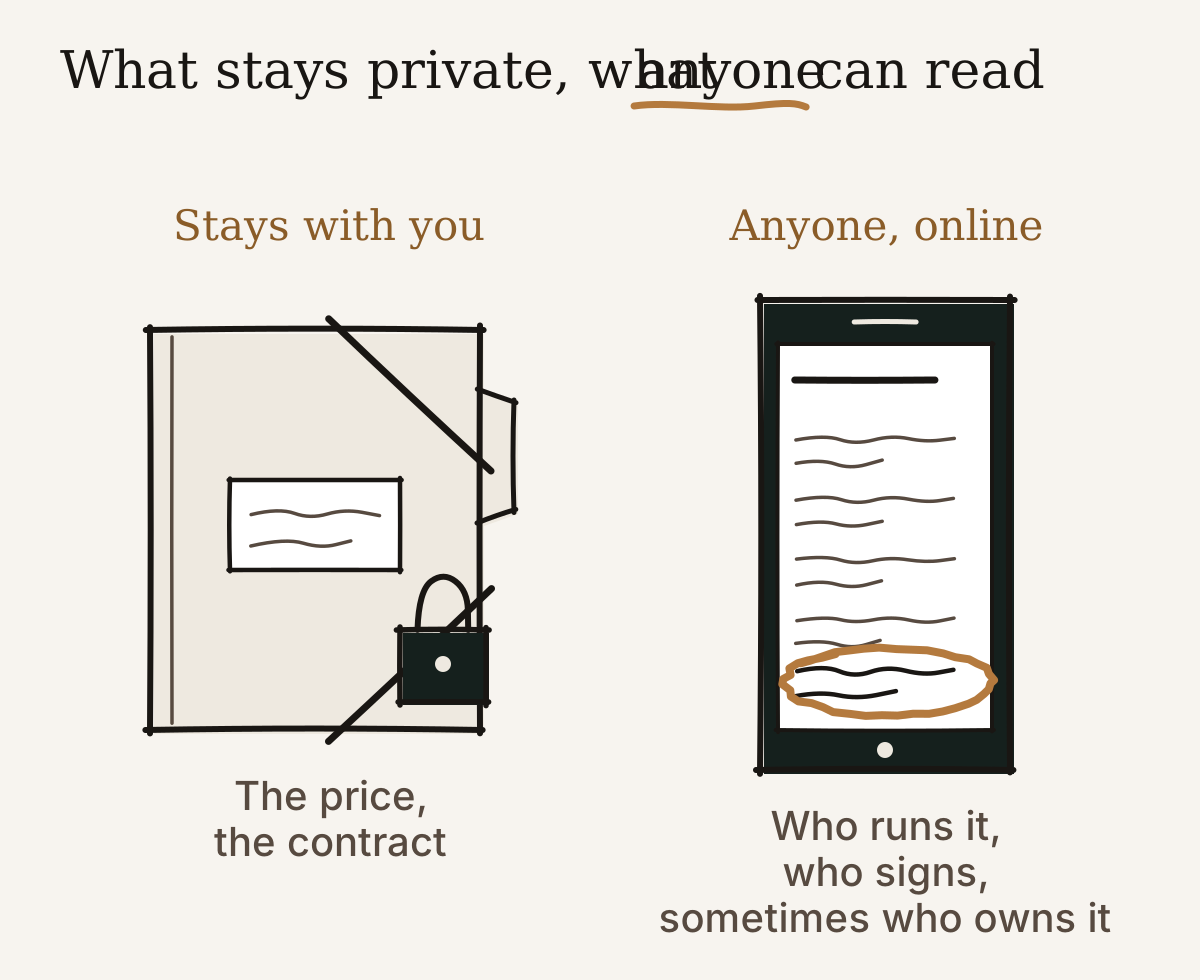
Is the sale itself public record? Partly. The price and the contract stay between you, the buyer and your advisers. But where companies are listed in a public register, the sale leaves traces there soon after signing: new managers, new signatories, sometimes new owners. Anyone can read those lines online. In Switzerland, Germany and Austria, for example, the law makes the register public and open to everyone; elsewhere, ask your notary or lawyer what it shows about your company. So the sale becomes visible on the register's date, which is rarely the date you'd pencilled in for your announcement. Plan your announcement to come first.
Will the price be public?
No. The price lives in the sale contract, which you and the buyer keep. The register records who runs the company and who may sign for it; what anyone paid is nowhere on it. In Switzerland, Germany and Austria, for example, the law sets what the register records about a company, and the price paid isn't on that list.
The people who do know the figure are few: the buyer, the advisers on both sides, your bank, the tax authority. It can still get out, through a buyer that reports its acquisitions or a sales rep who heard a number over a beer at the trade fair. Whether a copy of the contract has to be filed with anyone in your country is a question for your notary.
What becomes public, then?
Every line about your company that the sale changes: the new board members or managing directors, the people authorised to sign, the name or registered office if they move, the amended articles of association (the company's founding rulebook). Where owners are listed, the new owners too. In the three countries named above, the law sets that list.
If you sell the assets (the machines, the customer contracts, the business itself) rather than the shares, the company itself stays yours. Whether the register records the transfer, and what else it shows, depends on where you are, on what the buyer files and on what you later do with your old company: a new name, a new purpose, closing it down. Ask your notary before you sign.
Will people see who bought the company?
It depends on your company's legal form. In a private limited company (a GmbH or Sàrl), owners are on the register and each transfer is filed. In a company limited by shares (an AG or SA), shareholders sit in a share register the company keeps itself. In Switzerland, Germany and Austria, for example, the law says so for the first; in Switzerland and Germany, for the second.
That has a consequence for the second kind. If the buyer keeps the same board and the same signatories through the handover, the register can show nothing for months. It moves when people change; money changing hands leaves it still. In Switzerland, for example, the entry of a company limited by shares lists board members and signatories, never shareholders. Elsewhere, ask what the register shows for your company's form.
How soon after signing does it show?
In the mandates I run, days to a few weeks pass between signing and the line appearing online, rarely more; a few days if the notary files electronically on the day. The change must be reported, and once published it counts as made known to all. In Switzerland, Germany and Austria, for example, the law requires the report and gives the published entry that effect.
The filing comes from the company's managers, or from whoever files for them, often the notary. In Germany, for example, the notary who handled the sale of a GmbH's shares files the new list of shareholders without delay, and the entry is public the moment it first goes online. A Friday signing can be on someone's screen by the middle of the next week.
Who actually reads the register?
More people than owners expect. Services that republish register changes, credit insurers, banks, competitors and recruiters all follow those entries, some of them through automatic alerts. A supplier's credit insurer can learn of your sale before your own sales manager does. Your employees, meanwhile, stumble on it on their phones, scrolling through a lunch break in the canteen.
Do your annual accounts become public too?
That depends on the country, on your company's legal form and on its size, so there's no single rule to give you here. Ask your accountant whether your accounts are filed and open to inspection where you are, and since which year. It's a short conversation, and much better had before the sale than after it.
Can you keep the sale secret until you're ready?
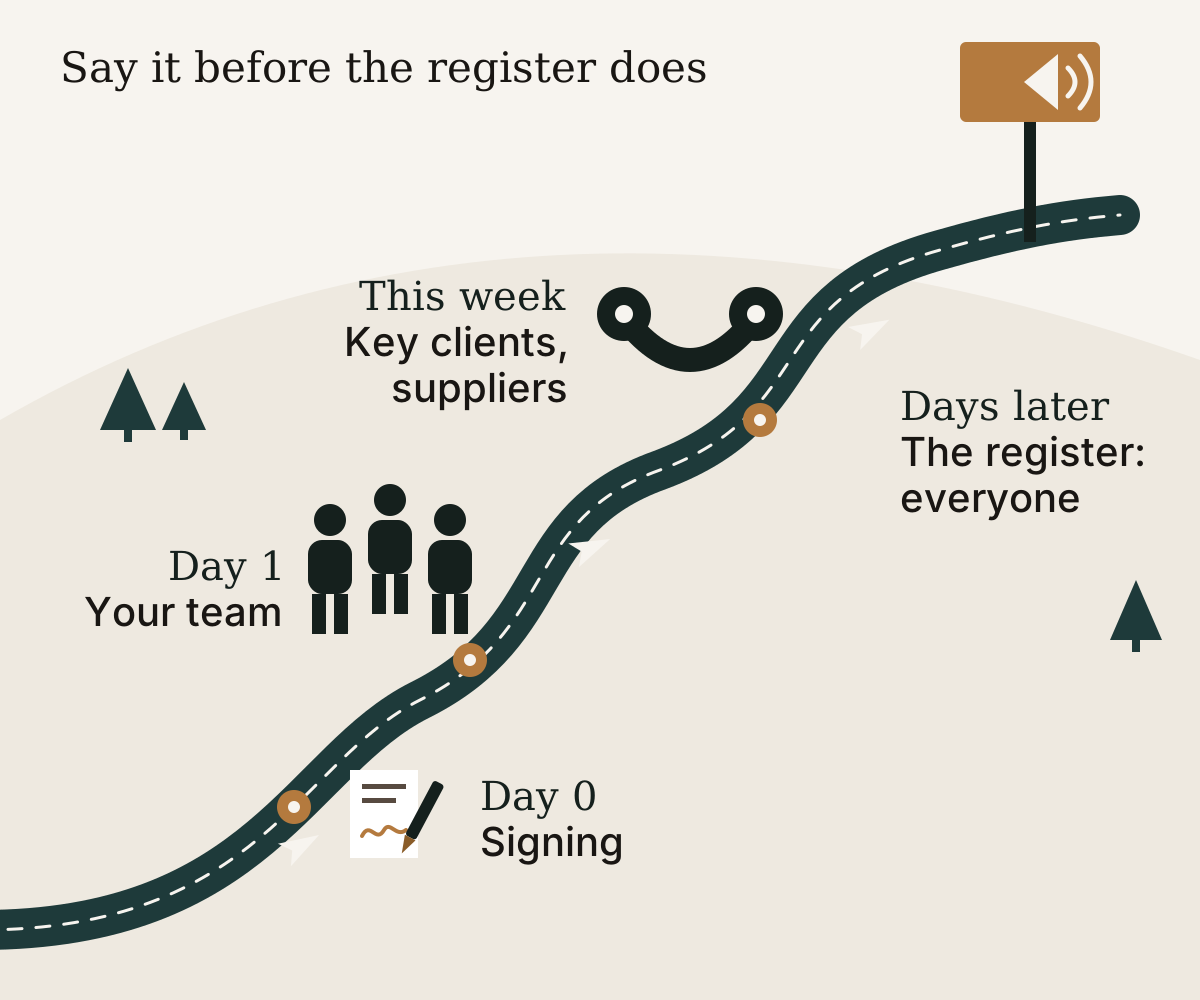
Before signing, yes: that's what confidentiality during the sale is for, with a non-disclosure agreement and tight circles of who knows what. After signing, no: the register filing can't be held back. What you do choose is the date of signing and transfer (the closing), and the order of your announcements before the register line.
Picture a machine shop of forty people, sold to a regional group; a made-up case, not a client. Signing and transfer happen on a Friday. The owner plans to gather her team on Monday, then write to clients within a fortnight. The notary files the change of managing director on Monday morning. On Wednesday, a credit insurer's alert lands with one of her suppliers. On Thursday, that supplier's rep stops the workshop foreman by the loading bay: "So, you've been sold?"
Nothing went wrong legally. Her clients were simply about to hear it from the wrong people, with her letter still in draft.
How do you time the announcement so the register doesn't speak first?
Before signing, ask your notary or lawyer when they'll file the change and when it will show online. Put that date in the closing calendar and draft your messages beforehand. Tell the team on closing day or the next morning, key clients and suppliers in person over the following days, then go public, all ahead of the register line.
What follows over the coming months belongs to telling clients and suppliers about a succession. One thing belongs to this month: read your own register extract as a buyer would. A sole signatory, a board of one: whatever it shows today is what will change, in full view, the week you sell.
The register doesn't lie, and it doesn't wait. It says who, on its own date, to anyone who looks. What stays in your hands is making sure the people who matter hear it from you first.