Selling a Business Checklist: Every Step From the Decision to the Handover, and Who Drives Each
Selling a business you run yourself is counted in months, not weeks. In the sales I conduct, the distance between the day the owner decides and the day someone else holds the keys is of the order of nine to eighteen months, and the longest stretch of that time passes before a single buyer has read a page about the company.
Here is the checklist, in order. First, decide and prepare. Second, value the business and build the sale file. Third, approach buyers and collect offers. Fourth, sign a letter of intent. Fifth, go through due diligence. Sixth, sign and close. Seventh, hand over. The longest stretch of the seven is the one before the first buyer appears. And each phase needs one person who holds the thread from start to finish; without that person, the work falls between two advisers.
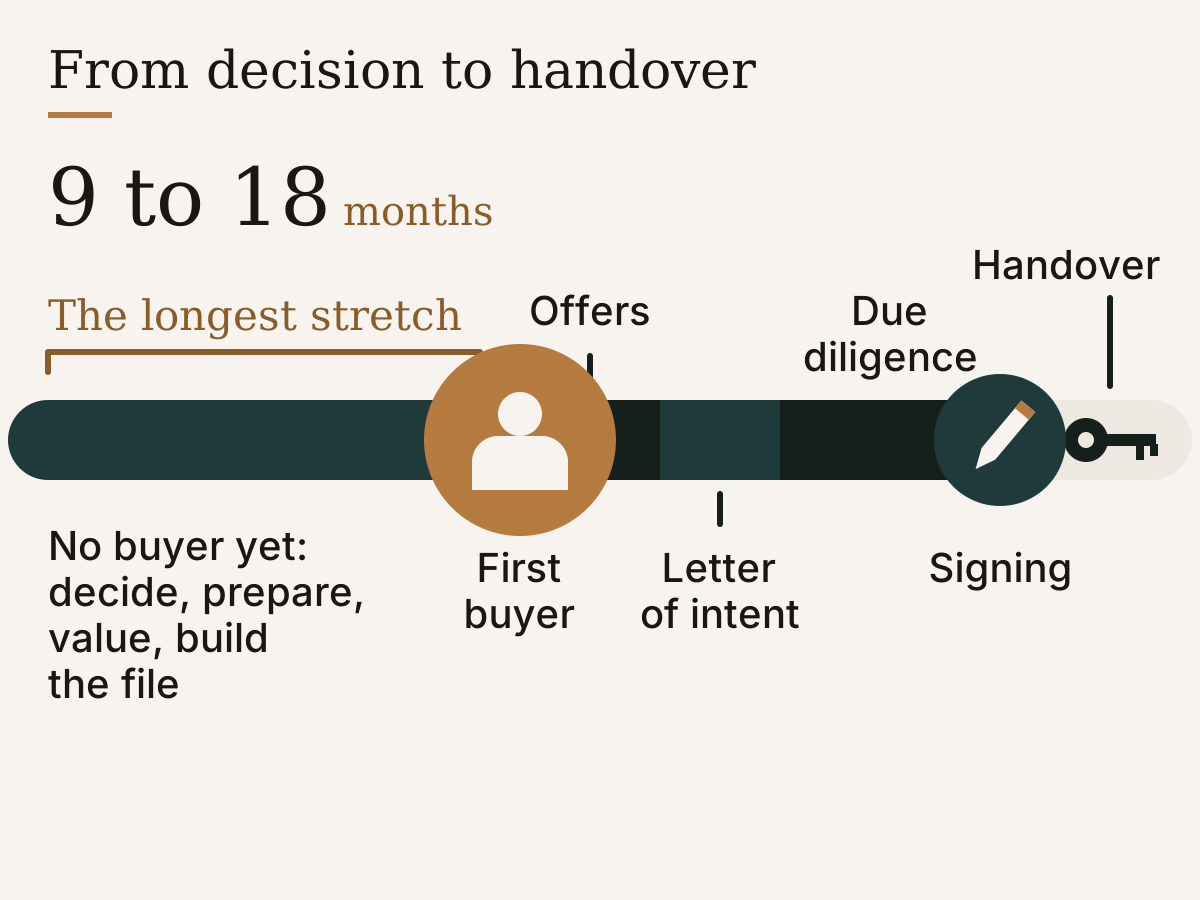
Phase one: decide and prepare, with no buyer in sight
This phase belongs to you, because only the owner can decide. Write down, on one page, why you're selling, by when, and what you expect: your floor, the price below which you won't go, what happens to your people, and what role you want afterwards, if any. You'll reread that page at every later step.
Then comes the work that takes the longest: making the company run without you. A serious buyer notices early when clients, prices and key decisions still pass through the owner, and either walks away or lowers the offer. Alongside that, put the numbers in order, so the accounts say what you say about the business.
Take a machine shop of forty people whose owner decides in January to sell. It's a made-up case, not a client. The first six months go into making the business readable without him: who signs off a quote when he's on holiday, who the key client calls, where the price list really lives. The first serious buyer only turns up in the autumn. Nothing went wrong; that's what the first phase costs.
Starting early doesn't mean selling early. It means never being forced to sell under pressure.
And if the sale never happens, the preparation still pays. A company that runs without its owner is worth more to the owner too.
Phase two: value the business and build the file
A valuation gives you a range. Treat it as the zone where a sensible offer should land, with your floor from phase one written beside it. Your trustee, the firm that keeps your books and does your tax, usually carries the numbers here.
The sale file, often called the memorandum, describes the company for someone who has never set foot in it. Most buyers will read it before they ever meet you. Whether it states a price depends on how many serious buyers you expect: with several, leave it out; with one or two, a figure or a range tends to serve you better.
A file built on an unprepared company looks fine on paper. It comes apart later, in due diligence, when every claim in it gets checked.
Phases three and four: buyers, offers, and the letter of intent
The first buyers to approach are usually the ones who already know the business: clients, suppliers, competitors, your own managers. Rank them by real interest and by the risk that word gets out, and the order of approach follows. I've written separately about where to look for a buyer and whom to call first. An M&A adviser, a specialist in company sales, often runs this phase. Nobody sees the file before signing a confidentiality agreement.
What comes back are indicative offers: a first written price that doesn't bind the buyer yet. You compare them, meet the most credible, and pick one to go further with.
That choice gets written into a letter of intent. It sets the frame: the price or a price range, how it's paid, the timetable, and a period of exclusivity during which you talk to no one else. The letter itself usually spells out which parts you're held to: the exclusivity, as a rule, while the price stays indicative. Everything written in it becomes the starting point of what follows, which is why the letter of intent deserves more care than its length suggests. Sign it without a floor written down beforehand, and its number quietly becomes the reference for the whole negotiation.
Phase five: due diligence
Now the buyer checks what the file claims: the numbers, the contracts, the staff, any disputes, the permits the business needs to operate. What he finds is used to renegotiate the price or the warranties you'll give, the promises about the company that you sign up to in the contract. On your side, the trustee fields the questions on the numbers and the lawyer those on the contracts. In my experience it lasts from a few weeks to a few months, and the length depends almost entirely on phase one. A company whose documents sit in one place gets through quickly; one still hunting for a signed lease in a basement cupboard does not. Here's how to prepare for it from the seller's side.
Phase six: signing and closing, and who holds the file
The purchase agreement fixes the price and its adjustments, and the warranties you give as seller. Signing and closing, the day money and shares actually change hands, can fall on the same day or a few weeks apart, while conditions are met: the buyer's financing, the consent of a landlord or a key partner. The exact form of the transfer depends on where you are and on the company's legal form. Ask your lawyer what act or registration it requires locally.
The trustee carries the numbers, the lawyer the contracts, the bank the financing, the M&A adviser the buyers. Each one handles a fragment. None of them holds the whole. What sits between the fragments belongs to nobody: the preparation of the company, whether the contract still matches what the file promised, the calendar that ties it all together. That's where the file drops between two advisers.
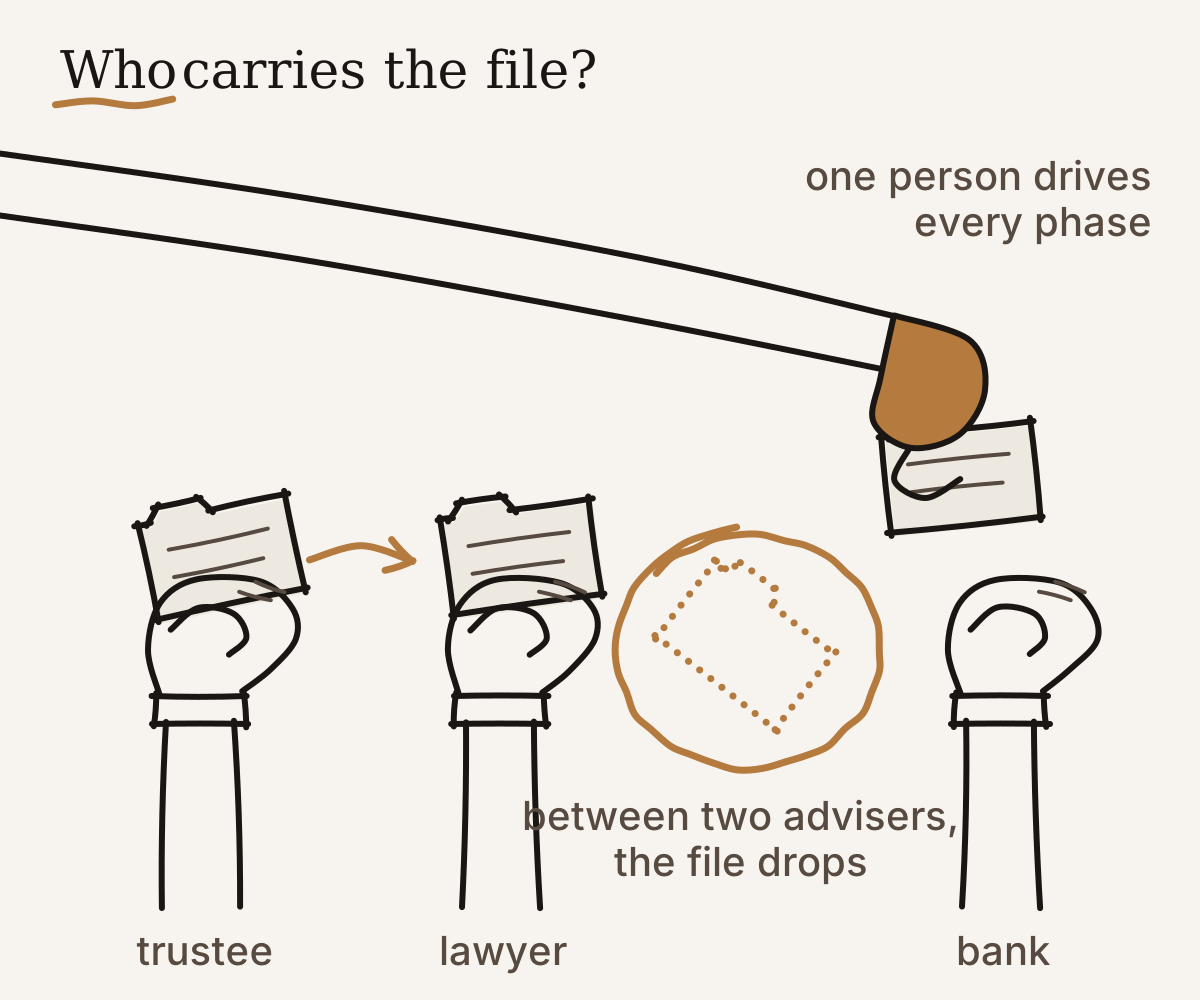
The usual answer is that the owner fills the gaps himself. He then becomes the client, the person most affected, the one who decides, a party to every conflict, and the project manager, all at once. Those roles pull against each other. He can keep every decision and still hand the project management to someone whose only job is to drive the process.
Phase seven: the handover
This phase is yours to carry. After closing, the seller usually stays a few months to pass on relationships, decisions and the knowledge that never made it onto paper. How long you stay, and in what role, is settled before signing: once the money has moved, you have little left to negotiate with. More on the transition period after the sale.
A phase skipped is paid for in the next one. The unprepared company shows up in the file, the file comes apart in due diligence, and the floor you never wrote down shows up in the letter of intent. Put your own sale on the ruler above, find the phase you're in, and write beside it the name of the person driving it. If the only name you can write is yours, you've found the gap.