How to Sell a Business Shortly After Buying It: What the Next Buyer Will Want to Understand
Two or three years after buying a company, the question is rarely whether you may sell it again. It's which road you take: sell now, with the company as it stands, or spend a year clearing what the next buyer will find first.
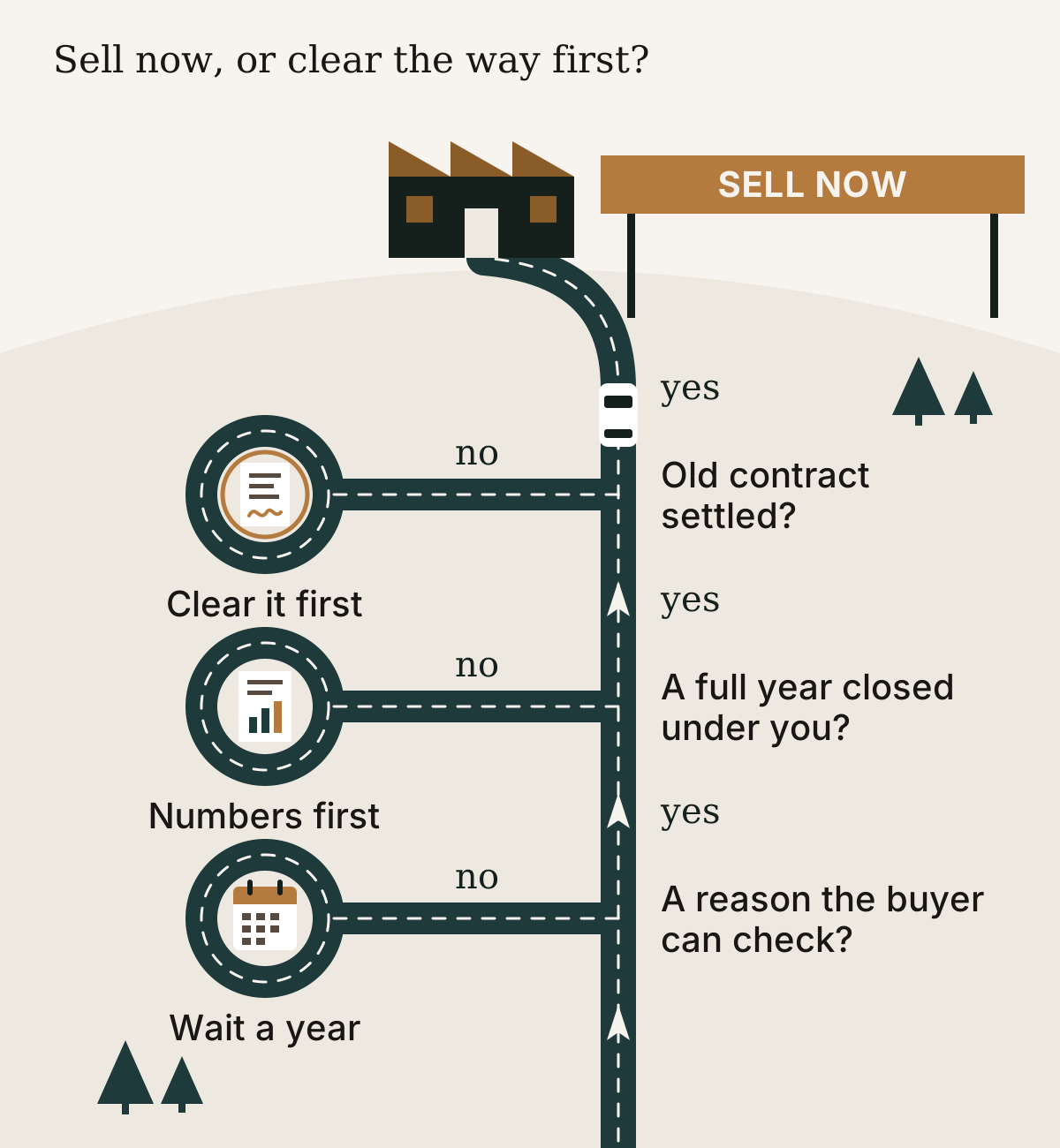
Yes, you can sell a business you bought two or three years ago. In the mandates I run, the next buyer does three things before naming a price. They compare their offer with what you paid and ask what has changed. They look for your reason for leaving. And they read your purchase contract, where commitments to the former owner may still be running: a seller loan, an earn-out, a handover. Sell now if your reason fits in one sentence the buyer can check, if the gap between the two prices comes from what happened inside the company, and if what you owe the former owner is settled, or can be, before the first conversation. If not, clear those three things first: a buyer who finds them before you mention them charges for them.
What the next buyer reads before naming a price
The price you paid is rarely private: the former owner talks, your bank knows the figure, and the trade remembers who bought what. Better that the buyer hears it from you, with the explanation attached.
An honest explanation of the gap draws first on what changed under you: a foreman who now quotes jobs without phoning you, a client list that no longer hangs on three names, better closed years. Then on what the new buyer pays for themselves, the synergies only they get. Then on the cycle, since what buyers are prepared to pay for a given profit moves from year to year. A higher price that rests only on the last two reads as luck.
Then your reason for leaving, which every buyer looks for. An outside reason that can be checked takes one sentence: your health, a partner who's going, a group that approached you with a lasting motive, a trade you've discovered isn't yours. "It's harder than I thought" is a reason too, and you can't hide it. The buyer reads it in the monthly figures.
As an order of magnitude from my practice, a buyer wants at least one full financial year closed under your direction, and two is better: that's how they tell what you built from what you bought. Without it, they're buying the former owner's figures plus your story, so get the numbers ready early.
The contract you signed when you bought
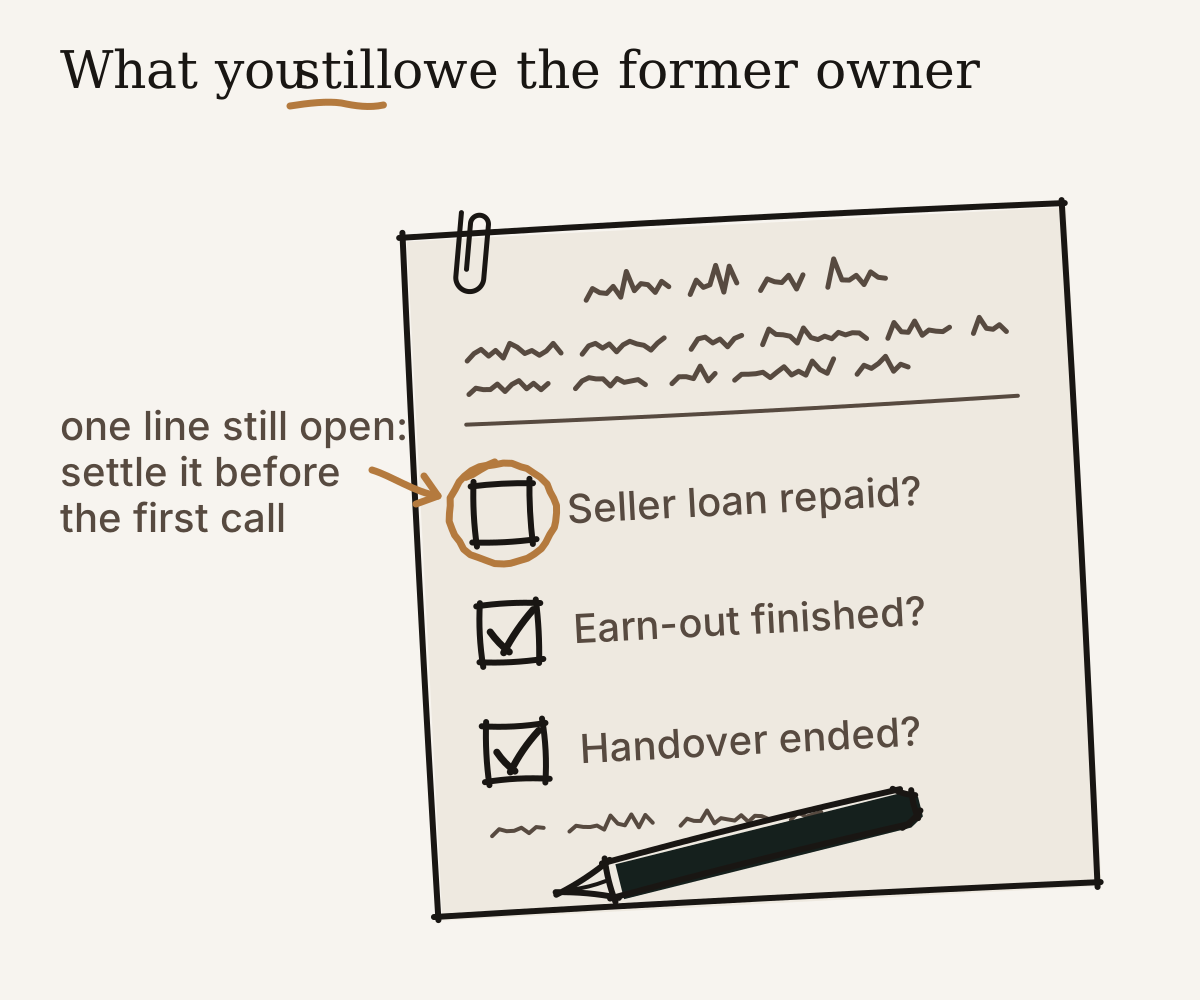
Take it out of the drawer before you call anyone, and start with the seller loan: the part of the price the former owner lent you, usually 10 to 20 % of it, repaid over three to seven years. Whatever is still owed is still your debt, or your acquisition holding's, the company you set up to buy the shares. Who repays it when you sell depends on the clause: it may fall due on a change of control, meaning the day the company changes owner, pass to the next buyer, or be repaid at signing. Read it, then ask the former owner what they would accept. The same clause, seen from the original seller's chair, looks rather different.
An earn-out is extra price tied to later results, usually measured over one to three years. The contract says, or fails to say, what becomes of it if the company changes hands: paid out at once, frozen at the date of the resale, or measured afterwards inside a business the new owner reshapes. Settle it or freeze it before you open any discussion; an earn-out cut short has its own mechanics.
A handover is the period, counted in months, in which the former owner stays on to pass over clients and know-how, sometimes followed by a consulting agreement. If it's still running, the former owner is still in the building, and the next buyer will notice if the biggest client still asks for the old boss by first name.
Warranties and escrow run the other way: not what you owe the former owner, but what they still owe you. Warranties are the promises the former owner made you about the company; escrow is part of the price parked with a neutral third party, usually for twelve to twenty-four months. Whether they can pass to the next buyer or stay with you is a question for the two contracts, the old one and the new one, and for your lawyer. Whether the former owner's non-compete was given to you or to the company, and whether it protects an owner after you, depends on its wording, and the same lawyer can tell you.
Then your own financing. If you bought with a bank acquisition loan, often sitting in an acquisition holding, the loan agreement usually says what happens on a sale: repayment, an early-repayment fee, or the bank's consent. Talk to the bank before any buyer does; a personal guarantee you gave it also has to be released, and that gets negotiated. One question goes to your tax adviser before you set a price: how is a gain on shares held for two years treated where you are, and does holding them through a company change anything?
The decision table
| Criterion | Sell now | Clear first |
|---|---|---|
| Your reason for leaving | Outside, checkable, one sentence | "Harder than I expected" |
| Gap with the price you paid | Explained by what changed | Unexplained, or negative |
| Seller loan | Repaid, or transferable under the contract | Due date and conditions unclear |
| Earn-out | Finished or frozen | Still running |
| Former owner's handover | Over | Still in the building |
| Financial years closed under you | At least one, two is better | None |
| Your bank | Told, exit terms known | Loan agreement not yet read |
Three rows do most of the deciding: the reason, the closed years that explain the gap, and the old contract.
A sign workshop, thirty months on
Picture a sign-making workshop with eighteen people, bought thirty months ago by a manager who came from a group; a made-up case, not a client. Part of the price was a seller loan of 15 % over five years, plus a two-year earn-out. Now a regional competitor, the one whose vans he passes every morning, offers to buy.
The earn-out is finished, so one question is gone. The seller loan has two and a half years left: if it's repaid in equal instalments, roughly half of it, about 7.5 % of the original price, is still owed. At the first meeting the competitor asks two things. Who repays that loan? And why is he leaving?
If the loan falls due on a change of control, the manager repays it out of what he receives, and he should have spoken to the former owner before the competitor brings it up. If he wants a group role again, one sentence and his career say so. If margins have been thinner than he hoped, the competitor will read it in the accounts before naming a price.
Who should sell now, and who should wait
Selling now suits the owner with an outside reason that can be checked, commitments to the former owner settled, or that can be settled, before the first conversation, and at least one closed year under their own name.
Clearing first suits the owner whose earn-out is still running, whose seller loan can be neither repaid nor taken over without the former owner's consent, or whose reason for leaving is the difficulty itself. In that last case, a year spent fixing what's hard changes what the numbers say, and the numbers are what the buyer believes.
There's a third route. Sell to someone who already knows the company, the former owner buying it back or a manager: they know what you paid and what you still owe.
The person selling what they bought two years ago is the seller, the former owner's debtor, the bank's borrower and the project manager of the sale, all at once. The lawyer reads the new contract, the bank its loan, the former owner the instalments left; each sees one role. Someone has to drive the whole thing, and it's hard to do that while holding all four roles yourself.