The Internal Successor Who Isn't Ready: What to Do When Plan A Fails

A succession plan built around an internal successor typically runs on a two-year clock, from the day the name first circulates internally to the day the outgoing owner actually clears out the office. That clock has a built-in flaw: the further into it you go, the more it costs to admit the chosen candidate isn't holding the role, and the stronger the pull to extend the trial rather than face the consequences. This guide follows that clock month by month, from the point doubt first appears to the point the options reopen despite the time already invested.
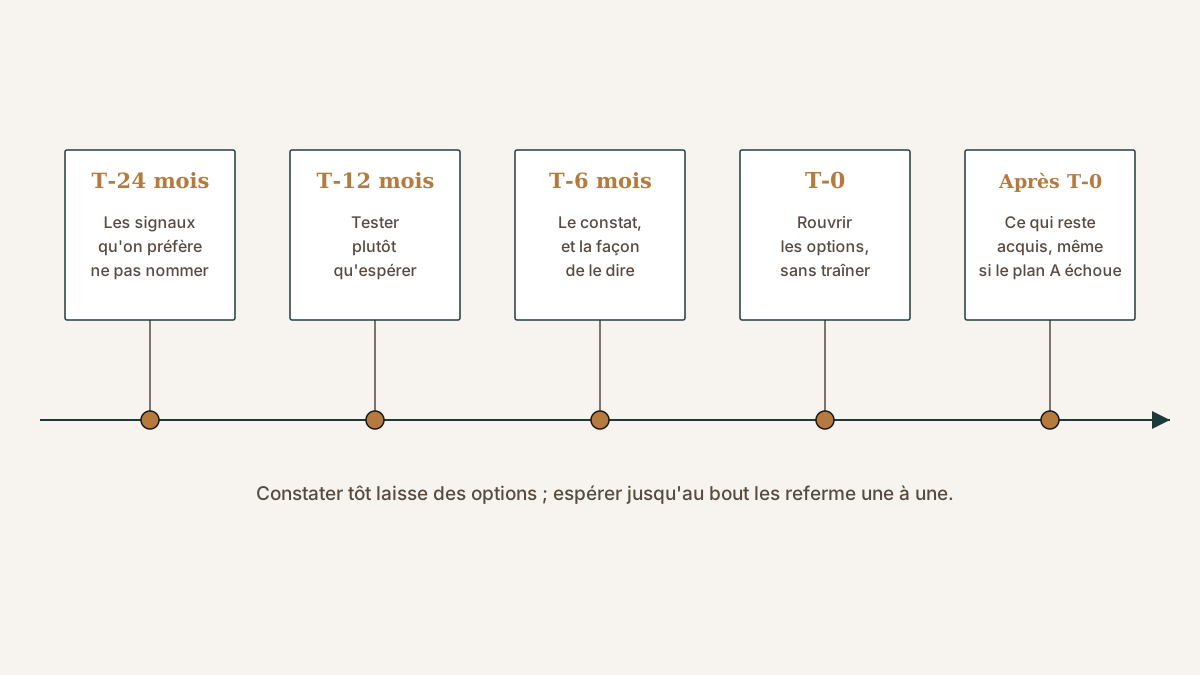
Month minus 24: the signs owners prefer not to name
The first doubts usually surface early, long before anyone says the word "failure" out loud. The candidate keeps routing back to the owner decisions that, on paper, already belong to their role. Managers who used to be the candidate's peers keep bypassing the new chain of command out of habit, or caution, and go straight to the former boss on anything urgent. The candidate themselves avoids the arguments that need having, postpones a hard conversation with an underperforming manager, or lets a commercial decision drift rather than push back against a difficult client.
None of this proves at this stage that the candidate will never fit the role. An owner who took fifteen years to become who they are today often judges a successor far too fast on their first two. The real risk at month minus 24 isn't over-reading weak signals; it's filing them in advance under "inexperience that will pass," without writing them down or revisiting them on a set schedule. Growing a successor from inside your own team means tracking these signs over time, not remembering them only once they've piled up too high to ignore.
Month minus 12: test instead of hope
At the halfway mark, hope stops being a method. This is the point to hand the candidate one real decision with real consequences, rather than responsibilities that always come wrapped in an informal safety net. In the mandates I run, this test often takes the shape of an annual budget handed over without the owner reviewing every line, or an entire negotiation with a strategic supplier carried out alone, outcome owned in full, good or bad.
Picture a sixty-person family-owned technical distribution business where the founder's son has held a deputy director role for eighteen months. At month minus 12, the board hands him sole responsibility for renegotiating the contract with the company's largest client, with no father hovering behind the scenes. This is a generic case, not a real client, but it shows what a genuine test reveals: either the candidate holds the pressure and the outcome, or the gap between the title on the org chart and the role actually being performed becomes visible to everyone, including to him. Handing the evaluation to someone other than the owner, a board member or an outside reviewer brought in for the purpose, keeps the judgment from getting tangled up with the personal relationship. The test that measures how much the business depends on the owner works on the same principle: intent doesn't count, only what actually happens once the safety net is gone.
Month minus 6: naming it, and how to say it
When the month minus 12 test doesn't convince, six months out from the planned handover is still early enough to act without panic, and already too late if the conclusion is only reached at that point. Saying it out loud means separating two conversations that owners almost always blur together: the one about competence, factual and grounded in decisions actually observed since month minus 12, and the one about the relationship, which stays intact and deserves to be handled on its own, especially when the candidate is a child, a nephew, or a long-serving employee.
A board, even a small one of three people, changes the nature of that conversation: it stops being the owner's personal verdict on their successor and becomes a governance decision, documented and shared. This is also where the absence of a management team that doesn't depend on one name costs the most: without managers able to keep the business running while the succession question reopens, every month of drift hits the operating business directly.
Month zero: reopening the options without losing the clock
By the date originally set for handover, three paths remain realistic, and none of them involves stretching the old plan under a new label. The first: delay the handover by a year or two, with an explicit corrective mandate rather than a polite status quo, which only works if the candidate themselves recognizes the gap and buys into the correction. The second: pair the internal candidate with an experienced outside profile, along the lines of a management buy-in, bringing in the missing dimension without pushing out someone who has already invested years in the business. The third, the heaviest to accept, means reopening a sale process or an external search altogether, admitting that internal succession, however well prepared it looked, doesn't happen on command.
The choice among these three depends less on how bad the failure looks than on how much time is actually available: a business whose finances and governance hold up without the owner's daily involvement can afford another year of correction; one still dependent on the owner's daily presence usually doesn't have that luxury and has to decide faster, even if that means picking the heavier option.
After month zero: what stays even when Plan A fails
A Plan A that fails doesn't erase what got built along the way. The board set up to make the month minus 12 test objective keeps existing and keeps being useful, whatever the outcome for the candidate under review. The process documentation, started so the successor could take over without everything living in the founder's head, keeps exactly the same value in front of an outside buyer. The candidate who loses the top job often still has a useful place elsewhere in the organization, provided the exit is named clearly rather than left for everyone to interpret on their own.
The owner who followed this clock honestly, at month minus 24 and at month minus 12, arrives at month zero with real options, uncomfortable as they may be. The one who chose to keep hoping reaches the same conclusion anyway, only once the clock they set for themselves has run out and there's no time left to choose between several paths.