Running the Company Before Owning It: A Two-Stage Timeline for Family Succession

Six years. That is the horizon I most often give a family whose child is ready to run the business but does not want, or is not able, to take over the shares right away. Three years before the handover of management, three years after it for the capital. Nothing requires the two transfers to fall on the same day. What makes them fail is leaving the second one without a date, a price or a rule while the first one moves ahead. The timeline below follows both movements, milestone by milestone, from the day the family admits there will be two of them to the day the child holds a majority.
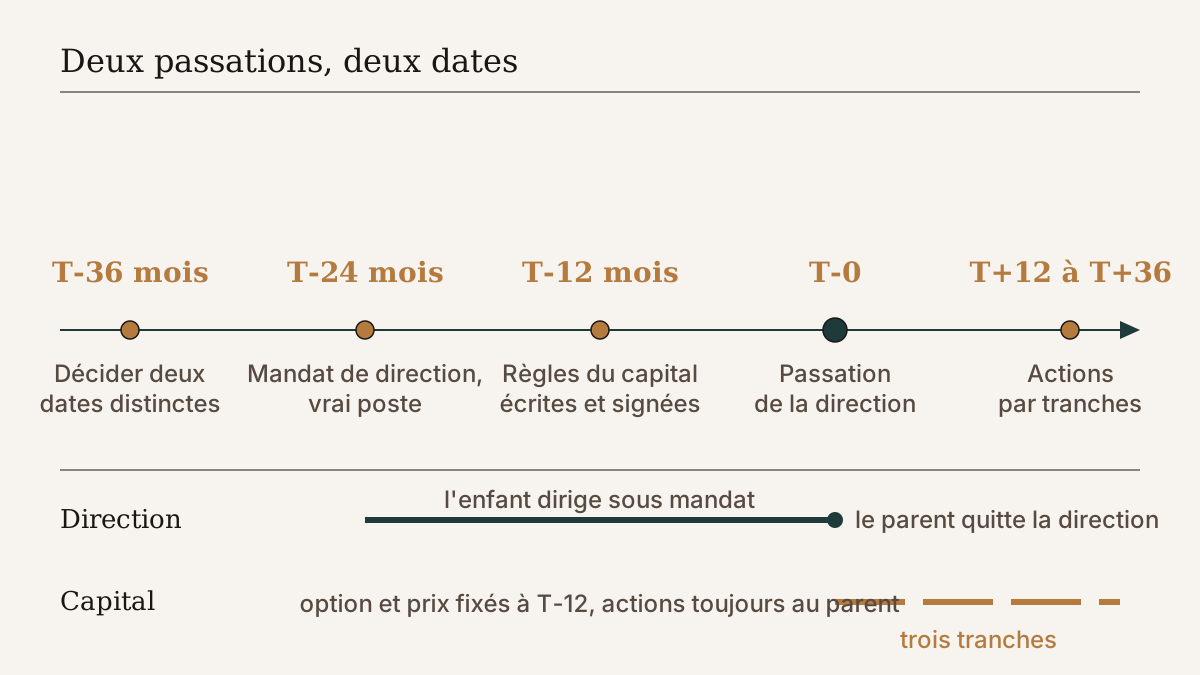
T-36 months: deciding that the two dates will differ
The starting point is an admission, and it is rarely made out loud. A 34-year-old daughter who has proven herself elsewhere may want to run her parents' company without having the means to buy its shares, or the wish to receive as a gift a block that would bind her to her siblings before she has proven anything. The parents, for their part, may want to keep ownership for a few years: because their retirement depends on it, because they want to see how the child holds the tiller, or simply because they are not ready.
As long as these reasons stay implicit, each side interprets the other's silence. The child reads a doubt about their ability into the postponement of the capital; the parents read a lack of commitment into the child's hesitation. So the first decision at T-36 months is to write down, on one page, that management will change hands on one date, capital on another, and why. That document has no legal force. It has a value far rarer in families: it records what was agreed before each person's memory rewrites it. A family council, even one that meets only three times a year, is the natural place to draft it and have it signed by the children who will not take over.
T-24 months: a management mandate, with a real job underneath
Two years before the handover, the child takes up the role with a managing director's employment contract, a written job description and a salary aligned with what the company would pay an external executive for the same position. That last condition is not a matter of comfort. An off-market salary distorts the assessment in both directions, and the tax authorities know how to recharacterise an unjustified gap between relatives. A real job, judged on real results, remains the only way to find out whether the child can carry the role; a courtesy title tests nothing.
This is also the moment to give the board of directors a substance it has often never had. In the mandates I lead, bringing in an independent director at exactly this milestone changes the nature of the two years that follow: assessing the child stops being a conversation between a parent and their child and becomes a decision of a corporate body, documented, with dated objectives. The parent remains chair, the child is managing director, the independent member arbitrates. That architecture protects everyone, including the child, who will know what their work is being measured against.
T-12 months: writing the capital rules before anyone needs them
A year before the handover, the capital has not yet moved, and that is the right time to set its rules, because nobody is in a hurry yet. Three documents are usually signed together.
The first is a call option written into a shareholders' agreement: the child obtains the right to acquire the shares on agreed dates, at a price or according to a formula fixed now. A formula (a multiple of average earnings over three years, for instance, with a floor and a cap) avoids renegotiating the value every time a tranche falls due, and above all avoids renegotiating it after the child has personally driven earnings up.
The second mirrors the first: a claw-back clause. If the child leaves the management role before the last tranche, for whatever reason, the shares already transferred can be bought back by the parents or by the company at a known price. Without it, a divorce, a falling-out or a change of life turns an orderly succession into a stranded shareholding.
The third concerns the siblings. If part of the capital is to pass by gift or by advance on inheritance rather than by sale, the question of how it is brought into account in the estate is settled now, through an inheritance agreement, and not on the day the parents die. Fairness towards the children who do not take over is almost always easier to organise when the value used is today's, frozen in writing, rather than that of a company the successor child will have grown for ten years.
On the tax side, the rules change from one country to another. In Switzerland, a gift of shares from parents to children is exempt in most cantons, with a few exceptions, Vaud and Neuchâtel among them; in Germany, it falls under gift tax, with allowances per child and a specific regime for business assets. Everywhere, the point needs checking before choosing between sale and gift; and a sale price below fair value can be read as a mixed gift. The family's trustee or tax adviser needs to go over these three documents before they are signed, not afterwards.
T-0: the management handover, visible from outside
When the day comes, the change has to be visible outside the family. At the commercial register, the child receives signing authority, individual or joint, and the parent gives it up or limits it to their board role. Key customers, the bank and strategic suppliers are informed by both of them, together, before the rumour mill does it for them. The parent leaves operational management and their office, which is harder than leaving their title.
Picture an industrial joinery of 45 people, where the son has been managing director under a mandate for two years; a hypothetical case, not a client. At T-0, the father still chairs the board and holds all the shares. If, six months later, the workshop foreman still goes upstairs to ask the father what he thinks of an investment, the handover has not happened, whatever the register says. The rule I have families adopt at this stage is simple: the parent no longer answers operational questions, they refer them to the child, without comment, including when they think the child is wrong. The board is the only place where they voice their opinion.
T+12 to T+36 months: the capital passes, in tranches, up to a majority
The tranches set out in the agreement are then executed on their dates. Three sources of financing are most often combined: a loan from the parents to the child, repaid out of the dividends the company distributes; a gift or an advance on inheritance for the portion the parents wish to pass on without consideration; and, more rarely, a bank loan once the child holds enough shares to pledge them. In the ranges I observe, a profitable SME finances the passage to a majority this way in five to eight years, without putting the child under strain or depriving the parents of the price.
The milestone that matters is not the last one but the one where the child crosses 50% of the votes. From that point, a parent who still chairs the board sits there only with the majority shareholder's consent, and that reversal deserves to be prepared rather than discovered. Some families use, for this period, shares with privileged voting rights or a temporary usufruct in favour of the parents; both tools exist under Swiss law, and in similar forms in other countries; both have their place, provided they carry a written end date, failing which they reproduce exactly the vagueness the timeline was meant to avoid.
What separates a successful two-stage succession from one that stalls is not the length of the timeline. It is that at each milestone, someone other than the parent and the child holds the agenda and checks that the next date is still the right one. A family can decide everything; it is rarely well served by being alone in carrying out what it has decided.