How to Sell a Business Quickly: What Speed Costs, and What Shortens a Sale Without Giving It Away
Five to fifteen percent off the price. That's roughly what a sale closed in four months instead of twelve costs the seller in the mandates I run, and that's before the part of the price that's held back or paid later.
Yes, you can sell a business quickly: in four to six months, against the usual nine to eighteen. Two conditions make it possible. The buyer already knows the company, and the numbers can be read from the first day. Without those two, urgency doesn't shorten the calendar. It shortens the price. And even with them, every month you save gets paid for, in price, in broader warranties (the promises about the company that you sign), or in a part of the price that arrives later.
What a sale can shed, and what it can't
Three stretches shrink when the conditions are right. Finding a buyer usually takes three to nine months. It drops to a few weeks when the buyer is already in the room: a manager, a client, a supplier, a competitor who has asked before. Think of the supplier who asks every December, half joking, whether you'd ever sell.
The sale file, the document that describes the company to a buyer, normally takes four to eight weeks. With up-to-date accounts and every contract in one place, it can be done in about ten days. Due diligence, the buyer's check of everything you've claimed, runs two to three months in an ordinary sale. When all the papers sit together and the buyer already knows the trade, I've seen it take three to six weeks.
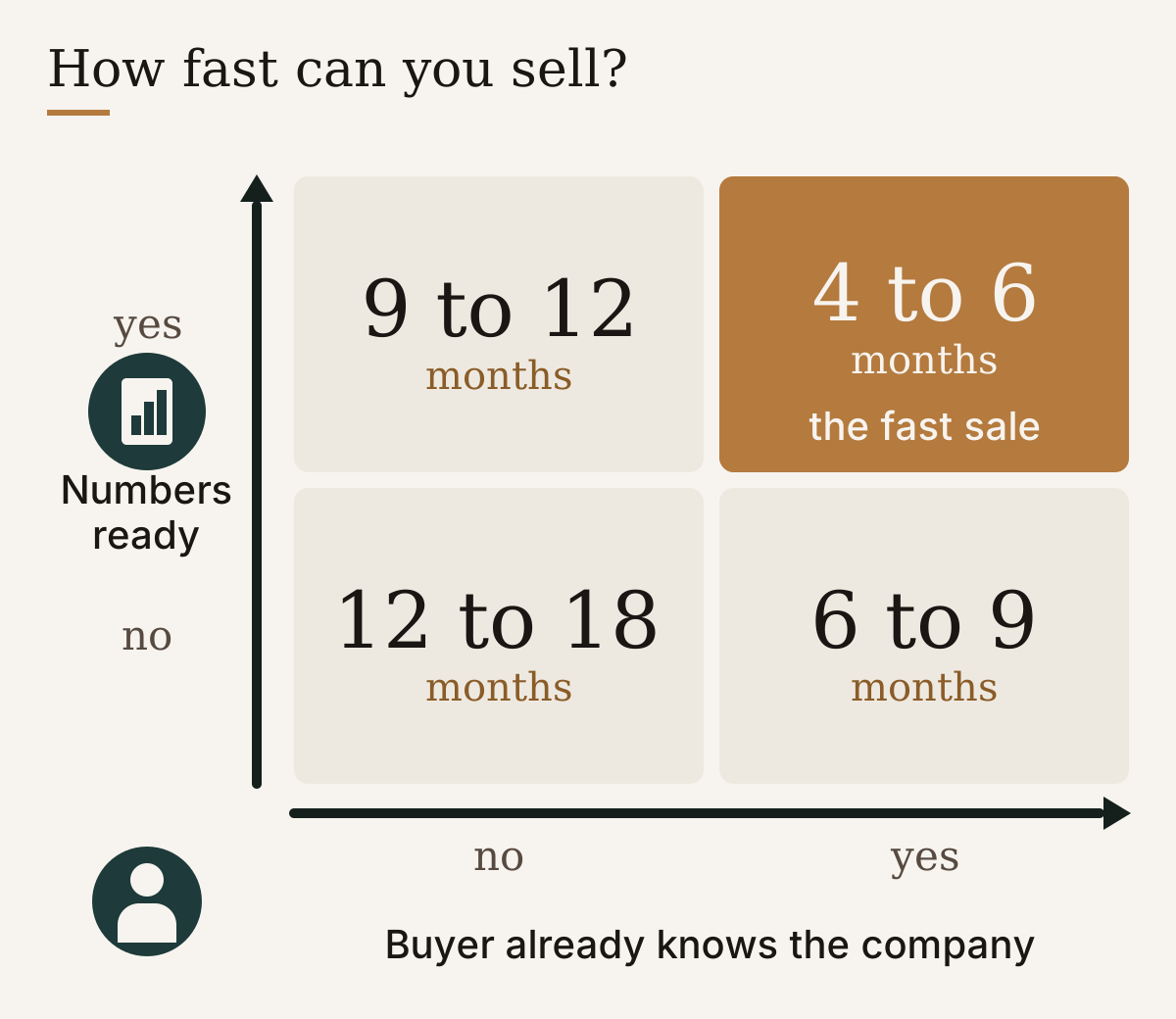
All three come back to the same two questions. Does the buyer already know the company? Are the numbers ready? With neither, a sale in my practice takes twelve to eighteen months. With ready numbers but a buyer who has to learn the business, nine to twelve. With a buyer who knows it but numbers still in a drawer, six to nine. With both, four to six months. That corner is the fast sale. Place yourself in it before you promise anyone a date.
Other stretches barely move. The buyer's bank keeps its own calendar: several weeks, whatever you do. The contract takes the lawyer's time: fewer open points make it faster, never instant. Then come the consents and formalities of the transfer: a landlord, a key client, sometimes an authority or a register. Those weeks aren't yours to shorten. Ask your lawyer early which ones apply where you are.
The bill for each month saved
What a sprint costs, line by line, in orders of magnitude from my own mandates. Three words first: escrow is money parked with a neutral third party; a seller loan means you lend the buyer part of the price; an earn-out is extra price tied to results.
| Line item | Order of magnitude | When it falls due, or what moves it |
|---|---|---|
| Competition given up | 5 to 15 % of the price | The day you sign: one buyer, no rival offer |
| Unknowns left unchecked | Broader warranties, and 5 to 15 % held in escrow for 12 to 24 months | After the sale, if something surfaces |
| Part of the price deferred | Seller loan of 10 to 20 % over 3 to 7 years, or an earn-out over 1 to 3 years | In the years after the sale, if the business holds |
| Preparation skipped | Value never built, no figure to put on it | When the buyer sees how much still runs through you |
| Fees | Not lower, sometimes higher | During the sprint: the same days, squeezed together |
| Your own time | 2 to 3 days a week | For the whole sprint |
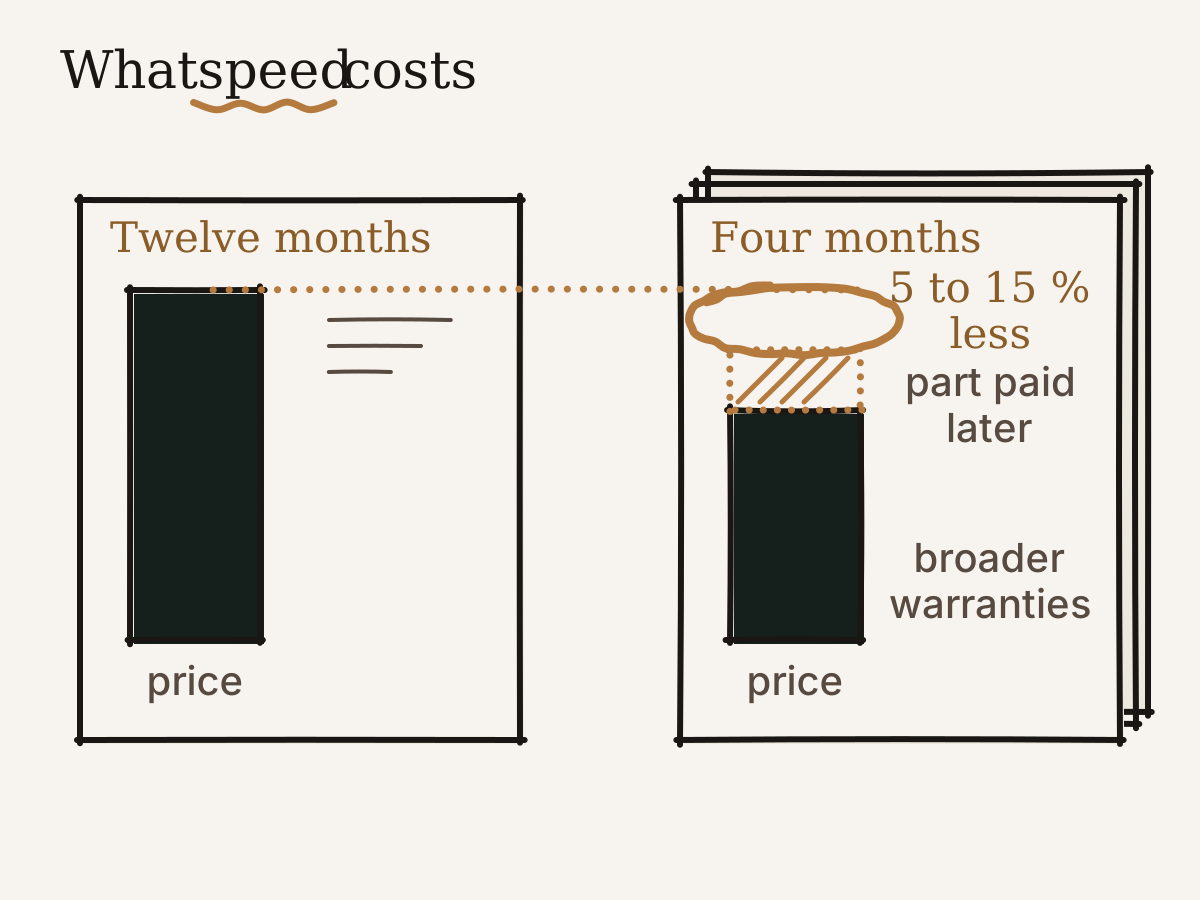
The first line is usually the heaviest. Selling fast almost always means selling to one buyer, so you give up competition between buyers, the only thing that really holds a price. In my mandates, the gap between a one-buyer sale and one with several bidders is of the order of 5 to 15 % of the price. I've broken down what a competitive process costs to run separately.
Next, the unknowns. Whatever the buyer had no time to check, he asks you to cover with promises. In a fast sale, warranties come broader, longer, or with a higher ceiling on what you could have to pay back. They usually run twelve to twenty-four months. Part of the price may also go into escrow. For a smaller company that's commonly 5 to 15 % of the price, for twelve to twenty-four months. Know what you actually sign as a seller before the sprint starts.
Then the deferred part. An earn-out is usually measured over one to three years; a seller loan typically covers 10 to 20 % of the price over three to seven years. Either way, that money isn't yours at signing, and it depends on what happens next.
The fourth line has no figure, and it may be the most expensive. A company that runs without its owner is worth more. A sprint sells the company as it stands today, without the months needed to build that. A serious buyer notices early that the biggest client still calls your mobile, and walks away or lowers the offer.
Fees don't fall with speed. The adviser, lawyer and accountant do the same days of work in less time, and urgent work sometimes costs more.
Take a building-services installer with twenty-five staff, which an ordinary twelve-month process would sell for around four million euros. It's a made-up case, not a client. The operations director offers to take it over and wants to sign before the summer. Five months is realistic, because he knows every site and every client, and the accounts are current. Measured against the four million, the bill reads like this: 400,000 euros off the price, 10 %; another 400,000 held in escrow for eighteen months; and 600,000, 15 %, lent back as a seller loan over five years. Of the four million the owner pictured, 2.6 million arrives on signing day.
When speed is worth its price
Speed is worth its price when a real reason stands behind it. A buyer at the table with a lasting motive. A partner who is leaving. Health, which I've covered in a separate piece on selling for health reasons. A market window that's closing. Tiredness on its own isn't such a reason, and neither is a round date like a sixtieth birthday. When nothing forces your hand, each month of waiting costs less than the discount.
If you do go, write three things down before the sprint begins. First, the discount you'll accept for each month saved. Second, the two or three concessions you can carry: a deferred part, perhaps yes; warranties beyond twenty-four months, no. Third, the name of the person who holds the calendar every single day. If that name is yours, you're seller, decision-maker and project manager at once, and the sprint will eat you.
What costs most in a sprint, in my experience, is the day lost between two advisers. The lawyer waits for the accountant's figures, the accountant waits for the bank, and nobody has told the bank the date moved. Each handles a fragment, and handles it well. A fast sale rests on one person who drives the whole thing.