Selling Your Business: Name a Price or Let the Buyer Offer?

Never name your price first. Whoever puts the first number on the table loses. It's the negotiating rule owners hear most often once they decide to sell, and for most owner-run businesses it's the wrong one.
Whether you should name a price or let the buyer make an offer depends on two things: how many serious buyers you have, and what kind of buyer they are. With several serious candidates competing, keep the price out of the sale document and let the first offers come to you. With one or two, give a price, or at least a range, because otherwise the buyer sets the opening number, and he'll set it low. Advisers who run sales with several candidates use a third way, which keeps the document silent without leaving the buyers guessing: no figure in the document, an expected range said out loud or written into the process letter, the letter that tells candidates how and by when to send their offers, and a floor price you've written down for yourself before any of it.
The sale document, the memorandum a buyer reads before deciding whether to bid, is read by people looking for the top of your expectations. Print a price and you've handed them that top. Offers gather at the figure or below it, and a buyer rarely goes above the number you printed unless another buyer pushes him there. A written price is a ceiling.
Silence has its own cost, though. A buyer with no reference starts from his own spreadsheet, and a spreadsheet built by the person paying always leans the same way. When he's alone at the table, nothing pulls his number up. You spend weeks climbing back to a figure you could have said in one sentence.
The rule about never going first comes from competitive sales, and there it's right. When four or five serious candidates know they aren't alone, each has to guess what the others will pay. So you leave the price out of the document, give everyone the same date for their indicative offers, meaning a first written price that doesn't bind them yet, and compare. Such a process costs time and fees, and only pays when the candidates are really there.
Most owner-run companies don't have five candidates. They have the competitor down the road, the manager who's been there fifteen years, perhaps an investor who called last spring. For that owner, the advice to stay silent was written for a different kind of sale.
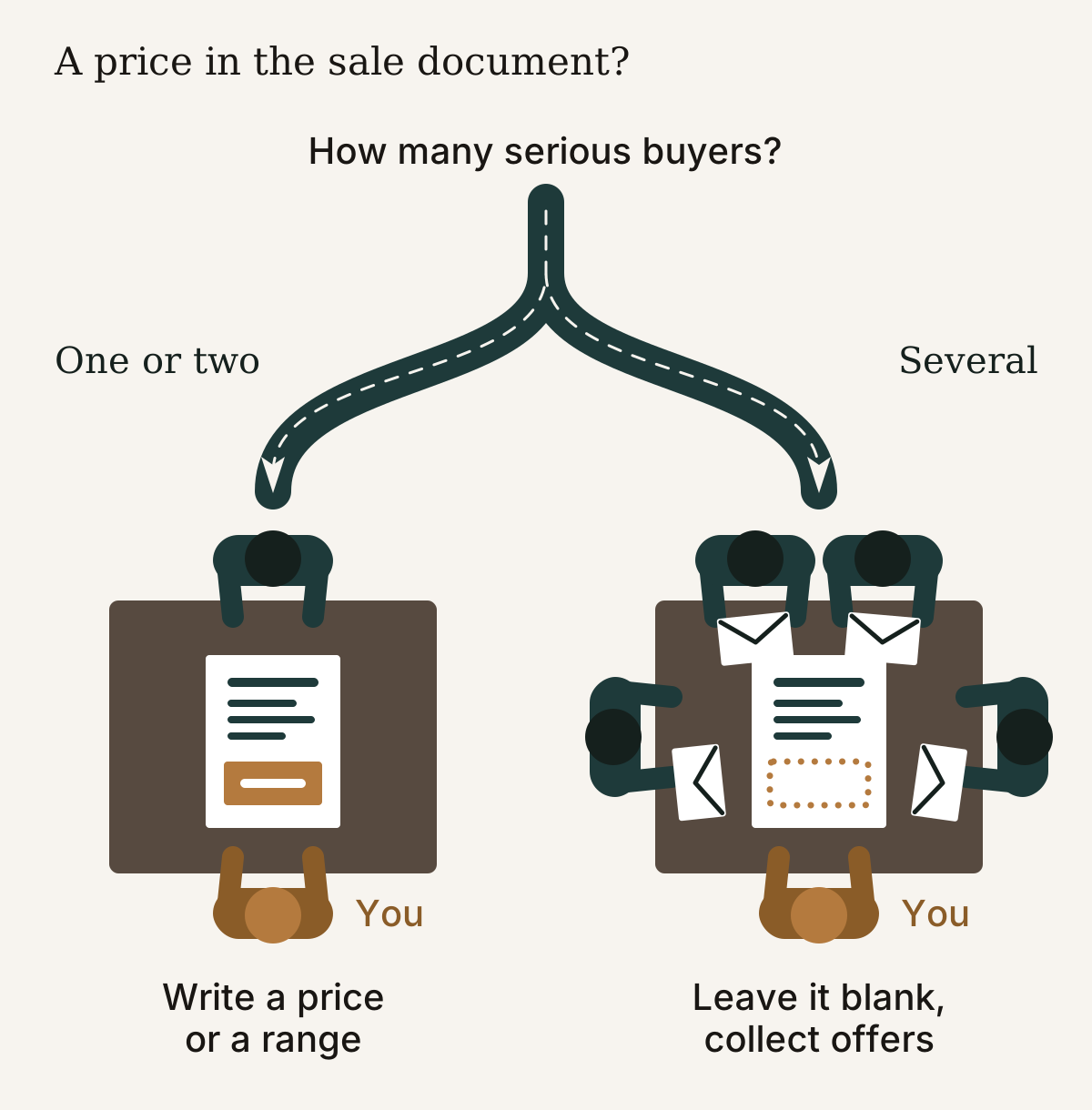
The count decides whether you give a number; the type of buyer decides how, since each type negotiates differently. A competitor or a strategic buyer, a company that wants your business for what it adds to its own, knows your market and does his own sums; your price tells him where you stand, nothing more, so give it plainly. A financial investor reasons in multiples of profit, a price stated as so many times the yearly result, and will turn any figure you give into one, so make sure the multiple behind your number holds up. A buyer who'll run the company himself, or an employee taking over, needs a reference point, often just to know what to ask his bank for.
Picture a joinery of twenty-five people whose only serious candidate is the workshop manager. It's a made-up case, not a client. If the owner says nothing about price, the manager goes to his bank with what he thinks he can borrow, and that amount quietly becomes the price. Nobody decided it. It was simply the first number anyone wrote down.
Two objections
"If I name a figure, I may sell for less than the buyer would have paid." With one buyer, who else would have paid more? Money left on the table only exists when a second bidder is there to put it there. With one or two buyers, the bigger risk runs the other way: a low first number you never quite climb out of.
"A high price will scare the buyer off." It can, if it's a number with nothing behind it. A price that comes with the method behind it, the profit you started from and the multiple you applied, gets discussed rather than dismissed. A range is gentler: it gives the order of magnitude without a precise ceiling, and leaves the buyer room to land inside it.
The third way
Advisers who run sales rarely choose between a number and silence. They leave the document without a figure, then give the expected range out loud at the first meeting, or put it in the process letter. It also lands better from whoever runs the process: from the owner, a figure sounds like a hope; from a third party, it sounds like a position.
Before any of that, the owner writes down his floor, the price below which he doesn't sell, for himself alone. I've written about drawing that line before the first offer, and here it does a second job. Without it, the first offer becomes your reference, whatever it says.
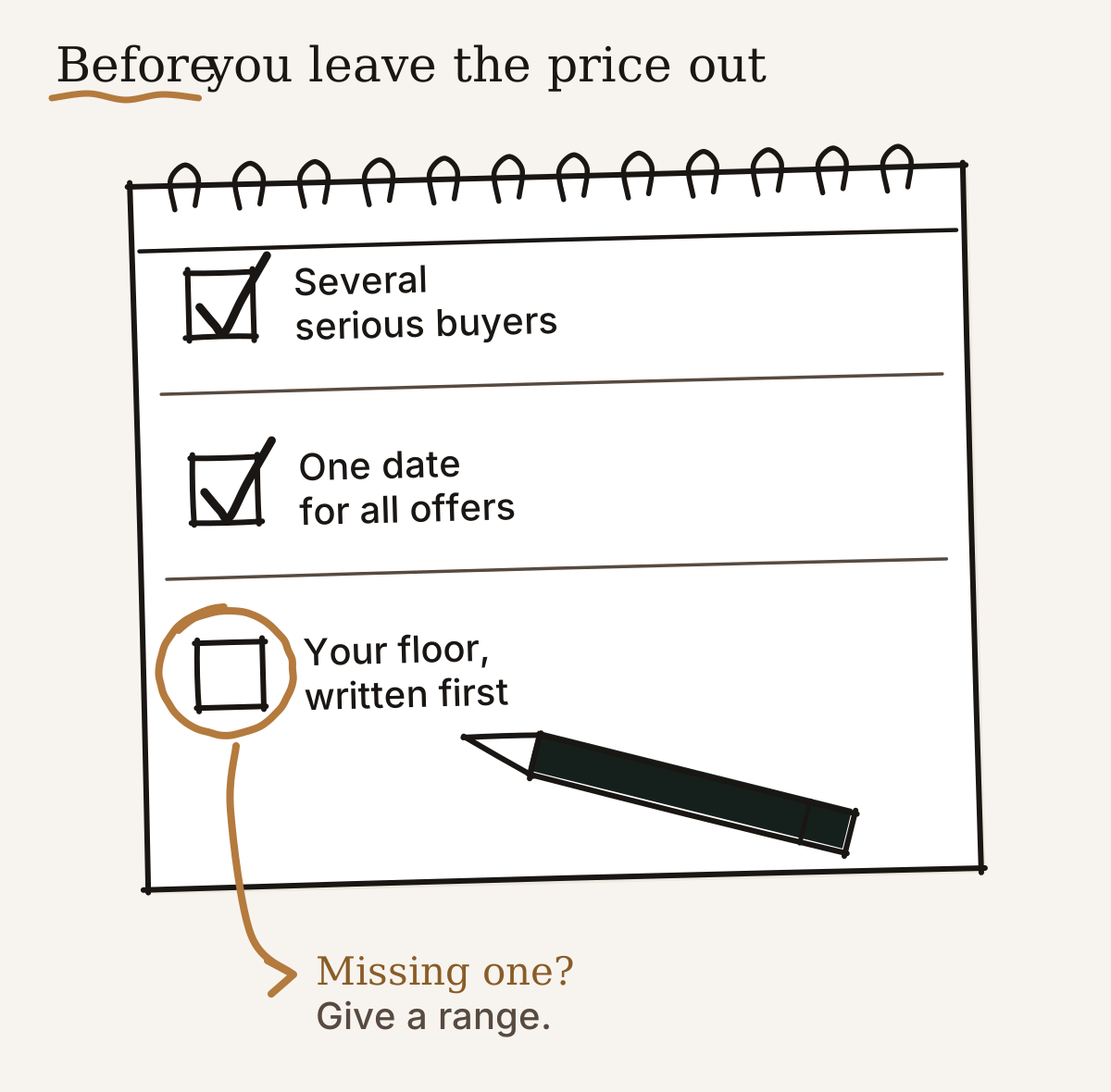
So leaving the price out works only when three things hold at once: several serious buyers, one date for all their offers, and your floor written down before you read a single one. If one is missing, you're back in the lone buyer's game, and the answer is a range.
The rule about the first number was made for auctions. Most owner-run companies aren't sold at auction. They're sold to one person, across one table. Count your serious buyers before you decide to keep quiet. If the count is one, silence isn't a tactic; it's letting him write the price.