Selling a Sole Proprietorship: The Liquidation Gain Taxed Apart, and the Date That Decides It

A sole proprietor has two ways out: sell the business as it stands, or turn it into a company first and sell the shares years later. The first is taxed as income; the second can be close to tax-free. What follows is Swiss law, where the first route turns on your 55th birthday and the second on a five-year clock. Germany and Austria come further down.
Without shares, you sell what the business owns: equipment, stock and goodwill. In Switzerland, the gain on them is self-employed income. Most of it is latent reserves, meaning value above book value: written-down equipment, goodwill never on the balance sheet.
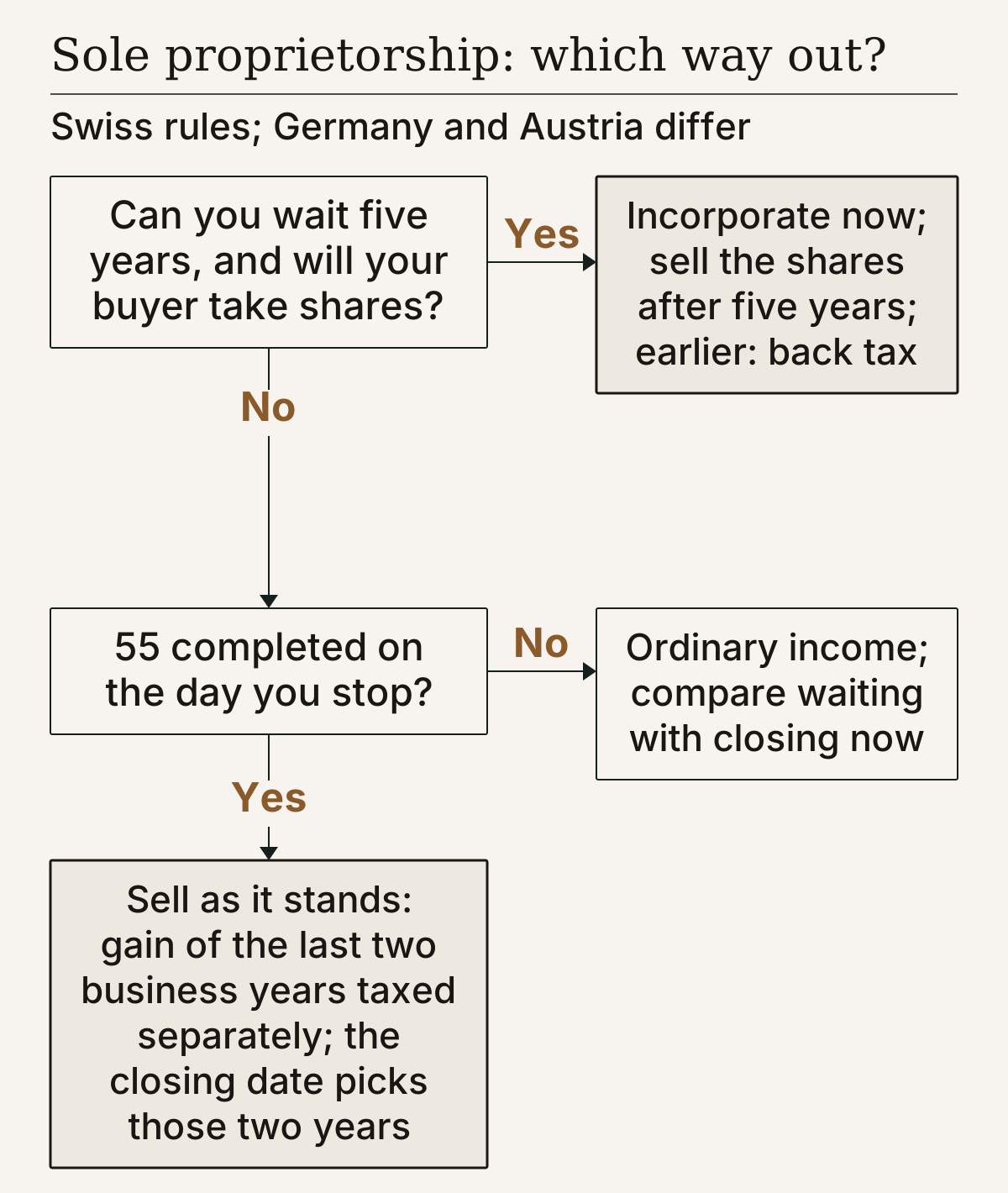
Route one: sell as it stands, and choose the date
From 55, if you stop self-employment for good (disability opens the same door), that gain, which the law calls the liquidation gain, gets its own treatment. It covers the latent reserves realised in your last two business years, taxed apart from your other income, federally and by the canton. The relief is meant for the final exit: start again as self-employed, and a second liquidation gain is ordinary income.
The calculation runs in three steps. First, real buy-ins, meaning voluntary payments into your pension fund to close a gap, made in the liquidation year or the year before, are deducted from your other income; whatever that income cannot absorb is deducted from the gain.
Then comes the fictive buy-in. If you made no real buy-in, or less than the law would have allowed, you can ask that part of the gain count as the buy-in you could have made. No money changes hands. The law fixes its size: 15 percent of your average self-employed income over the five business years before the liquidation year, multiplied by your years from age 25 to the liquidation year, counted no further than the reference age of the Swiss state pension (AHV), 65 in the standard case. From the result, subtract the pension savings you already hold, including the tied private account known as pillar 3a. The fictive buy-in can never exceed the gain itself. That slice is then taxed on its own, like a pension lump sum. At federal level it pays a fifth of the ordinary tariff; the canton applies its own lump-sum rate. Paying a real buy-in instead is a separate trade-off.
Third, what remains after both is taxed in full at federal level, but at the rate that would apply to a fifth of it, never below 2 percent. The two reliefs differ, and the word fifth hides it: on the buy-in slice you pay one fifth of the normal tax; on the remainder you pay the whole tax, but at the rate of someone earning a fifth of that amount. Your canton fixes its own rate.
The liquidation year is the business year in which the liquidation is completed, and the window covers that year and the one before. Gains realised before that window are ordinary income. The age test applies on the day you stop: 55 completed, not 55 sometime that year.
That's why I fix the cessation date to the quarter, not just the year. A hypothetical case, not a client: a plumbing and heating business with twelve people, owned by a 57-year-old who was never in a pension fund. An offer comes in for goodwill, equipment and stock; say the gain on them is 900,000 francs, almost all of it latent reserves. He sold the workshop building early last year, and his business year is the calendar year. Say the building gain was about 400,000 francs.
If the sale completes this December, the window covers this year and last, so those 400,000 join the liquidation gain at the separate rate. If closing slips to February, the window becomes next year and this one, and the building gain stays ordinary income at the full progressive rate.
The fictive buy-in matters too. Thirty-two years count, 25 to 57, and I keep that count for both dates to compare like with like. On an average self-employed income of, say, 150,000 francs, the buy-in he could have made comes to 720,000 francs. With nothing in a pension fund to subtract, those 720,000 are taxed like a pension lump sum. Closing in December, the remaining 580,000 pay full tax at the rate that applies to a fifth of that sum; closing in February, the remainder is 180,000 and the 400,000 building gain is ordinary income.
In the files I see, the buyer's calendar or the owner's birthday sets the date, rarely the two-year window. A building still in the business is a second lever: take it into private wealth instead of selling it. On request, only the depreciation you claimed is taxed now: what the building cost, minus its value in your tax accounts. The gain above the original cost is taxed only when you later sell the building.
The gain also carries AHV contributions as self-employed income, around 10 percent in total (8.1 percent AHV plus the smaller disability and income-compensation contributions); and if you stop working before reference age, contributions continue after the sale, calculated on wealth.
Route two: incorporate now, sell later
In Switzerland, a private person's gain on privately held shares is normally not taxed. That's route two, and it only works with a buyer who will take shares rather than assets (asset deal or share deal).
The transfer is tax-neutral if the business stays taxable in Switzerland and its tax book values carry over unchanged. The catch is the five-year clock. Sell the shares within five years for more than the equity you brought in, valued as the tax accounts show it, and the latent reserves you carried over are taxed after all, as if you had sold the assets back then. The tax office reopens that year: a back tax. Decide about a building before you incorporate. Once it sits in the company, moving it back to private ownership is a transfer at market value, taxed like a sale.
Germany and Austria: the age test exists there too
In Germany, selling the whole business yields a taxable sale gain: price, minus costs, minus the book value of the business's net assets. From 55, or with permanent incapacity, two reliefs exist, each on application. One is an allowance of 45,000 euros, which shrinks by whatever the gain exceeds 136,000 euros. A gain of 150,000 euros leaves 31,000 of allowance; at 181,000 it is gone. The other is a reduced rate on up to 5 million euros of gain: 56 percent of your average rate, at least 14 percent. Each can be used once in a lifetime.
In Austria, on application, the sale gain is taxed at half the average rate on total income. It applies in three cases: the owner is 60 and stops all gainful activity; disability makes carrying on impossible; or the owner's death leads to the sale or closure. Seven years must also have passed since the business opened or was last bought.
The tax-free version of route two does not exist in either neighbour. In Germany, a holder of at least one percent who sells GmbH shares has business income: 40 percent is exempt, 60 percent taxed. In Austria, the gain on shares carries a flat 27.5 percent. The table below is Swiss throughout.
The two routes side by side
| Criterion | Sell the business as it stands | Incorporate first, sell the shares later |
|---|---|---|
| Age on the day you stop | 55 completed (disability aside), else ordinary income | Irrelevant: a private share gain normally isn't taxed |
| Timing | Any time from 55 | Five years or more after incorporating |
| What the buyer gets | The assets they choose, few old liabilities | The company, history included |
| Building | Sold inside the two-year window: part of the liquidation gain | Decide before incorporating |
| Missing pension savings | A real or fictive buy-in lowers the bill | No fictive buy-in on a share sale |
| AHV contributions | Yes, as self-employed income | Not on the gain itself |
| If plans change | Start again, and a second liquidation is ordinary income | Selling inside five years triggers back tax |
Who fits what
Selling as it stands is the route for an owner who'll be 55 on the day they stop, won't wait five years, and has a buyer for the assets. Incorporation is for the younger owner with five years ahead and a buyer for the whole company. The risk: a buyer who turns up in year three with a good offer you cannot accept without the back tax.
The owner in between, 53 with an offer on the table, has the hardest file. Put three figures side by side: the tax on closing now, the tax after the 55th birthday with the fictive buy-in, and what the buyer charges for waiting. That comparison, not the buyer's schedule, should set the date, and a written ruling should confirm it before you sign.