Should I Sell My Business to Private Equity? What the Second Sale Changes
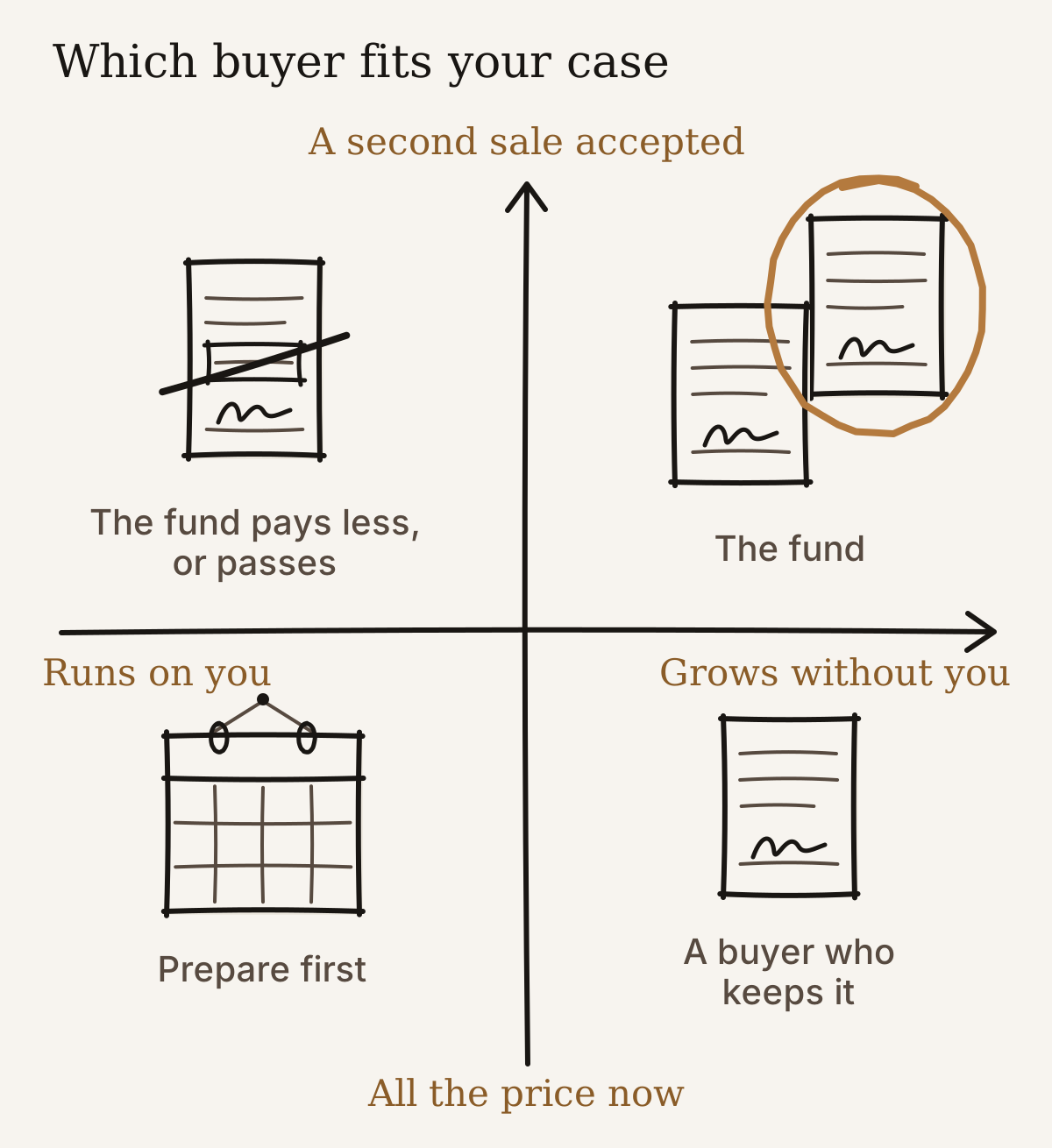
Two buyers can want your company for opposite reasons. One wants to keep it: a competitor, a family office, a successor. The other, a private equity fund, buys it in order to sell it again. So the fork in front of you isn't who pays more. It's whether you sell once, or accept that your company will be sold twice, the second time with you still on board.
Should you sell to private equity, then? Yes, if you accept that second sale: the company will be sold again a few years later, to a buyer you don't choose, and you'll still be in it, through the part of your price the fund asks you to reinvest and the role it asks you to keep for a while. No, if you want a clean exit, with the whole price now and no role afterwards. Three questions settle most of the rest, and the table below adds two. Can the company grow without you? Will you reinvest and stay? And where is the fund in its own life? The date of the second sale is roughly fixed on the day you sign.
What a fund is paid to do
Private equity, pooled money that buys companies, works like this. A management firm gathers money from investors, such as pension funds, insurers and wealthy families, into a fund, a pot with an end date. It buys companies, grows them, and sells them before the fund closes, handing the money back with a gain. It isn't there to keep companies. Selling is the job.
So it pays well for a company that grows without its owner. Think of a team that holds, revenue that recurs, and clients who come for the company, not for the boss. And a growth plan it can finance: buying neighbouring businesses, opening new markets. A company that still runs on its owner gets a lower price, or no offer at all. How a fund reads your file, next to the other buyers, is another article. Here the question is whether its logic suits you.
The fund also pays part of the price with acquisition debt: a loan that your own company, once bought, repays out of its profits. If you stay, expect years where profit goes to the bank first, and a fund that reads your figures month by month.
The clock started before you signed
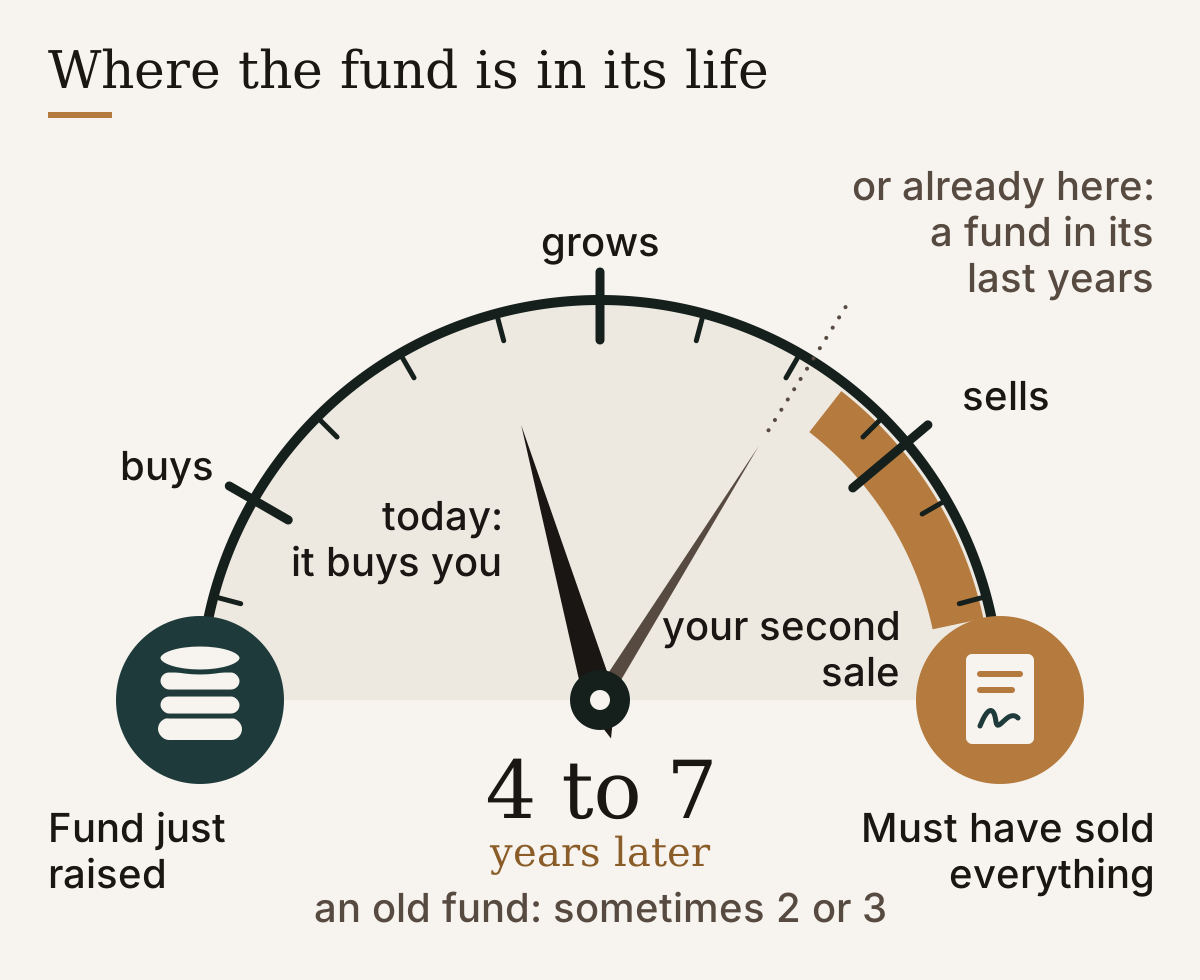
As a rule, a fund lives around ten years. It buys in its first years and sells in its last ones. In the funds I see across the table, a company stays in the fund's hands for something like four to seven years. Orders of magnitude, not statistics.
The date of your second sale depends on how old the fund is on the day it buys you. A fund early in its life can keep your company six or seven years. A fund in its final years has to sell quickly, sometimes within two or three. Same price, same contract, a very different calendar.
Two ways you stay in
The fund often asks for two things that keep you in. The first is a rollover, reinvesting part of your price: you put some of it back into the acquisition holding, the company created to buy yours, and keep a minority stake, most often well under half. The fund wants your interests tied to its own, and proof for its investors that the seller believes in the plan. Its clauses are covered in keeping a minority stake after the sale.
The second is your time: usually a transition of one to three years, sometimes longer, under an employment or management contract, before the fund replaces you or brings in a managing director. You become an employee of the company you used to own, with a boss above you.
Then the second sale. Your minority stake is sold along with the fund's, when it chooses, to a buyer it chooses, often another fund or a group. The clause that makes you follow is a drag-along, a duty to sell alongside, and it gets negotiated together with the reinvested share. On that day your stake is worth whatever the company is worth: sometimes a lot, sometimes little.
The questions, side by side
| The question | It points to the fund if | It points to a buyer who keeps it if |
|---|---|---|
| Can the company grow without you? | Yes: a team that holds, recurring revenue | Not yet, it still runs on you: then prepare first, whoever buys |
| How do you want to be paid? | Part of your price comes back later, at the second sale as a rule, at whatever it's worth then | You want all of it now |
| Can you work for someone else? | You accept a boss above you during the transition | You'd rather not report to anyone |
| Must the company stay as it is? | Name, site and team can change | You want it kept as it is |
| Who ends up owning it? | You accept a final buyer you don't choose | You want to know who that will be |
Here's a case I've made up, not a client. A technical services company with 45 staff, an owner aged 58, two offers. A rival group pays everything at signing. A fund pays a little more, asks him to reinvest part of the price and stay three years, and the fund is in its sixth year. The price gap matters least here. A fund that age won't hold for long, so the second sale lands around his 62nd birthday, with a buyer nobody can name today. His real question: does he want to still be there that day?
In the sales I run, the sellers who regret choosing a fund were rarely underpaid. What they hadn't grasped was that they'd remain a shareholder and an employee of a company that was no longer theirs, until a second sale whose date and buyer they wouldn't choose.
Before your first meeting with a fund, ask:
- In which year of its life is the fund, and when must it have sold?
- What share of the price must you reinvest, and on what terms can you sell it?
- How long must you stay, and with what powers?
- What's the plan, growth alone or acquisitions, and how much debt goes on the company?
- Who runs the company after you?
- Who does the fund expect to sell to?
I'd want a neutral party running the process to read the fund's offer, its calendar and its reinvestment terms before you sit down with it: someone who isn't also the seller.
Who each path suits
A fund suits the owner who still has five years of appetite for the job, a company that runs without them, and the stomach to stake part of their price a second time. A buyer who keeps the company suits the owner who wants a clean exit, or who cares that the company stays what it is.
The owner whose company still depends on them doesn't have to choose today. There are two or three years of preparation to do first, and the fund will come back. Funds sense that dependence and walk away or cut the price; the preparation that fixes it creates value even if you never sell. Starting early doesn't mean selling early. It means never having to sell under pressure, to a fund or to anyone else.