Earn-out structure: All or nothing, tiers, or a sliding scale? Which payment curve to ask for

For a target in money, ask for a sliding scale between a floor and a cap. Keep all or nothing for yes-or-no events, and for a small share of the price.
An earn-out is the part of your sale price paid later, once the company has changed hands, if it reaches agreed results over an agreed period, in practice usually one to three years. Two drafts of the same earn-out clause can promise the same top-up and pay it out in very different ways. The first sets a single target: reach it and you receive the whole amount, miss it by any margin and you receive nothing. The second draws a straight line between a floor and a cap and pays you in proportion to where the result lands on it. Tiers sit between the two: a few bands of results, each paying a fixed sum.
So which curve should you ask for? For any target measured in money, such as revenue or operating profit, ask for a sliding scale between a floor (below it, nothing) and a cap (above it, nothing more). A narrow miss then pays almost as much as a hit, a clear beat pays more, and no single accounting entry decides the whole amount. Accept all or nothing only when the target is itself a yes or a no, a licence obtained or a major contract renewed, and only for a modest part of the price. Tiers are a compromise: every step is a small threshold of its own.
What a near miss pays on each curve
Take a made-up case, not a client. A software maintenance company of about 25 people is sold for 6 million, of which 1.5 million is deferred. The deferred part depends on operating profit, what the business earns from its work before interest and tax, in the second year after the sale. The target is 1.2 million.
Under all or nothing, profit comes in at 1.15 million and the seller receives nothing. Fifty thousand short on profit, and 1.5 million of the price is gone.
Now put the same deal on a scale. The floor is 1.0 million, where the top-up starts. The cap is 1.4 million, where it reaches the full 1.5 million. Between them runs a straight line, so the payment follows the result pro rata, in direct proportion. At 1.15 million the seller gets the matching share, a little over a third, about 560,000. At the target of 1.2 million, half. At 1.4 million or more, all of it.
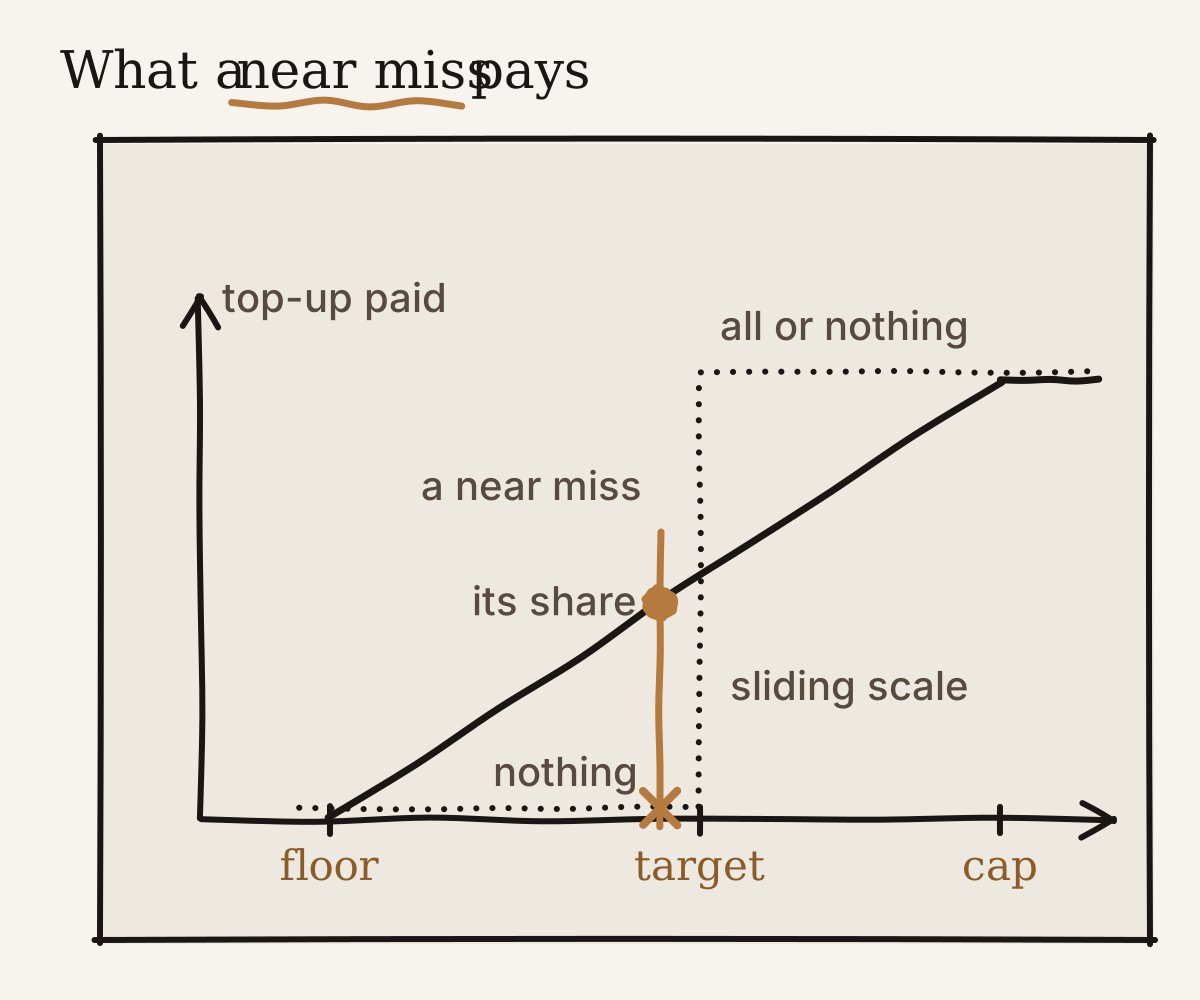
That scale has a catch, and it’s better to see it before signing than after. With the target in the middle, hitting the target pays only half the maximum; the maximum rewards beating it. So have the payout written down at three points: at the target, at ten per cent below it, at ten per cent above it. In this case that gives 750,000, 300,000 and 1.2 million. If the figure at the target isn’t the one you had in mind, move the floor or the cap. Don’t give up the shape of the curve to fix it.
Why one threshold turns every accounting entry into a dispute
With a single threshold, the whole top-up hangs on whether the figure lands one unit above the line or one unit below. Any accounting choice can tip it on its own: a provision, money set aside for a cost expected later, booked in December or in January; a repair counted as an investment or as an expense; a bonus; a year-end discount for a large customer. Both sides end up fighting over every entry, and after the sale it’s the buyer who keeps the books. On a scale, the same entry moves the payment only by its share. Nobody goes to war over a provision that shifts the top-up by a fraction.
In the sales I run, the first draft of the clause written on the buyer’s side most often contains a single threshold. The scale arrives when the seller asks for it. A buyer has good reason to accept it, because it’s an exchange. With the target in the middle, a narrow hit pays you half the maximum instead of all of it: that is the buyer’s gain. A narrow miss pays you almost as much instead of nothing: that is yours, the floor instead of the cliff edge. The cap stays, so the buyer never pays more than the agreed maximum.
| All or nothing | Tiers | Sliding scale, floor and cap | |
|---|---|---|---|
| A near miss pays | Nothing | The band below, if the miss crosses a step | Its share, close to what the target pays |
| A big beat pays | The same as a narrow hit | The top band, nothing beyond | More, up to the cap |
| Where disputes arise | On every entry that touches the figure | At the edge of each step | Rarely: an entry moves only its share |
| Buyer’s temptation to steer the figure | Strong: one entry can save the whole amount | Real, near each edge | Weak: one entry saves a fraction |
| Ease of reading | One line, one number | Sums anyone checks in a minute | One proportion sum |
| Which target it fits | A yes or no event | A rough metric, or a wish for simple sums | Any target measured in money |
Tiers deserve a fair hearing. In practice there are two to four bands, and anyone can check the arithmetic in a minute, seller, buyer or the seller’s spouse at the kitchen table. That simplicity is worth something when both parties want a calculation each can redo in their head, or when the metric is too rough to support a payment worked out to the last unit. The price is that every edge between two bands is a small threshold, with the same dispute in a smaller size.
What to settle around the curve
Which figure it reads, and the accounting method behind that figure, are questions for the earn-out clause as a whole. Who owes you the money, and with what security, is whether the buyer can actually pay. If you might leave before the measuring period ends, ask what happens to the curve then.
Over several years, ask one more thing: do the years offset each other, so that a poor first year can be caught up by a strong second one, or is each year judged alone?
And negotiate the curve early, at the letter of intent, not in the final contract. Drawing it on one page before the letter of intent, with the three points calculated, is the kind of work a neutral party running the sale process does while you’re still free to say no.
Which curve for which target
When the target is an event that exists only as yes or no, a licence granted, a major contract renewed, a certification obtained, there is no “almost”. A single threshold tells the truth about such a target. Keep that top-up small compared with the price, though, because it can be worth zero.
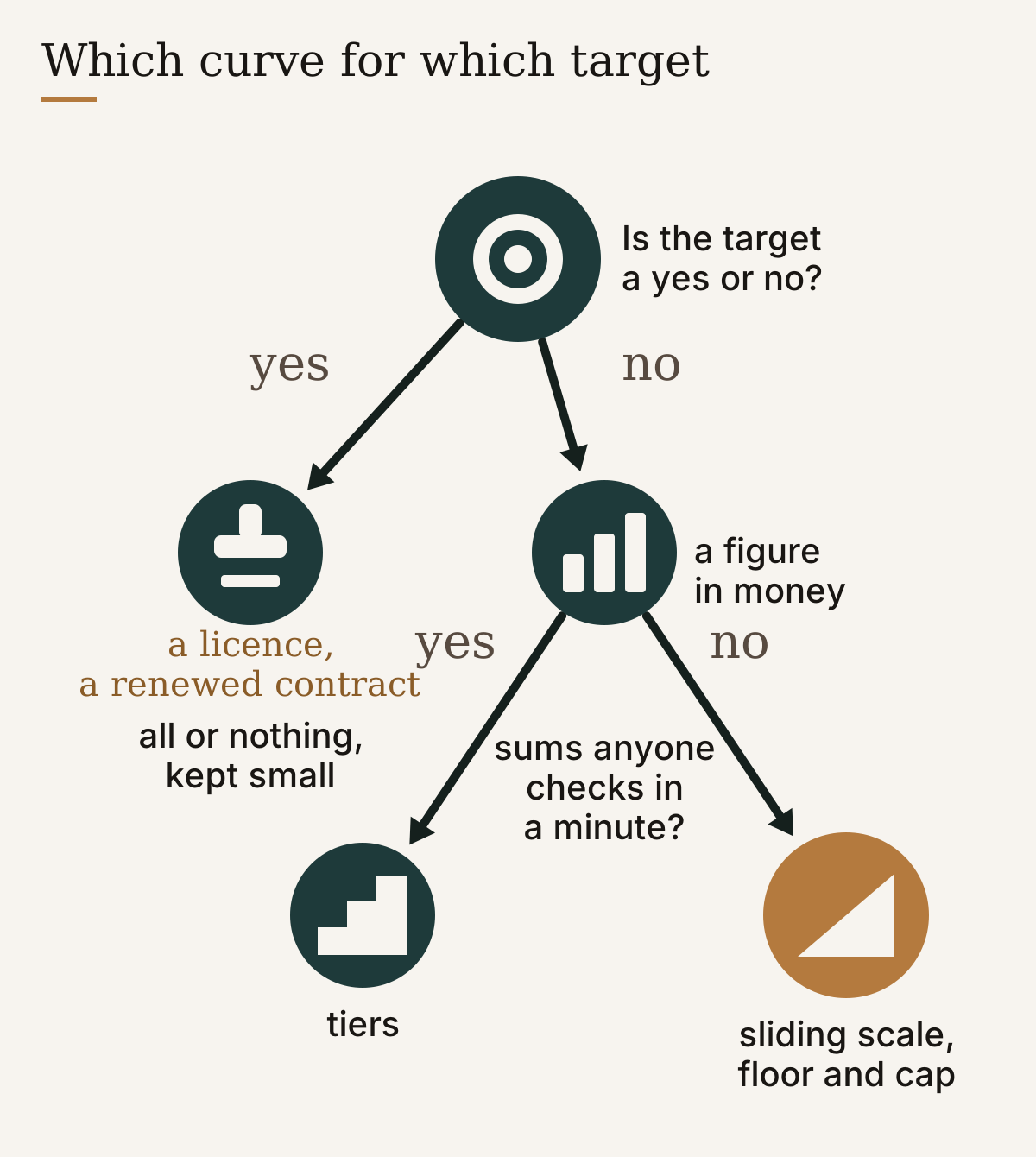
When the target is a figure in money, a sliding scale with a floor and a cap fits best. If you stay involved during the measuring period, it also pays for your work at every level of result, not only around one line.
When both parties want sums each of them can redo in their head, and accept a few small edges in return, tiers do the job.
Whichever you choose, one test holds. If the curve can’t be drawn on a single page with three numbers, floor, target and cap, and what it pays at each of them, it isn’t ready to be signed.
End of the article.