Family business succession planning: Settle every relative’s job before you hand over

Before the handover, give each relative on the payroll a written job, pay at the market rate and the successor as boss. Settle it while you still can.
Choosing the successor is the easy half of a family succession. What breaks it is everyone else in the family on the payroll: the brother in sales, the wife who keeps the books, the nephew in the workshop, people whose place nobody ever settled.
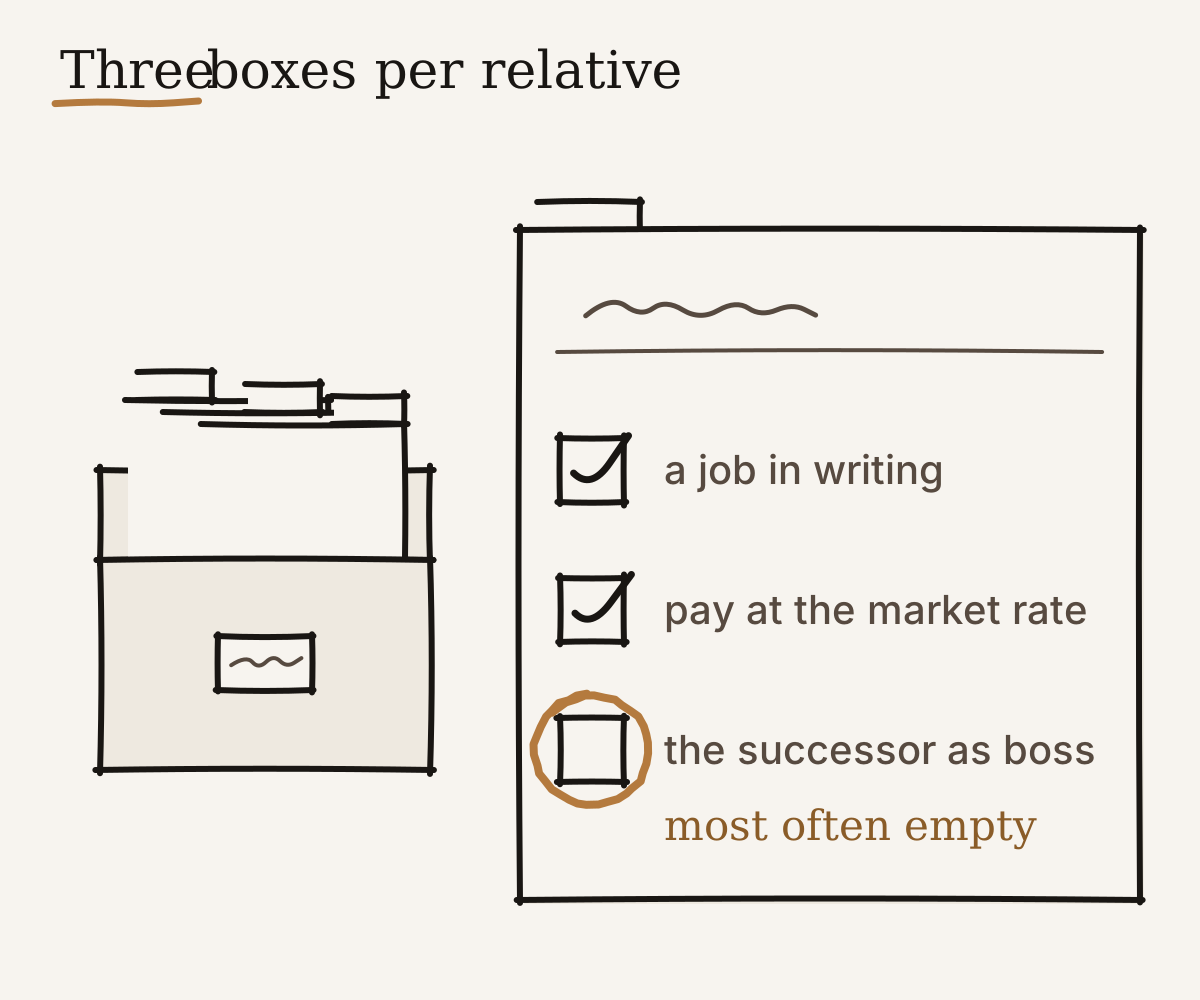
Here is how you settle the other half. Before the handover, every relative who works in the company gets three things. A job in writing, saying what it covers. Pay at the market rate, meaning what you’d pay an outsider for that same job. And, from the handover, the successor as their boss, not you, on the same piece of paper. You settle all three yourself, while you still have the authority to do it.
Leave it unsettled and you know what follows. The relative keeps coming to you. You decide, because you always have. Each time, the successor’s authority shrinks a little and you stay the arbiter. You wanted to hand over the running of things; instead you’ve become the court of appeal.
A relative who has been underpaid for years carries an unspoken claim: some day, they expect, there’ll be shares, a bonus, a say. One who’s overpaid is a cost your successor can’t cut without a family quarrel. Both fall due on the day you hand over. While you’re at it, ask your tax adviser what the tax authority makes of a salary nobody outside the family would earn for that job.
Imagine a metalwork firm of about forty people; a case, not a client. The founder’s brother-in-law has run shipping for eighteen years, paid a little above the market, with no job description. The founder’s daughter takes over. In her first month a customer complains about late deliveries, and she asks her uncle for a delivery plan. He calls her father that same evening. Her father has a quiet word, and shipping carries on as before. She has learned who her uncle still answers to.
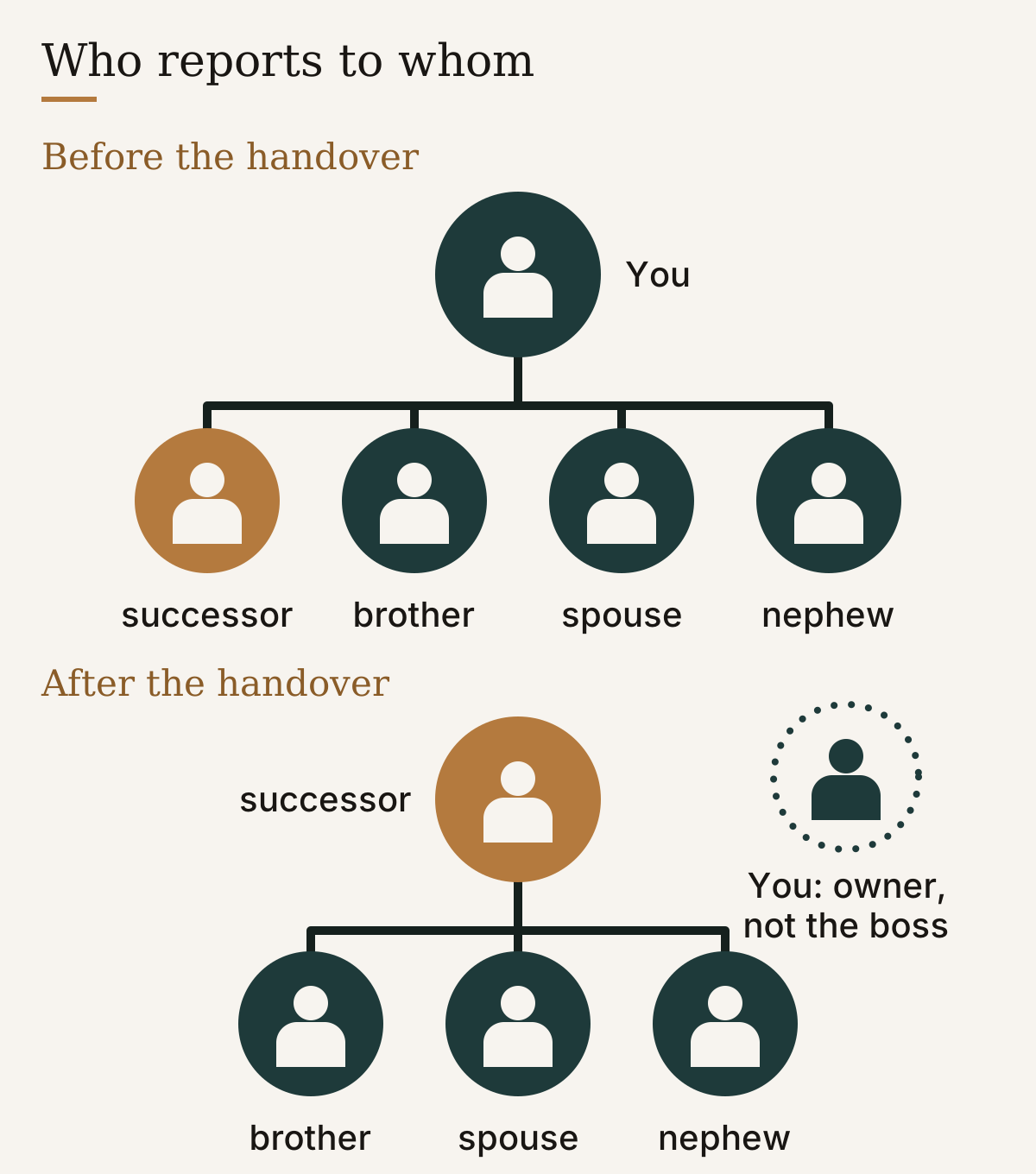
In the family successions I conduct, there’s one question successors ask least and need most: who will my uncle call on the day I tell him no? If the honest answer is still “my father”, the handover hasn’t happened yet, whatever the share register says.
“They’re family, we don’t need paper.” You may already owe them that piece of paper. In Switzerland, Germany and Austria, for example, the law requires an employer to give an employee a written record of the job and the pay; elsewhere, ask your accountant whether the same applies where you are.
“Paying the market rate would upset a twenty-year arrangement.” It will. You made that arrangement, and your successor never agreed to it. Better you unwind it, with the history you share, than leave your successor to renegotiate an uncle’s salary.
“My son will sort it out with his uncle once he’s in charge.” His uncle has twenty years of walking straight into your office, and you’ll still be at the table every Sunday. Without the paper, your son inherits a man he can’t manage.
“This will cause conflict now.” Some, yes. Conflict now happens with you in the room and your authority intact. Conflict later happens to your successor alone, with you asked to referee from retirement.
Some relatives wear two hats, employee and shareholder. Keep them apart. The job and the pay are decided by the boss. The shares and the vote follow the rules agreed between shareholders, or go to a family council. Don’t pay as salary what is really a share of ownership, or hand out shares to make up for a low salary.
Then there’s the relative who cannot accept the successor as boss. Decide now, while you can still do it gracefully. It might be a different role that does not report to the successor, or a clean departure: notice, a settlement, a clear answer on whether any shares stay. Some relatives end up as shareholders with no job at all.
Take one person at a time, roughly a year or two before the handover in my experience. You lead each conversation yourself, and the successor sits in, because the reporting line is about them. Whatever you agree gets written down. The same goes for the successor: a child’s job in the firm proves nothing unless the job is real.
The paper does two jobs. It lets your successor say no to a cousin and point to the job description as the reason. And if the family route fails and the company is sold, the buyer will read the payroll and ask who these people are and what they do. A relative working without a contract is a question best answered with a document.
Families picture the handover as the day the keys change hands. For the relatives on the payroll, it’s the evening one of them calls you about the new boss and finds you have nothing left to rule on. Prepare that evening while your word still settles things. Afterwards, you’d be settling them from the wrong chair.
Sources
End of the article.