What paperwork is needed to sell a business? Start with the agreements that only exist out loud
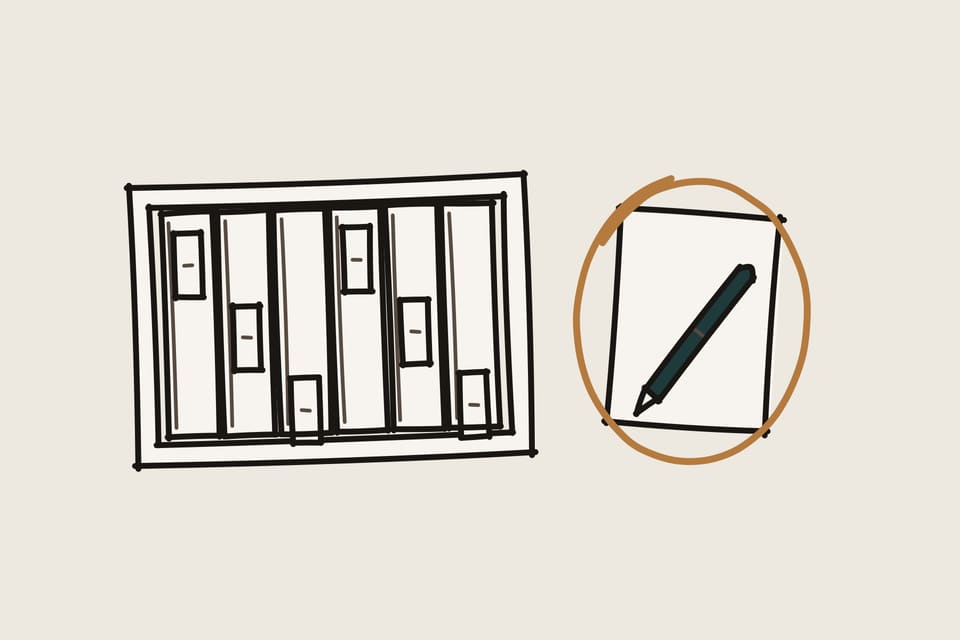
Two piles. Accounts, articles and contracts take a few weeks. Unwritten promises surface late and cost you a warranty or a lower price: start there.
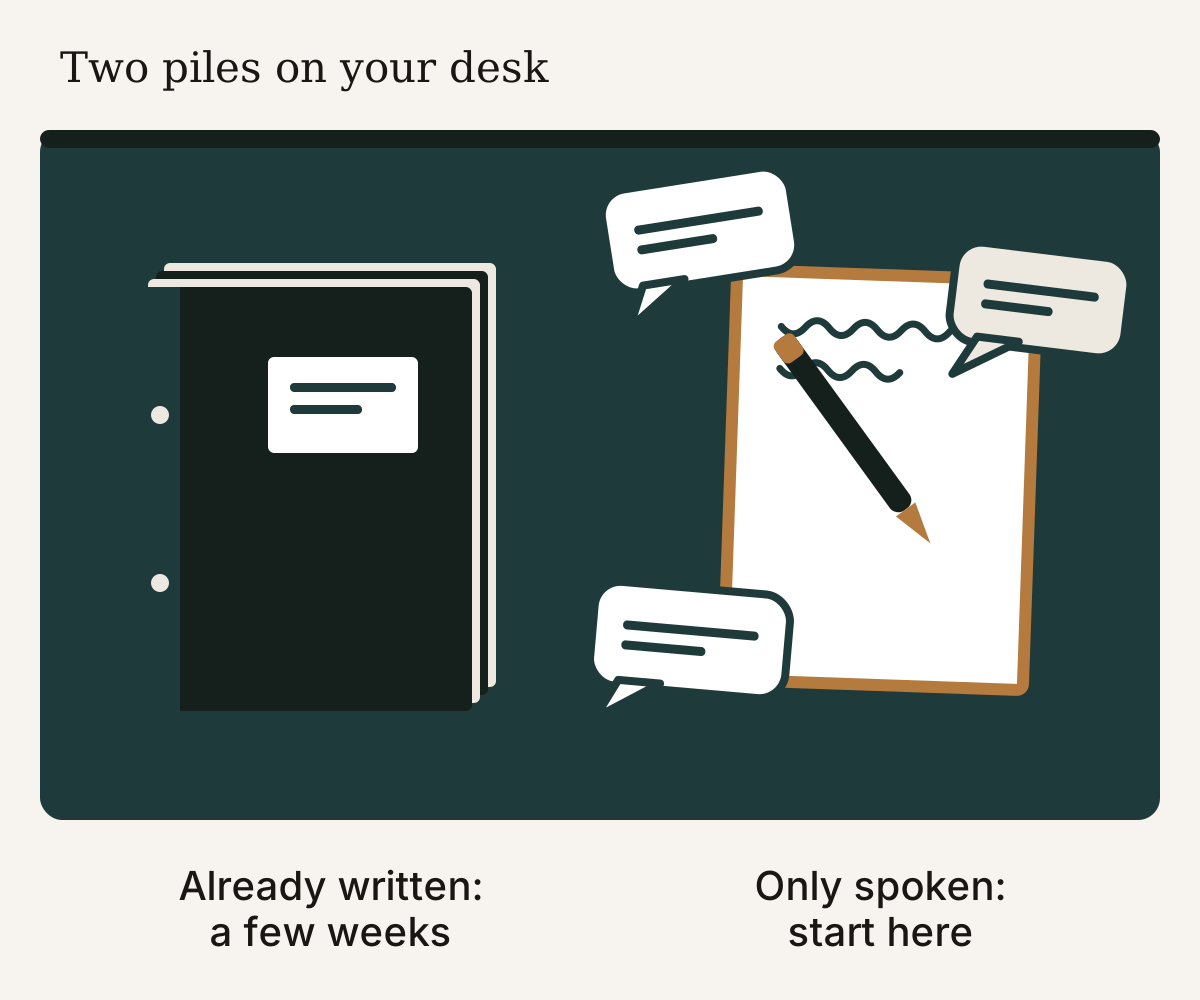
The paperwork a buyer will ask for forms two piles: what you already have, and what you still have to write. The first already exists: accounts, articles of association, the extract from the company register, customer and supplier contracts, the lease, employment contracts, permits, loans and guarantees. Your accountant and your lawyer can gather it in a few weeks, and it surprises nobody. The second pile doesn’t exist on paper yet. It’s the discount you promised a customer, the stake you promised a manager, the arrangement with a supplier that’s older than the contract. The buyer discovers it late, often from someone other than you, and turns it into a cut in the price or a warranty: a written promise that you will pay if it ever comes due. Start with the second pile.
The pile that already exists
In the sales I conduct, this pile takes two to four weeks when your accountant and your lawyer already hold the files.
- Annual accounts.
- Articles of association and the extract from the company register.
- Customer and supplier contracts.
- The lease, or the title deeds if the company owns its premises.
- Employment contracts and the pension scheme.
- Permits, licences, trademarks and domain names.
- Loans, guarantees and any security pledged on the company’s assets.
- Insurance policies and pending disputes.
What a buyer checks inside each is covered in the legal files a buyer opens first and in preparing your figures for a buyer.
The pile that exists only out loud
A promise made out loud binds the company just as a signed one does, unless the law demands a particular form for that type of contract, written or notarised. In Switzerland, Germany and Austria, for example, that is the rule the law starts from; elsewhere, ask your lawyer which promises bind where you are. In my mandates, the buyer rarely hears about these promises from the seller. It’s the manager, the customer on a reference call, or the supplier who mentions them.
- The discount you promised a customer. Picture an invented case, a printing firm with 25 people: for eight years the owner has given his biggest customer a year-end discount agreed by phone. The buyer learns of it from that customer’s purchasing manager on a reference call, five months into the sale, and from then on it’s a line in the price negotiation. Written up in the first month, it would have been a line in the sales file, the set of documents you hand the buyer.
- The stake, bonus or succession you promised a manager. “One day part of this will be yours,” said over dinner, stays a promise in the mind of the person who heard it. In Germany, for example, a promise to transfer shares in a GmbH, a private limited company, only binds once a notary has recorded it. That is one of the exceptions: said out loud, it binds nobody, and the manager will still bring it up with the buyer.
- The supplier arrangement older than the contract. Exclusivity or longer payment terms agreed with a handshake, while the signed contract says something else. Write down what you actually practise, then decide whether it stays.
- The relative who works without a contract. A spouse who does the books on Saturdays, a son paid below the market rate. Either give them a contract at a fair salary, or end the arrangement properly before the sale.
- The lease extension agreed by phone. The landlord said you could stay on, or lent you the storage room next door. Ask for a letter that confirms it: a buyer won’t count on premises nobody has promised in writing.
- What’s yours that the company uses. The van in your name, the software licence you pay for personally, the trademark you registered yourself, the workshop you own: nothing on paper says the company may use them. Decide before the sale whether each is sold with the business, leased to it, or kept; without a decision, the buyer counts it as missing. Your personal guarantees for its loans, and any money you’ve lent it, go on the list too.
- The perks and tolerances nobody wrote down. The customer who pays at 90 days, the price-list discount nobody applies, overtime never logged. The buyer finds them by comparing the cash with the contracts.
Three things you can do with each one
Every promise on your list ends one of three ways. You confirm it in writing, with an amendment, a letter or the minutes of a meeting. You bring it to a clean end before the data room (the shared folder where the buyer reads your files) opens. Or you declare it in the sales file, with what it costs. Whatever you don’t do yourself, the buyer will do for you, at the buyer’s price.
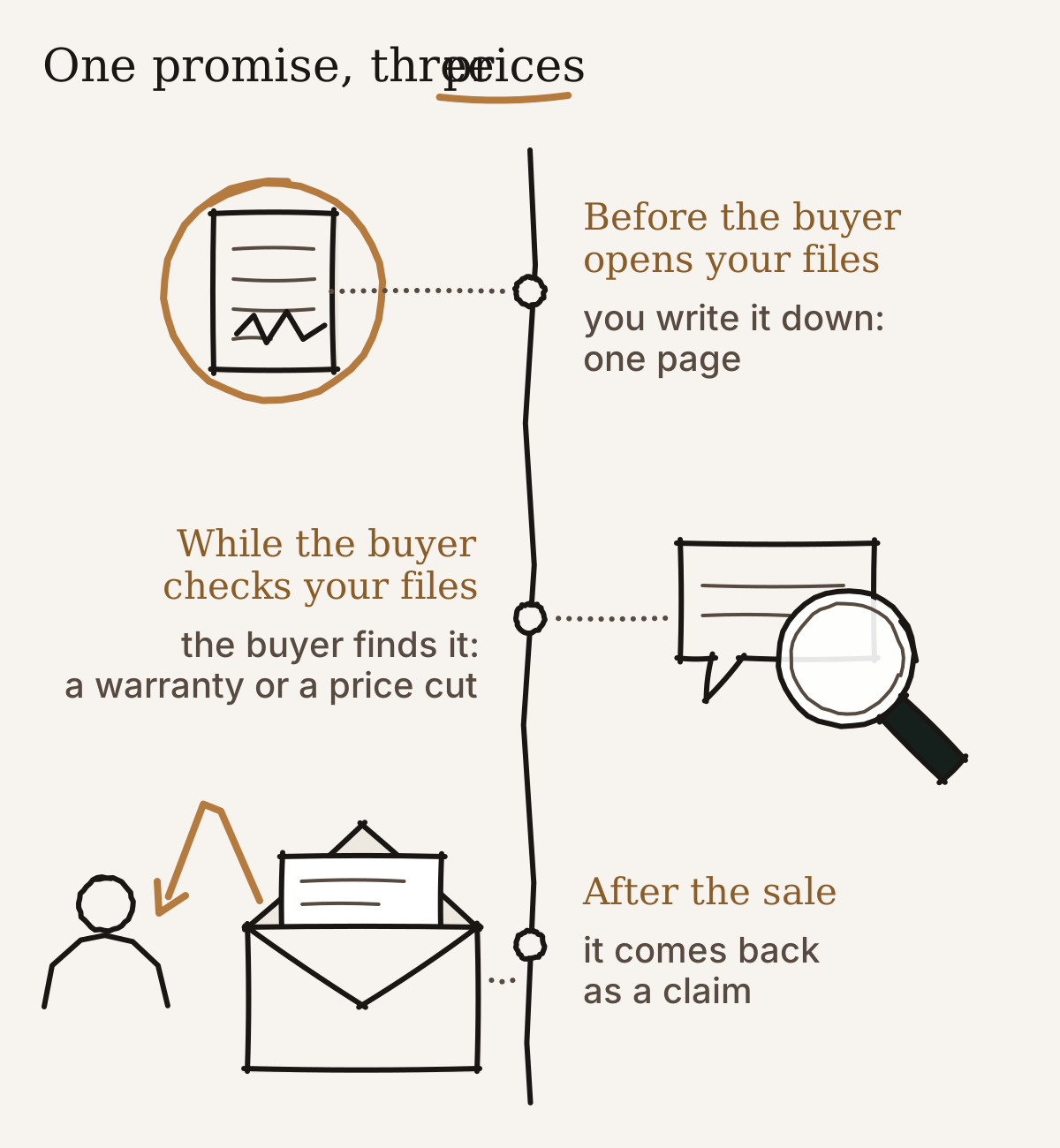
That price depends on when the promise surfaces. Before the data room, it’s one page you wrote. During due diligence, the buyer’s close examination of your files, it is found, given a figure and turned into a seller’s warranty or into a lower price. After closing, once the sale is completed, a promise you never declared comes back as a claim under those warranties.
I’ve never seen the stack of binders delay a signing. What delays it is the thing written nowhere that comes out during due diligence.
So this week, take a blank sheet and write down every promise you remember that isn’t in any contract. Do it alone, before you talk to anyone about selling, since who learns about the sale, and when matters as much as what goes on the page. That sheet is the first document in your sales file.
Sources
- Swiss Code of Obligations (CO), Art. 11SwitzerlandFedlex (opens in a new tab)
- German Civil Code (BGB), § 125Germanygesetze-im-internet.de (opens in a new tab)
- German Limited Liability Companies Act (GmbHG), § 15Germanygesetze-im-internet.de (opens in a new tab)
- Austrian Civil Code (ABGB), § 883AustriaRIS (opens in a new tab)
End of the article.