When should you sell your business? When the buyers in your trade are buying

Sell when the buyers in your trade are buying: their appetite sets your price as much as your results, and their window opens and closes without you.
Two dates compete for the sale of your company, and only one of them is yours. The first sits in your head: a birthday, the year you always meant to stop, the day your successor should be ready. The second is set by the buyers in your trade, the groups and funds that buy companies like yours, and nobody will ask you about it. When the two drift far apart, you have to choose which one to follow.
So when should you sell your business? When the buyers in your trade are buying. The price you get depends as much on their appetite as on your results. When groups or funds start buying your peers, a window opens; it closes once each of them has bought what it came for. The decision then comes down to two questions: is the window open in your trade, and could you hand over within a few months? If nobody is buying in your trade, set your own date and prepare for it.
Why their calendar weighs more than yours
Two kinds of buyer drive these waves. The first is the strategic buyer: a group, meaning a company that already owns several businesses and keeps adding to them, or simply a larger competitor. It pays for a piece it lacks. That piece might be a region, a customer base, or a technique its own people don’t have. Once it has it, it stops looking there, however good the next company in that region may be.
The second is the fund, an investment firm that buys companies with its investors’ money and sells them on later. Some funds build a group from scratch, which the trade calls buy and build. They buy a first company, the platform, then add similar ones to it, several within a few years, and finally sell the whole. When the fund has enough, it stops adding and moves on to another trade. The two kinds don’t negotiate the same way, and I’ve written about what each type of buyer is really after.
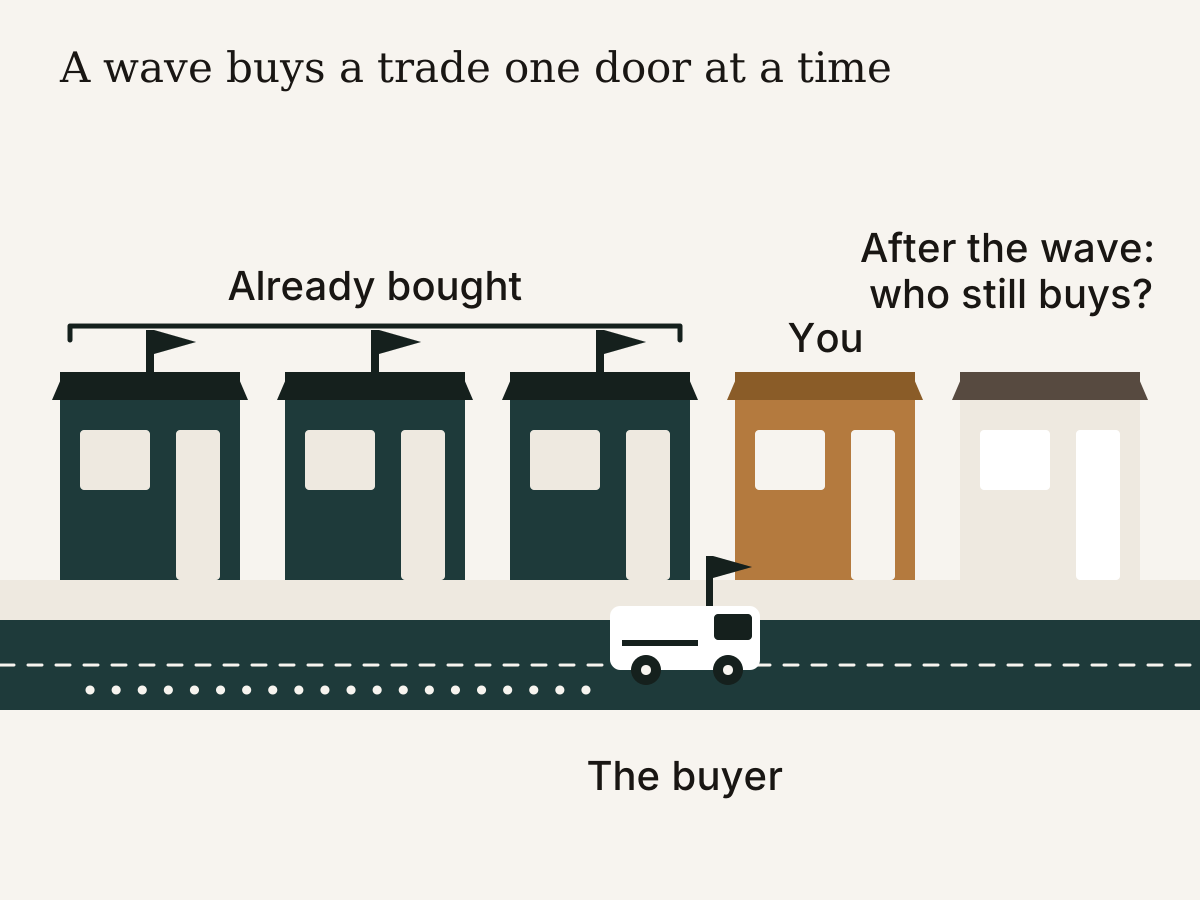
Now put several of these buyers in one trade, each wanting a presence in your region. The first of your peers to sell have several bidders. The last ones face a single buyer that knows it’s alone, or nobody at all. After the wave, who still buys?
In the sales I’ve worked on, the gap between what the first and the last sellers of a wave obtain is often larger than what a few more years of good results would have added. That’s why I put the buyers’ calendar ahead of the owner’s. Two more strong years rarely make up for arriving after the buyers have stopped.
The signals that a window is open
A wave rarely announces itself. It shows up as a handful of facts you can observe from your own desk. This is how I read them.
| Signal | What it tells you | How to read it |
|---|---|---|
| A peer recently sold to a group or a fund | Someone has started buying in your trade | Opening signal |
| A second peer sells, to the same buyer or another | The first deal wasn’t a one-off | Opening signal |
| Calls or letters from advisers acting for a client interested in your trade | A buyer is looking for targets, and your name is on a list | Opening signal; the caller has already compared you with your peers |
| The buyer of your peer announces more acquisitions | It hasn’t got enough yet and is still adding | Opening signal |
| Suppliers and customers tell you who has been bought | The deals are happening among people you work with | Opening signal |
| Buyers now take smaller firms | The peers that mattered to them have been bought | The wave is ending |
| Buyers now pay less | Fewer of them are left competing | The wave is ending |
| The trade press stops reporting deals in your trade | The buyers have what they came for | The wave is ending |
My rule of thumb, a practitioner’s rule rather than a statistic: three or more opening signals within a year or two, and the window is open in your trade. The last three rows say the opposite. Once they appear, the question has moved from whether to sell now to who is still buying.
The adviser’s call deserves a second look. A buyer that approaches you during a wave is comparing you with the peers it has already examined, and it knows the prices paid. Before you answer, it helps to know what to do in the days after an unexpected approach.
Take an imaginary heating and ventilation installer with about thirty people. The owner is 58 and has always planned to sell at 65. Within eighteen months, two competitors in the region sell to the same group. Then an adviser calls, acting for that group. Read against the table, that’s three opening signals in well under two years. His seven-year plan and the group’s calendar no longer line up.
Two questions, three ways out
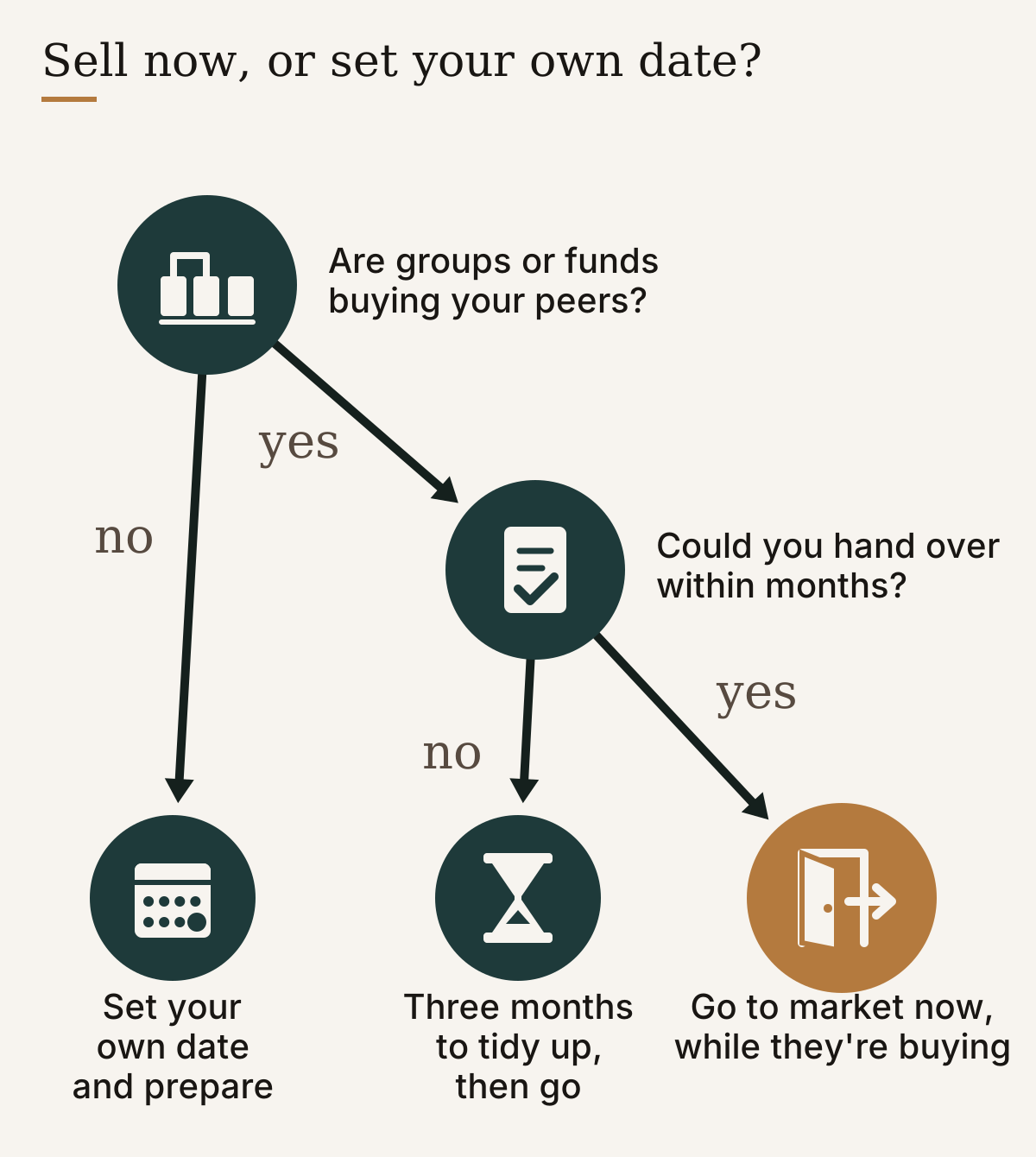
The table answers the first question. Are groups or funds buying your peers? If the answer is no, the second question can wait: set your own date and prepare.
The second question is about you. Could you hand over within months? Being ready means a buyer can read the company without you: the numbers, the team, the contracts, and how much of it all still depends on the owner. A business where every large customer still rings the founder’s mobile isn’t ready, however profitable it is.
Our installer has already answered yes to the first question. Whether he goes to market now or spends three months tidying up depends entirely on the second.
Which branch fits your situation
If the window is open and you’re ready, go to market now, while they’re buying. Run a sale with several of the buyers in your trade in the room at once. The one that called is a candidate, and it should know it has company.
Open window, company not ready yet? Take three months to tidy up, then go. Use them on the numbers, on how much the business leans on you, and on the contracts. Accept from the start that not everything will be fixed. The window won’t wait two years while you get there.
A fourth case sits outside the tree: some owners see the window open and simply don’t want to stop. That’s a legitimate answer. There are still ways of taking the price of the wave without leaving: selling a majority and staying on, or selling a stake first. At the very least, take the meetings. You’ll learn what your company is worth to them, which is worth knowing even if you never sign.
And if nobody is buying in your trade, set a date of your own and prepare for it. Check the signals in the table twice a year. Don’t wait for a wave that may never come.
Looking back over the waves I’ve watched, the owners who sold best weren’t the ones who predicted them. They were simply ready when the phone rang.
End of the article.