

Family business succession and innovation: Should you let your successor change what you built?
Yes. Write down the three to five things that stay, leave the rest to your successor without asking, and fix the date when your veto ends.
“First let her show me she can run the place the way I did. The changes can come later, once she’s earned them.” I hear a version of this from founders who are handing a family business to a daughter, a son or a long-serving manager, often in the very first conversation. It sounds careful. In practice it’s one of the quickest ways to hand over a company that grows old along with you.
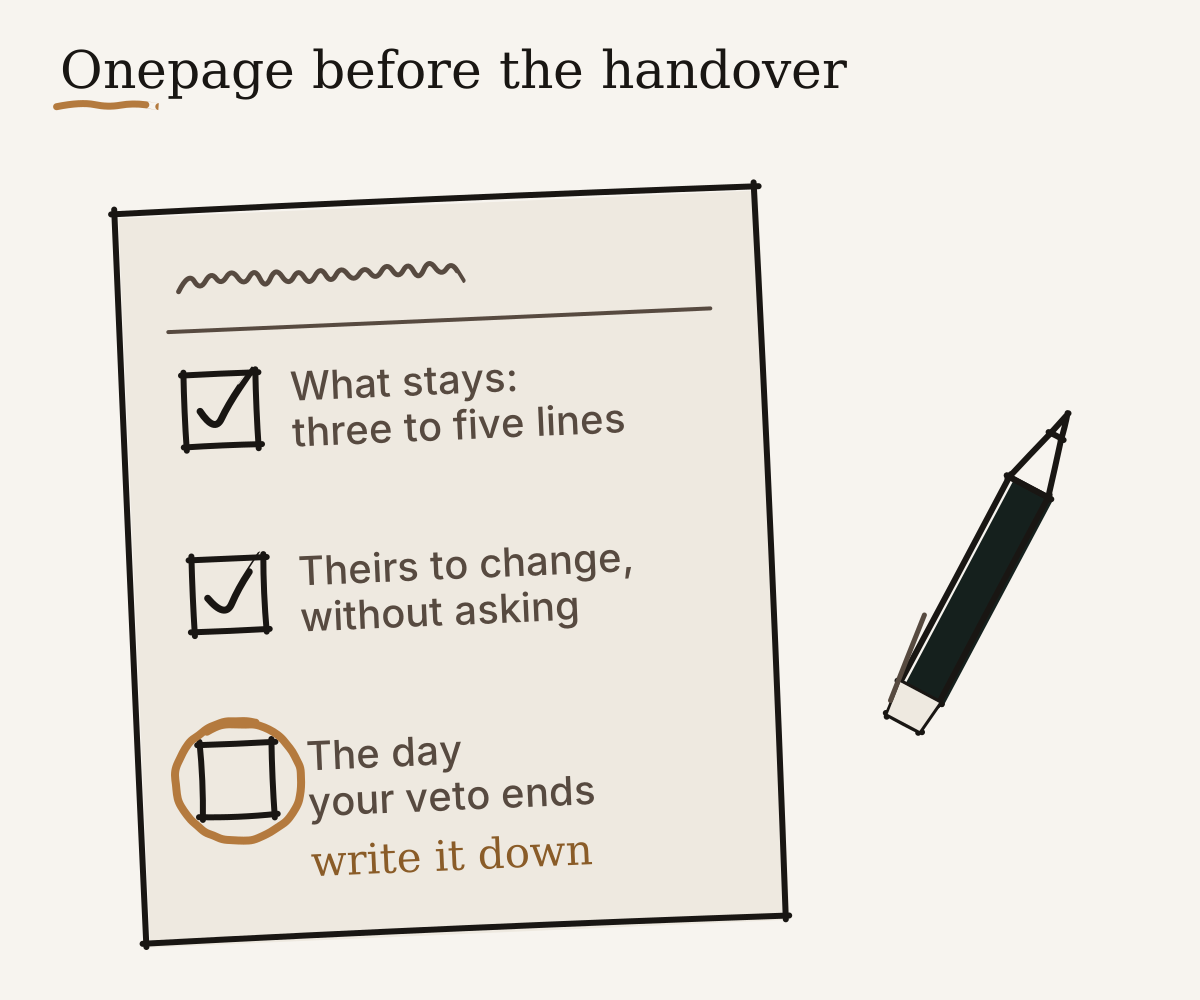
So, should you let your successor change what you built? Yes. A successor who may touch neither the product, the methods, the prices nor the customers is a caretaker with a director’s title. The decision that matters is what stays. Before the handover, write on a single page the three to five things that stay: the name, perhaps the site, a quality rule, a commitment to the team. Everything else is your successor’s to change without asking you. Those few lines are your veto. Set the day it ends, after which even they can be discussed again.
“Innovation can wait until the successor has earned it”
The first year after the handover is the year everyone watches. Team, customers and suppliers want to know what the new boss will actually do. Will the Monday meeting still start at seven? Will the old supplier keep the contract out of habit? A successor who changes nothing during those months gets read as a caretaker, and every later change becomes harder, because people have already decided who they’re dealing with.
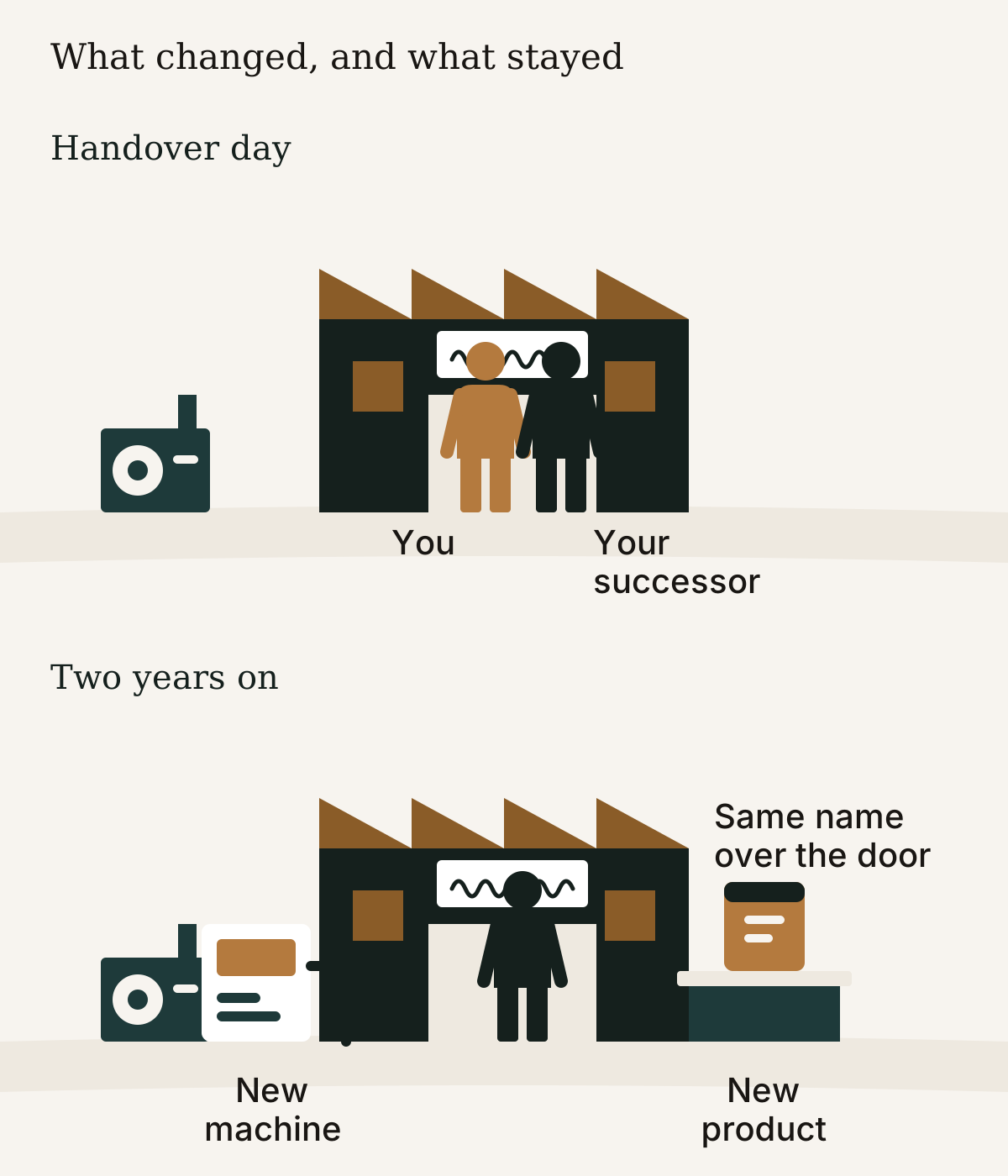
There’s a second problem with waiting. Your methods were built for the market you knew when you built them. Your customers have moved since then, and so have your competitors. Your successor sees customers you stopped seeing years ago, the ones who quietly left and the ones who never came. Asking them to prove themselves by copying you tests their memory of your company. Proof comes from decisions. The same holds before the handover: a job in the family business tests nothing unless it’s a real one.
“If I keep a veto, I protect the company from mistakes”
A veto with no end date sends every change through your office. Picture the pile of quotes waiting on your desk on a Friday afternoon because a new price needs your nod. Your successor stops proposing, or leaves. And you’re back in the role you meant to give up: the bottleneck, under a different title.
In family handovers the founder often keeps shares or a seat on the board for a few years, sometimes as part of a staged handover where the successor runs the company before owning it. That seat is where the unwritten veto survives. Whatever you decide about the veto applies to the seat as well, including its end date.
Your experience still has a use after the handover. It’s at its most valuable when your successor asks for it, on subjects they choose. Advice someone asked for carries more weight than a veto they have to put up with. If you keep a veto at all, keep it on a short list, and write down the day it ends.
“Writing down what stays ties the successor’s hands”
Leaving everything open feels generous. Yet without a written list, the list is implicit and endless. Your successor has to guess what you hold sacred, and they’ll guess wide, so every change turns into a negotiation over dinner. Three to five written lines free everything else.
What goes on the page is yours to choose. Founders put down the company name, the site, a quality rule they’ve never compromised on, a commitment to the team, sometimes a family principle. What’s left to the successor, without asking, is usually the larger part: the product, the methods, the prices, the suppliers, the organisation, and which customers to keep or let go.
Imagine a joinery of around thirty people; none of this describes a client. The daughter takes over. She wants to drop a historic product range that earns very little and move quoting online. Her father calls the range “our history”. Without a page, the argument comes back with every quote that includes it. With one, the question was settled before the handover: the range is either on the page, or it’s hers to stop.
Two sheets of paper, one table
This week, write your page. Three headings are enough: what stays, what is your successor’s to change, and the date your veto ends. Ask your successor to write their own sheet, with what they’d change in their first year. Then put both sheets on the same table.
Someone other than the two of you should run that meeting and hold you to the day your veto ends: a board member, a family council if you have one, or an independent party that leads the whole succession. You still decide what goes on your page. You just stop chairing the discussion about it.
Of the family handovers I see, the ones that last share one thing. Within the first year, the successor did something the founder would never have done, and the two had agreed beforehand that this was allowed.
End of the article.


