How to find a buyer for an export business? What changes when the buyer comes from another country

The likeliest buyer of an export business sits in its export markets. With a foreign owner, decisions move: write down site, team, brand and who decides.
Time and again, I watch owners of exporting companies draw up their list of possible buyers, and almost every name on it is within a couple of hours’ drive. The competitor across the region, a contact from the bank, the production manager. Then the serious offer arrives from a firm they’ve been invoicing for years, in another country.
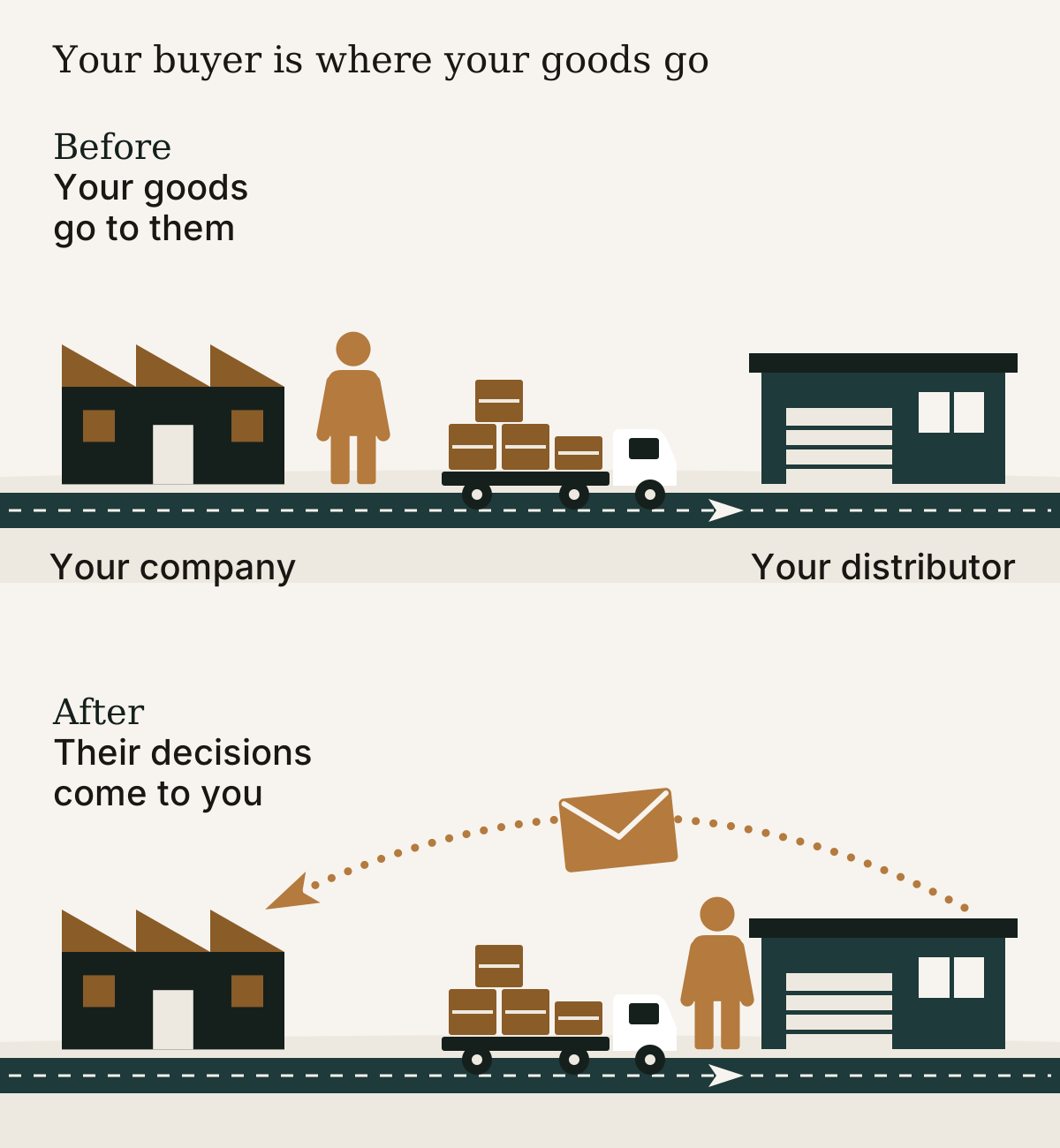
So how do you find a buyer for an export business? Look where your goods go. The likeliest buyers sit in your export markets: the distributor who has sold your products there for years, a large customer abroad that depends on what you make, a foreign competitor you keep running into at the same trade fairs. Each already knows your product and has a reason to want it: a production site, know-how it can’t build itself, or access to customers and a market. With a buyer from another country, though, the decisions about your company will be taken somewhere else once the sale is done. So before you sign, write down what happens to the site, the team and the brand, and who decides after the sale.
The distributor is the name I see left off most often, and the one I’d put near the top. He knows your prices, your delivery times and every complaint of the last ten years. He probably knows which of his customers would follow you elsewhere. And his reason to buy doesn’t depend on you: if someone else buys your company, his supply is at risk; if he buys it, he stops reselling and starts making. The customer abroad has a reason of the same family, the fear of losing a supplier it can’t replace in a hurry. The foreign competitor usually wants something different: a production base closer to its own customers, a technique its engineers haven’t mastered, or a foothold in a market it has been trying to enter for years.
I ask the export sales manager for that list; the accountant won’t have it. Who asked about your plans over coffee at the last trade fair? Who sent two engineers to walk round the workshop, for no obvious reason? Once you have the names, you rank them the way you would a buyer from among the people who already know your business: real interest first, then the risk that they talk. A distributor who hears you’re selling may mention it to your other distributors, and then to their customers, so the order in which people find out matters there as much as at home.
What I’ve learned to ask early is what exactly each of them would be buying, because the answer tells you what they’ll keep. A distributor buying production tends to keep the workshop and merge your export sales into his own sales team, since selling is what he already does. A competitor buying a technique or a market may keep the engineers and the brand, and move production to its own plant within a few years. A customer buying security of supply keeps the machines running, and may stop you selling to its rivals.
Imagine, as an invented case, a maker of packaging machines with about forty people, bought by its long-standing distributor abroad. The workshop stays. Two years on, the order book looks much the same. But prices, hiring and the choice of which machine to develop next are all settled at the distributor’s head office, a flight away. Nobody has broken a promise. That’s simply what owning a company means.
What I ask owners to write down before signing
A buyer from another country isn’t a worse buyer. But after the sale, budgets are approved at his head office, and the person your team rings with a problem may be in another time zone. Whatever you want to survive that move has to be in the contract, because afterwards you’re no longer in the room.
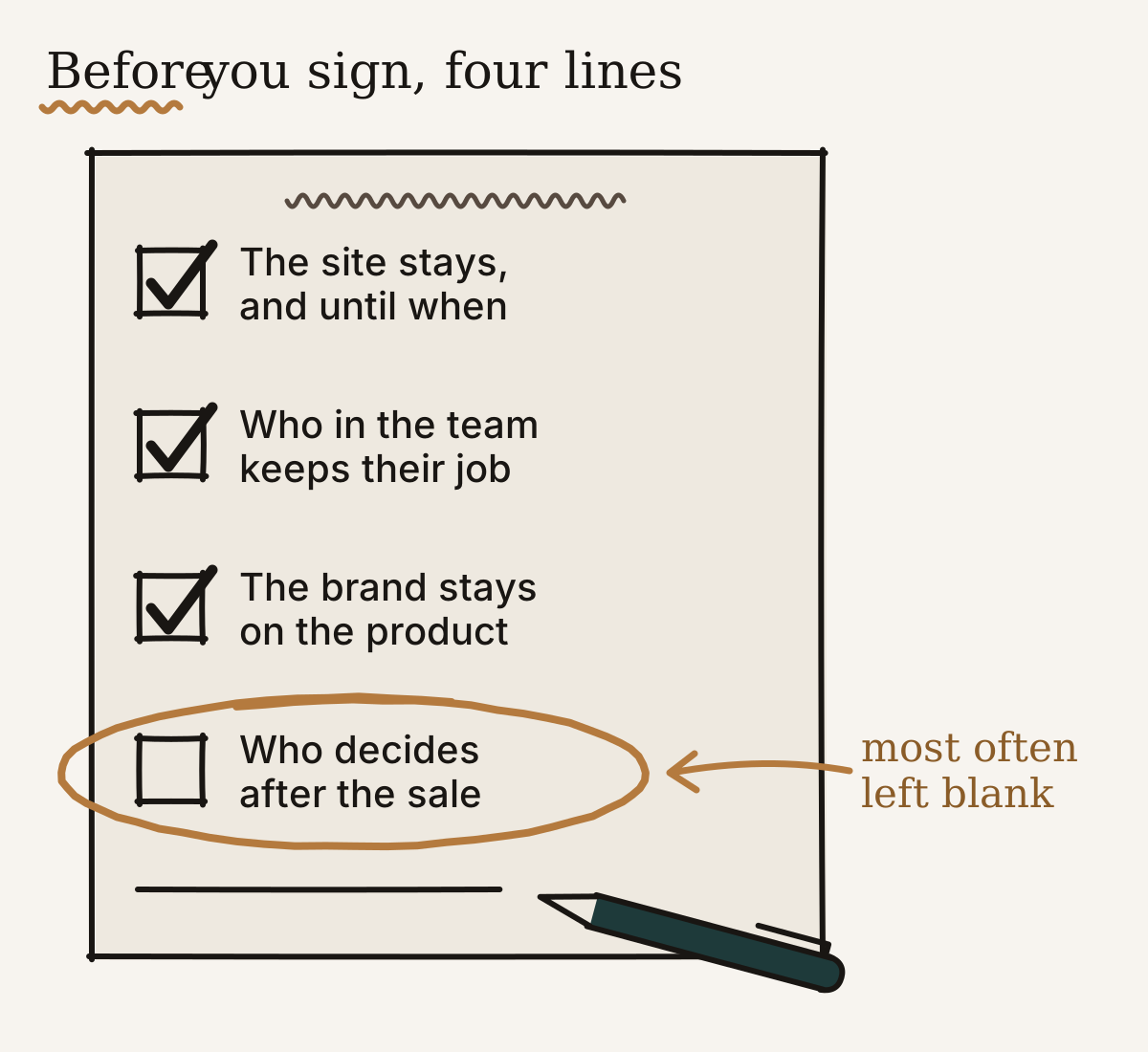
In practice it comes down to four lines. The site: does the workshop stay where it is, and until when? A promise without a date is worth very little. The team: who keeps their job, on what terms, and how long your managers stay in charge locally. The brand: does your name stay on the product, in your home market and in the others. And who decides: which decisions stay with local management (hiring, prices, investments up to an agreed amount), and who sits on the board.
That last line is the one I most often find missing. Owners negotiate the site and the jobs, because they think of their people first. They rarely ask who, from next year, will say yes or no.
Each line also needs what happens if it isn’t kept. A commitment with nothing written beside it is a wish. So the contract says what follows, for instance a sum the buyer pays if the site closes before the agreed date. Ask your lawyer what it would take to enforce such a clause against a company based in another country. And settle all four before the first offer arrives. Added halfway through the negotiation, every line looks like a new demand.
The owners I’ve seen sell well to a foreign buyer had one conversation early that others skip. They asked the buyer to describe, in plain terms, an ordinary week at the workshop two years after the sale: who signs the purchase orders, who calls the big customer when a delivery is late. The answer told them more than the price did.
End of the article.