

Business valuation calculator based on revenue: What is my shop worth once the lease and customers count?
A revenue calculator gives the middle of the range. For a shop, the lease and why customers come decide whether you sell near the top or the bottom.
A small shop run by its owner usually sells for one and a half to three times its owner’s earnings: the profit, plus the salary and perks you pay yourself out of the shop. For many shops that’s between a fifth and half of one year’s revenue, less in thin-margin trades. The stock is paid on top, at cost.
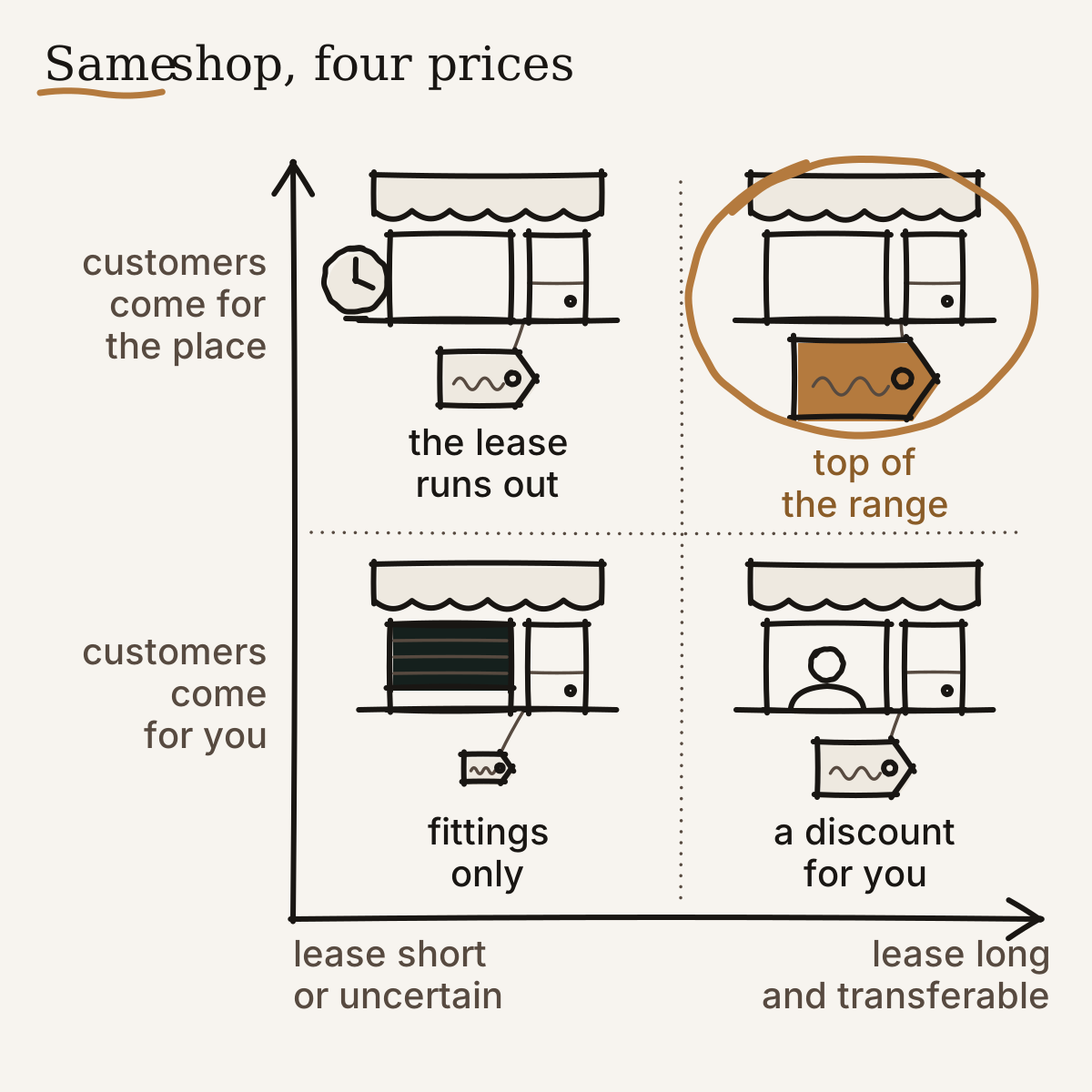
So if you’ve typed your turnover into a business valuation calculator based on revenue, the number it shows you is the middle of that range, and nothing more. What moves your shop to the top or the bottom is the lease (how long it has left, whether it can pass to a buyer, what it costs) and the reason your customers come through the door: the place, or you. In the shops I see valued, those two weigh far more than the fittings.
What the calculator can’t see
An online calculator multiplies your revenue by an average for your trade. It knows nothing about your lease, your street or the hours you spend behind the counter. That’s why the band is so wide, and why a quick calculator and a full valuation report answer different questions.
A buyer pays for years of earnings still to come. The lease says how many of those years are secured inside these walls. A long lease, at a market rent, that a buyer can take over (a transferable lease) puts the price near the top of the range. A lease that ends in two years, or can’t pass to anyone, puts it near the bottom, sometimes below, at whatever the fittings would fetch.
In my files, a short or uncertain lease costs the seller more than all the equipment in the shop.
The customers are the other half. The price above the fittings pays for people who’ll keep coming back. Some come for the place: the passing trade, the parking, the neighbours, the habit of turning left at the bakery. Others come for you, your advice, your name, the fact that you open early on Saturdays. What belongs to the place passes to the buyer with the lease. What belongs to you passes only in part, and the buyer discounts the customers who come for you.
A florist’s shop, priced line by line
Imagine a neighbourhood florist with two employees. It’s a made-up case, not a client. The shop turns over €400,000 a year and leaves its owner €80,000, profit plus her own pay. I’ve used euros; the arithmetic is the same in any currency.
| What the buyer pays for | The florist, roughly | What pushes it up or down |
|---|---|---|
| Base on earnings | 1.5 to 3 × €80,000: €120,000 to €240,000 | Everything below decides where in the band |
| Cross-check on revenue | A fifth to half of €400,000: €80,000 to €200,000 | A check only, the earnings line counts; thin margins pull it down, good ones lift it |
| Lease | 18 months left, the landlord has promised nothing | Up: long, transferable, market rent. Down: short, uncertain, rent about to rise |
| Location and customers | Do they come for the corner or for her? | Up: passing trade, parking, habit. Down: they come for her advice and her name |
| Fittings and equipment | Included in the price | Counted at second-hand value, not at what they cost new |
| Stock | A few thousand, on top | At cost, counted on handover day, less for what won’t sell |
Look at the lease line. The buyer’s bank reads the lease before it lends, and the banks I deal with want the secured years to cover the loan, often five to seven years for a small shop (how the buyer’s loan works). With eighteen months secured, the offer lands near the bottom of the band, or at the price of the cold room and the counters, or it comes with a condition: a new lease first.
Give the same shop a nine-year transferable lease, signed before it goes on the market, and the offer moves towards the top.
What selling costs you, on top of the price
In the sales I see, the costs run roughly like this:
- An intermediary, if you use one: a few per cent of the price, often between five and ten on a small shop, usually with a minimum of a few thousand.
- A lawyer or notary: a few thousand.
- Your time: six to twelve months from deciding to handing over the keys, then a few weeks in the shop afterwards, paid or not.
- Tax on the gain, which depends on your country and on the legal form of the business. Ask your accountant before you set a price.
The lease itself can cost you at the sale. The landlord may tie his consent to a higher rent, a guarantee or a new lease. A higher rent cuts the buyer’s earnings, so it comes off your price several times over: the price is a multiple of those earnings.
Your lease, before anyone else reads it
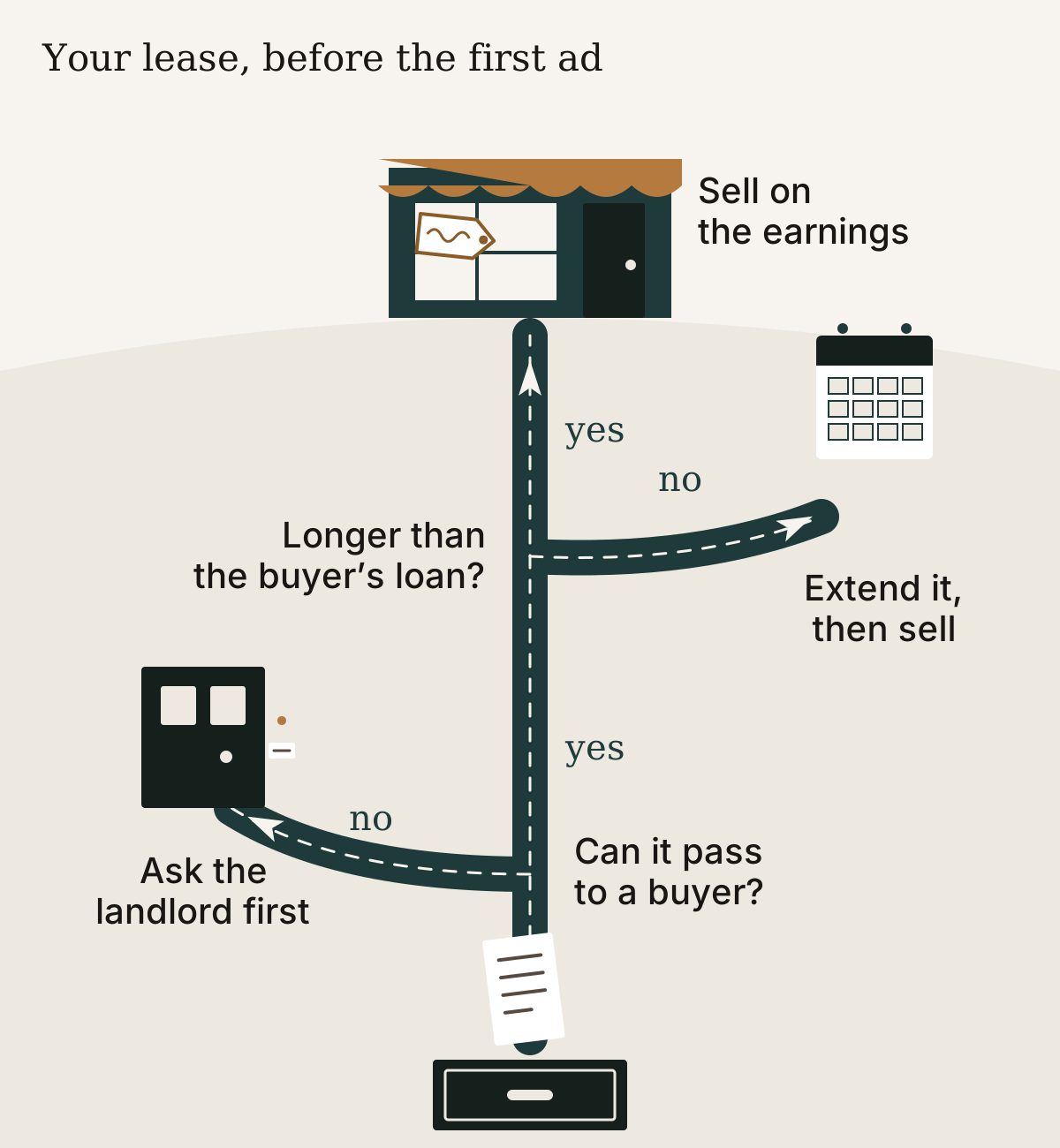
Whether your lease can pass to a buyer, on what terms, and what the landlord can ask for, depends on the contract and on the law where you are. Put that question to your landlord and your lawyer before you look for a buyer. In Germany, for example, a tenant may not hand the use of the premises to someone else without the landlord’s permission. Without it, the buyer can’t move in.
This week, take the lease out of the drawer and check how long it has left, what it says about transferring or subletting, and when the rent is next reviewed. Then ask the landlord, before any buyer, whether he’d accept a transfer, and on what terms. If the time left is shorter than the loan a buyer will need, extend or renew it before the first ad. If it’s long enough and it can pass, sell on the earnings.
Even a yes from the landlord doesn’t always leave you free on handover day. In Switzerland, for example, a commercial tenant can transfer the lease with the landlord’s written consent, refused only for good reason. The buyer then takes over the lease on the same terms. The seller stays answerable alongside him for what the lease owes, for two years at most.
A secured lease protects the price. If you end up not selling, it protects the shop too. Starting early doesn’t mean selling early.
The shop owners I see reach the top of the range have nearly always settled the lease a year or two before they wrote the first ad. The ones who discover the problem in the buyer’s letter of intent (his first written offer) negotiate from a weak position, against the landlord and the buyer at once.
Sources
End of the article.


