

Business valuation calculator or full report? Which level of valuation to order, and when
A business valuation calculator gives a rough range. When to order an estimate on adjusted accounts or a full report instead, and what each one costs.
Before you pay anyone to value your company, decide how far the work needs to go: a free online business valuation calculator, an estimate built on adjusted accounts (your figures corrected to what a buyer would see), or a full report signed by an independent valuer. The method is the valuer’s job.
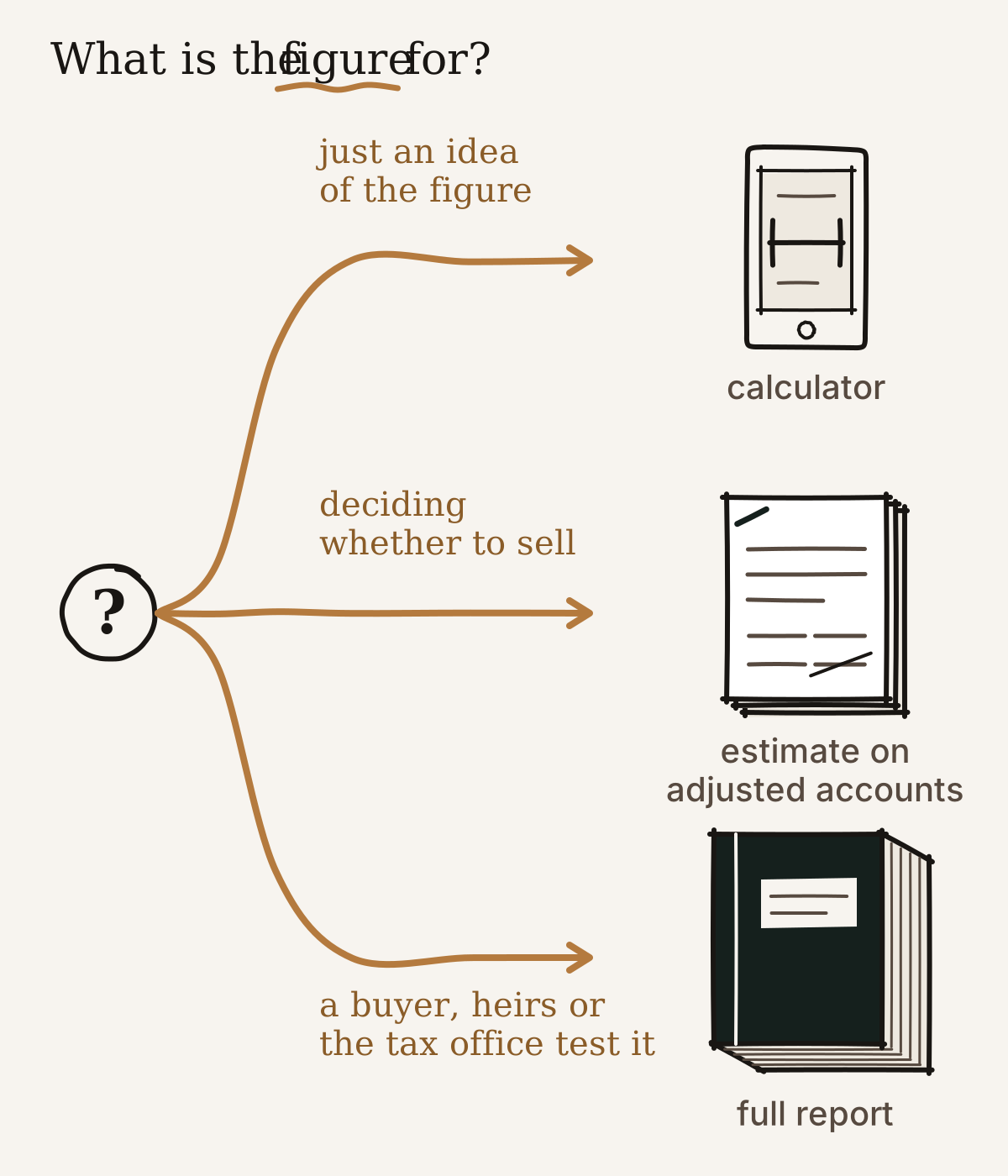
Which level depends on what the figure has to do. If you only want an idea of what the company might be worth, a calculator is enough: ten minutes, free or close to it, and a wide range. If you’re deciding whether to sell, and which price you’d accept, order an estimate on adjusted accounts. In the files that land on my desk, that takes a few weeks and costs somewhere in the four figures. If the figure has to hold up against someone with a reason to dispute it, such as a buyer, co-heirs, a departing partner or the tax office, you need the full report: one to three months, from around ten thousand for a small, simple company to well into five figures for a large or complex one. Treat those amounts as a scale: every valuer prices differently.
The method isn’t your decision
Valuers work with three families of method. Net assets: what the company owns, minus what it owes. Multiples: a price expressed as so many times the yearly profit, taken from comparable sales. Future earnings: the profit the coming years should bring, converted into today’s money. A serious valuer runs two or three and compares. The future-earnings formula rests on two assumptions that make most of the number.
When two methods disagree, the gap is worth reading. Imagine a printing firm with a hall full of presses that are worth more on the balance sheet than its profits can justify. Its net assets come out above its future-earnings value, and that tells you something useful: a buyer won’t pay book value for machines that don’t earn it.
Three levels, side by side
| Calculator | Estimate on adjusted accounts | Full report | |
|---|---|---|---|
| What the figure is for | A rough idea | Deciding whether to sell, and at what price | A figure others must accept |
| Who has to accept it | Only you | You and your advisers | A buyer, heirs, a partner, the tax office |
| Built on | Raw figures you type in | Cleaned-up accounts | Cleaned-up accounts, forecasts, written assumptions |
| What it won’t tell you | How much the firm depends on you | Whether anyone else accepts it | The price a buyer will pay |
| Time | About ten minutes | A few weeks | One to three months |
| Cost, order of magnitude | Free or close to it | Four figures | From around ten thousand |
A calculator takes the revenue or profit you type in and multiplies it by a sector average. Picture the owner of a twelve-person kitchen-fitting business who pays herself far less than a hired manager would cost. The calculator counts the difference as profit. A buyer won’t, because he’ll have to pay someone to do her job. Nor does it know that half the orders come in on her mobile.
The estimate starts by cleaning the accounts. The owner’s salary is brought to what the market would pay. Rent the company pays you for a building you own goes to market rate too. One-offs come out: the year a van was sold, the dispute that cost a fortune once. Assets the business doesn’t need to run, a holiday flat or a vintage car on the books, are set aside and valued on their own. They’re the lines a buyer adds and subtracts, and now you see them first. What comes back is a range with its reasoning, enough to decide and to know which offer you’d turn down. A buyer will still redo the calculation his own way, and nothing binds him to yours.
The full report is written by an independent valuer following a professional standard. It states the valuation date, the assumptions, the methods and why each one weighs what it weighs. That’s what lets it stand up to someone who wants a different number. Imagine three siblings: one takes over the family firm, the other two must be paid out of the estate; a scenario, no family I know. A figure from their father’s long-time accountant won’t survive the first family dinner. A report from a valuer none of them chose alone has a chance. It also ages with the accounts: a report from three years ago won’t hold in front of today’s buyer.
A value, a price and a tax figure are three different numbers
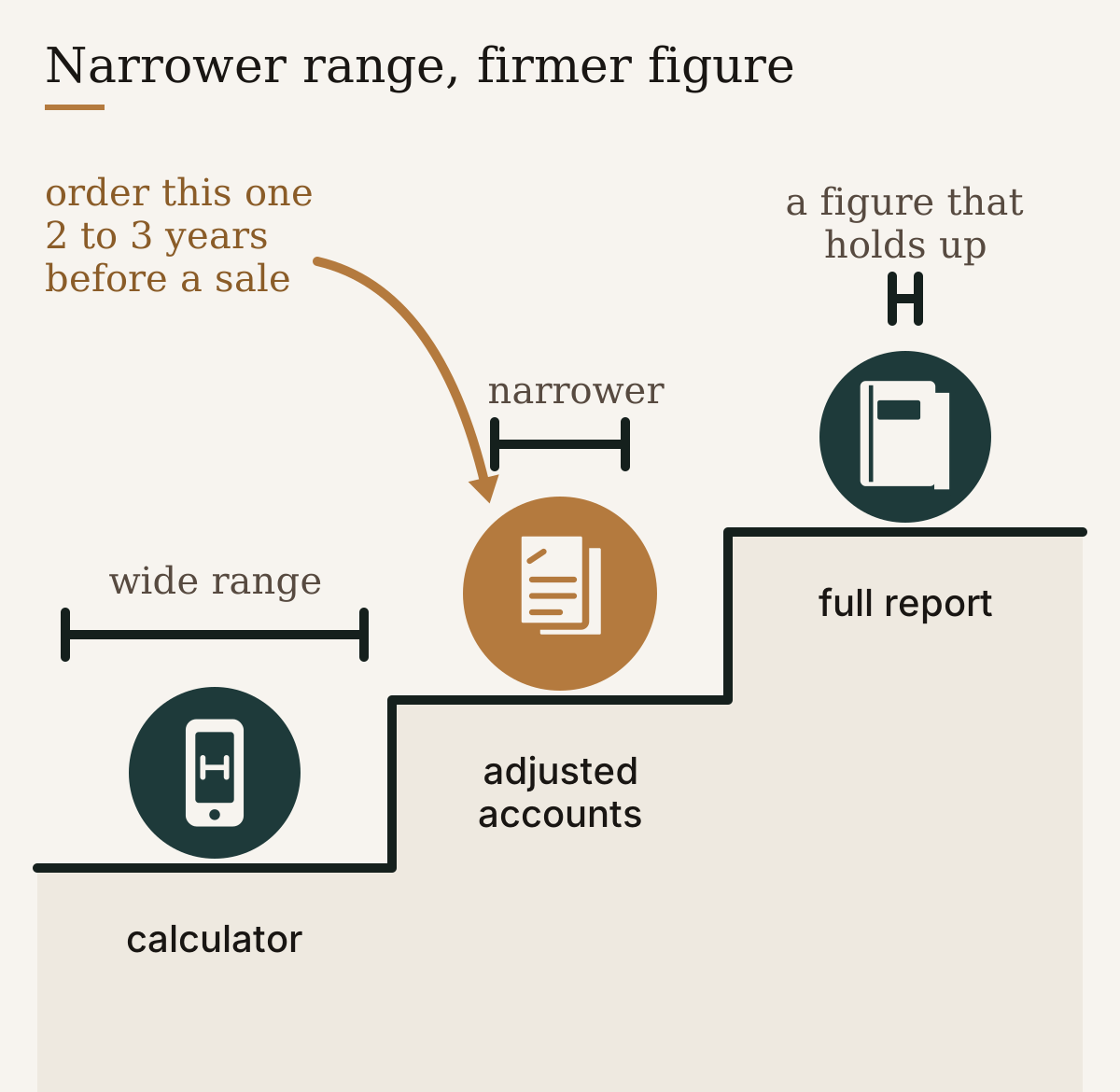
Each level narrows the range, and none of them closes the deal. Even the full report gives you a value, not a price. The price comes out of the negotiation and out of how it’s paid: part at closing, part later through a loan from you to the buyer, part tied to the next few years’ results. Two buyers can agree with your valuer and still put very different deals on the table. Whether to name a price yourself or let the buyer offer is a separate decision.
A tax value is a third kind of figure. Where a gift, an inheritance or wealth itself is taxed, the tax office needs a number too, and it sets one by its own rules. In Germany, for example, the tax law allows a simplified method for inheritance and gift tax. It takes the average profit of the last three years, after corrections such as a market-rate salary for the owner where none was booked. That average is multiplied by a fixed factor of 13.75, and the result never goes below the net asset value. A buyer would rarely land on the same figure.
No formula beats a real price. A sale between people with no reason to favour each other says more than any calculation. In Switzerland, for example, the tax office estimates unlisted shares every year for wealth tax, weighing what the company earns and what it owns. Once a genuine sale between independent parties has taken place, the price paid counts as the value, as long as the company’s situation hasn’t changed much.
Which level suits whom
If you’re five years or more from any handover and simply curious, use a calculator, then hold the figure loosely. It’s a weather forecast for a month you haven’t reached.
If you’re two to three years from the date you have in mind, order the estimate on adjusted accounts this quarter. It shows what a buyer would knock off and leaves you the time to fix it, starting with the drivers you can still move. That work raises the value even if you never sell, and starting early is what keeps you from ever having to sell under pressure.
If a buyer has put an offer in writing, if your children need a figure to divide the estate, if a partner is leaving or the tax office has asked, commission the full report, for that use, dated close to the day it will be read.
The most expensive valuation I come across is the free one: a calculator figure an owner has carried in his head for six years, against which every real offer looks like an insult.
Sources
- Swiss Federal Tax Administration, Vermögenssteuer natürlicher Personen (wealth tax of individuals), sections 4.3.2 and 6Switzerlandadmin.ch (opens in a new tab)
- German Valuation Act (Bewertungsgesetz, BewG), § 11 and §§ 199 to 203Germanygesetze-im-internet.de (opens in a new tab)
- German Inheritance and Gift Tax Act (Erbschaftsteuer- und Schenkungsteuergesetz, ErbStG), § 1 and § 12Germanygesetze-im-internet.de (opens in a new tab)
End of the article.


