

Passing your business to your spouse: When it makes sense, and what it doesn’t settle
Handing your business to your spouse settles who runs it for a few years, not your succession: they’re about your age. When it works, what to start now.
Handing the business to your spouse settles nothing about your succession. It settles who runs the place for the next few years.
It can still be the right call. It makes sense when your spouse already runs part of the business (the office, the schedule, the bank, a handful of customers), when the team already follows them, and when you have to step back, for your health or out of sheer fatigue, sooner than a real successor could be ready. The direction of the company is then settled for a while. The succession isn’t, because your spouse is roughly your age. So do two things in the same year: the relay, and the start of the real succession.
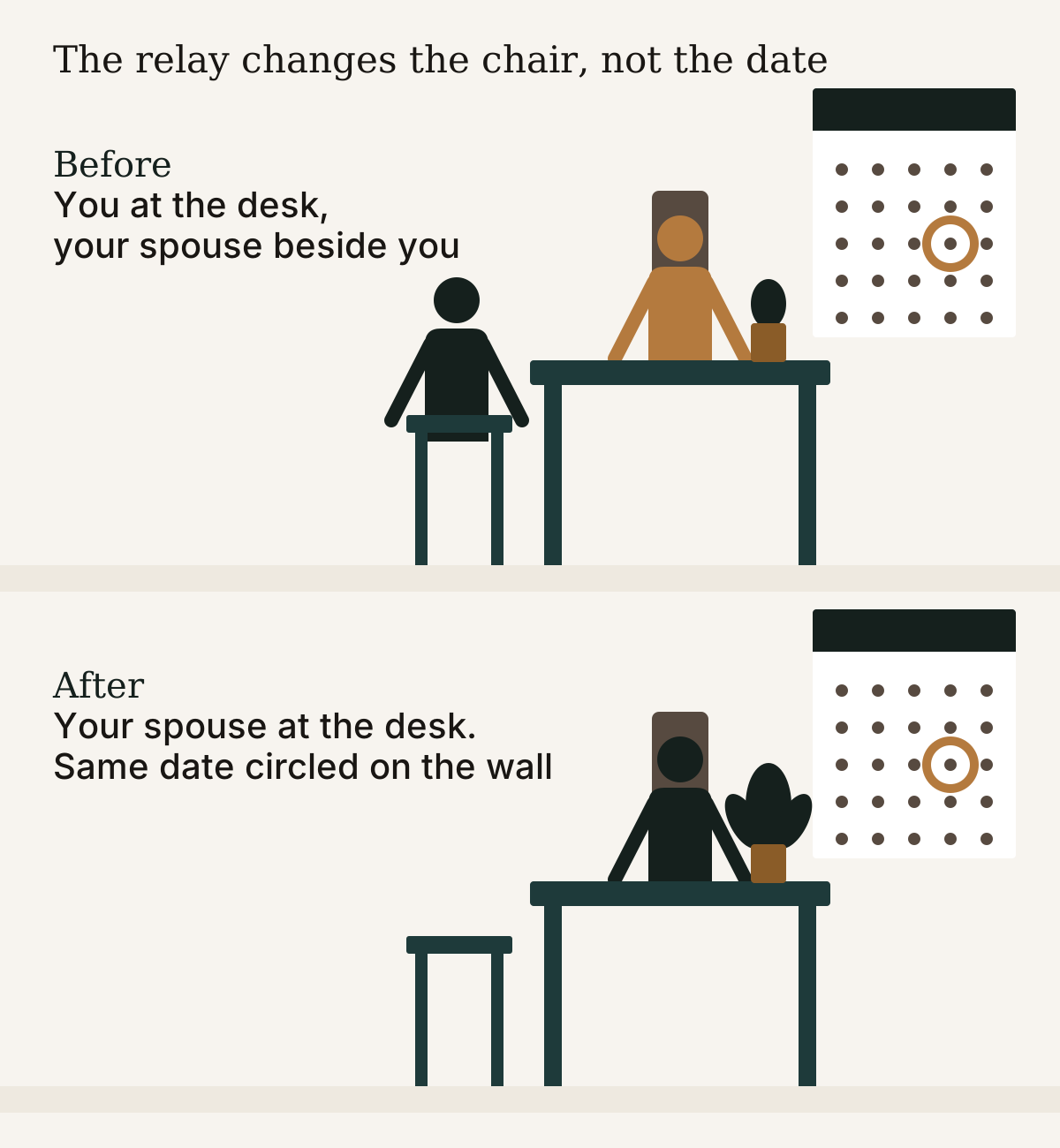
In the couples I meet, the two partners are usually within a few years of each other. Your spouse takes the helm at about the age you’re leaving it. The company still depends on one person; that person has simply moved one chair over. A buyer who looks at the business in five years will see the same dependency you had, with a different name on the door. And the question you thought you’d closed, who comes after, comes back, usually to one of you alone.
I hear three objections.
“My spouse knows the business better than anyone.” Often true. They’ve sent out the invoices for years and they know which customer calls on a Friday afternoon. That’s exactly why the relay works. It’s an argument about who can run the company tomorrow morning, and it says nothing about who runs it once your spouse wants to stop too.
“It costs nothing and keeps it in the family.” What stays in the family, first of all, is the dependency. What the move changes about who owns the shares depends on where you live and on your marital property regime, so ask your notary what that regime does to company shares. While you’re there, ask a second question: if your spouse, the one now running the company, died first, who would own those shares?
“We’ll see when the time comes.” You’ll both be reading the same calendar. A successor your own age retires with you, and the time comes for both of you within the same few years.
A relay to the spouse is also what tends to happen with no plan at all, if you die or fall ill first. Who inherits and who may run the company in that case depends on the country, which is one more question for your notary. The planned version is better than the one that’s forced on you. In the successions I see, the second one, the one after the spouse, is most often the one done in a hurry: after an illness, a death, or simply exhaustion, by one person, under pressure.
Imagine a heating and plumbing firm with fourteen people, invented for the purpose. He’s 61, she’s 58, and she has always kept the office, the schedule and the invoicing. His back gives out, so she takes over. Three years later she’s 61 and he’s 64. The site foreman who could have grown into the role has left for a competitor, because nobody ever told him there was a path. Their son is 29 and lives elsewhere. She sells to the first buyer who calls.
What to do in the same year
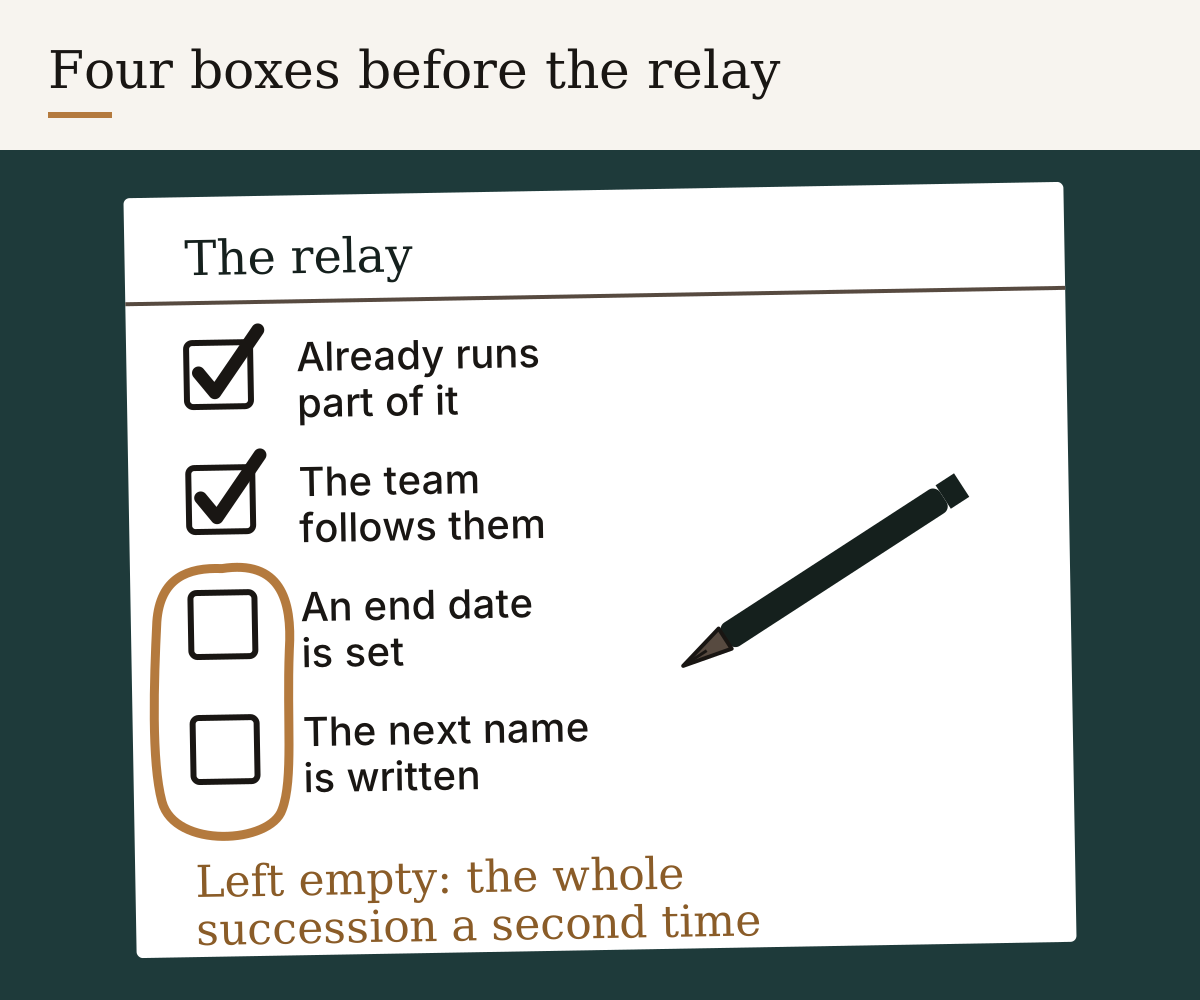
Look at the relay as a sheet with four boxes. Two of them are usually ticked before anyone asks: your spouse already runs part of it, and the team follows them. The other two are the ones couples leave blank: an end date is set, and the next name is written. Left empty, they mean doing the whole succession a second time.
Put the end date in writing. In the relays I’ve seen hold, it sits somewhere between three and five years. Beyond that, it’s no longer a relay; it’s a second career as owner, with its own succession to organise.
Then write the next name, or the route if there is no name yet, and begin now: a child, an employee you help grow into the role, or a sale. In the heating firm, that would have meant a conversation with the foreman in the first month, while he was still there to have it.
Finally, agree on what your spouse’s job during those years really is. Replacing you is the smaller part of it. The larger part is getting the company to run without either of you: written procedures, a second level that takes decisions, customers who know the team by name. That work is what keeps the next handover from starting at zero.
So hand the business to your spouse if they’re the right person. Just don’t call it your succession. Call it the few years you gave yourselves to prepare it.
End of the article.


