What does a business transfer agreement contain? The clauses you negotiate yourself
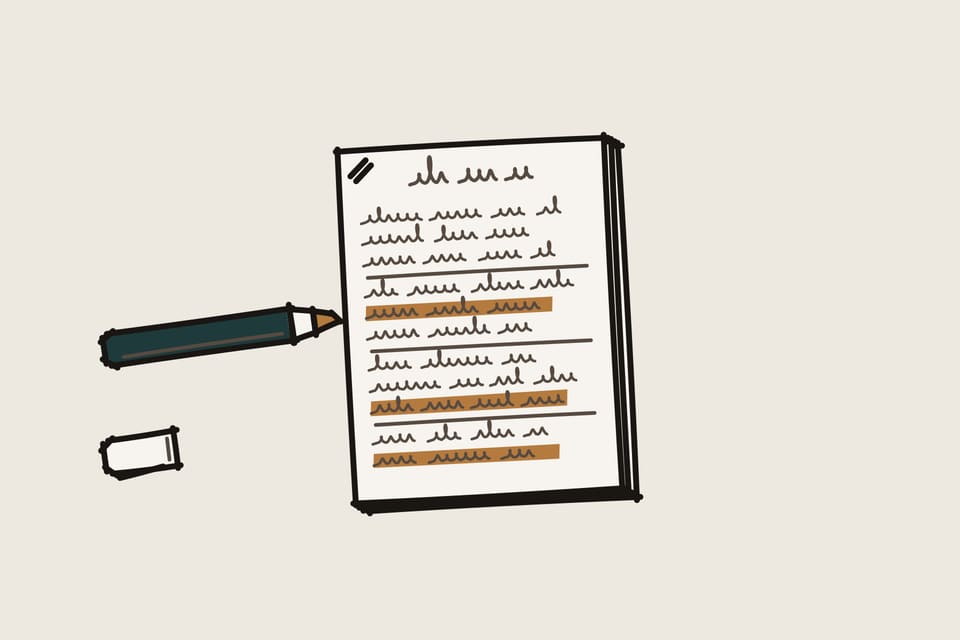
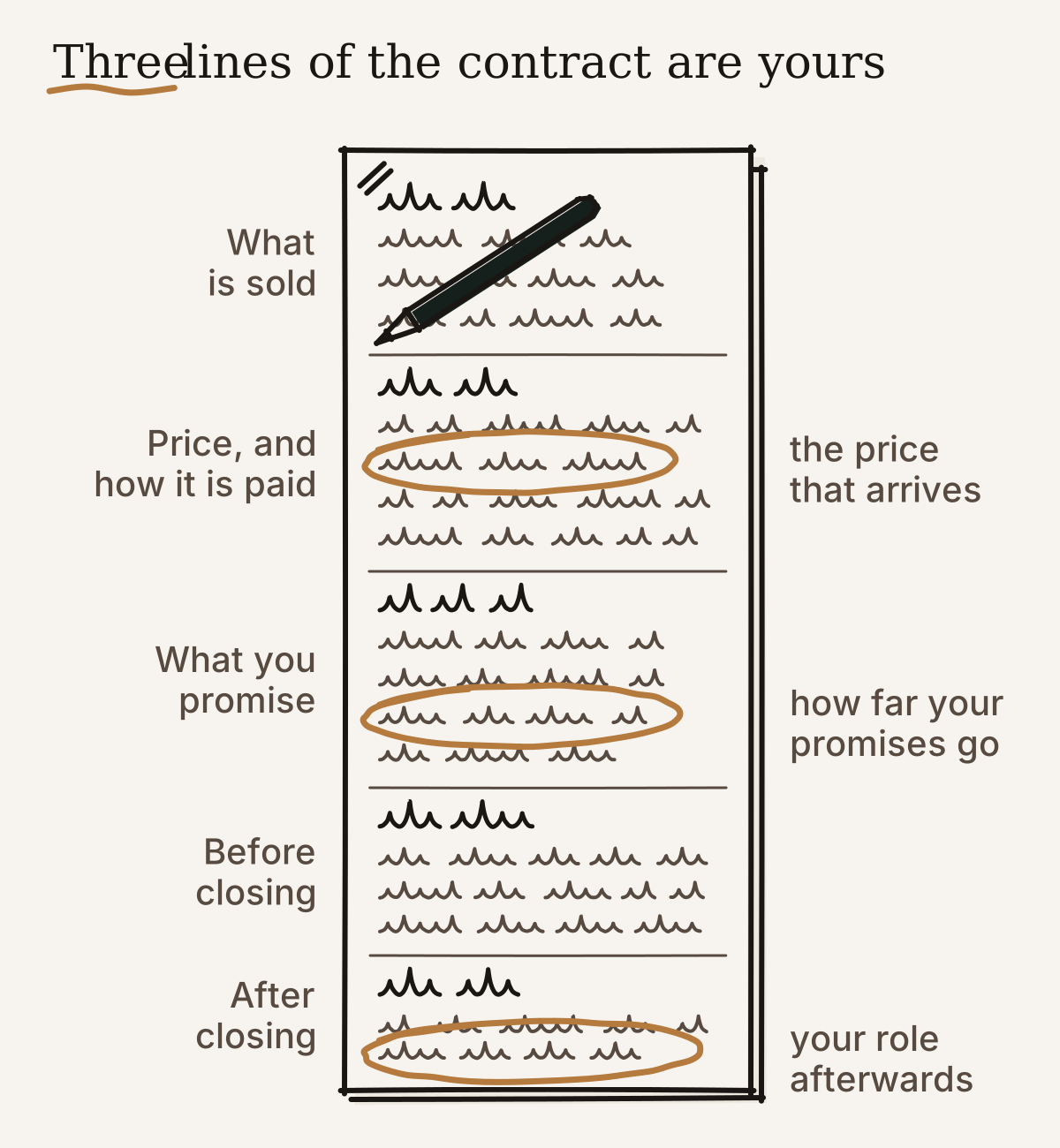
Four blocks, written over months: what is sold, the price, your promises, the conditions. Three lines only you decide: real price, promises, your role.
Nobody writes a business transfer agreement in one sitting. Its first numbers go into the letter of intent. The full text takes shape over the next three to six months, in the mandates I run, and a few of its clauses still bind you years after someone else has the keys. Each block gets settled at its own moment, and a block you let slip rarely gets a second reading.
So what’s in it? Four blocks. What’s being sold: the company’s shares, or the business itself, asset by asset. The price and how it’s paid: fixed or adjusted, all at the transfer or partly later. What you promise about the state of the company, and what happens if a promise proves wrong. And what has to be in place before the transfer. After those come the clauses that bind you once it’s sold: your transition role and your non-compete. The lawyers draft all of it. Three things, though, only you can decide: the price that actually reaches your account, how far your promises go, and what you do after the sale.
Months before any draft: the letter of intent frames the price
The contract starts before anyone calls it one. The letter of intent, a short document signed once you’ve picked a buyer, fixes the frame of the price, the timetable and a period of exclusivity during which you talk to no one else. Its numbers become the reference for every draft that follows, which is why the letter of intent deserves as much care as the contract.
Take a made-up case, not a client: a distributor of catering equipment, 25 people, an owner of 63. He signs a letter stating a price of around 6 million, subject to due diligence, the buyer’s audit of the company. He reads the 6. The buyer’s lawyers read the rest: the word around, the words subject to, and a line on how the price is paid that says to be agreed. That line is where your first decision begins.
During the buyer’s audit: the first draft lands
In my mandates, due diligence usually runs four to eight weeks, and the first full draft arrives during it or just after, most often written by the buyer’s lawyers. Whoever writes the first draft picks the structure, the definitions and the starting position of every clause. Your side then spends weeks moving their words.
The price block is where the headline figure comes apart. It’s rarely paid in one go. One part arrives at closing, the day shares and money change hands. Another may be held back, or placed in escrow, money parked with a third party, to cover your promises. A third may be an earn-out, price tied to future results, usually running one to three years; how earn-outs actually pay out deserves its own reading. Sometimes you also lend part of the price to the buyer, a seller loan repaid over time.
The price can move after closing too. It’s adjusted to what is actually found on the closing date: the cash, the debt and the working capital, the money tied up in daily operations.
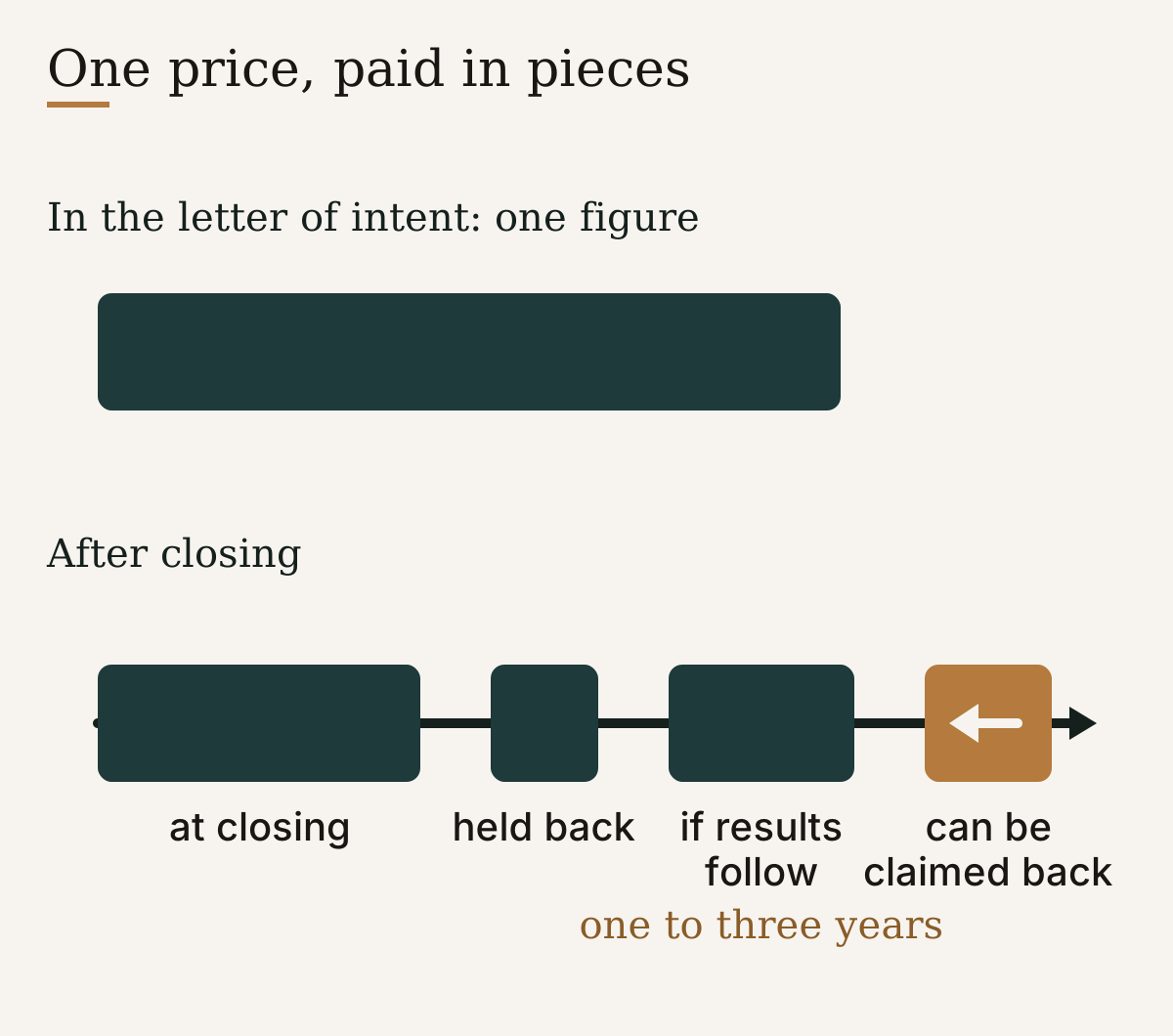
How big each piece is varies from one contract to another. The question to put to every draft is plain. Of the headline figure, how much is in my account on closing day, and what has to go right for the rest to follow? Only you know what you need from the sale. That makes the answer your call, not the lawyers’.
Someone has to track which draft says what, and it needn’t be you: you keep every decision, the running of the drafts can sit with someone whose only job is to run them.
Signing: your promises, your exceptions, the conditions
Even without a detailed contract, the law already has an opinion. In Switzerland and Germany, for example, the law defines a sale by two duties, delivering and paying, and by default makes the seller answer for defects, even unknown ones, for two years. Elsewhere, ask your lawyer what the law says when the contract is silent. None of that was written for a company with 25 people, hundreds of supplier contracts and years of tax returns. So the contract replaces the law’s version with warranties, written promises about the company, and limits on them.
Those limits come down to three numbers. A cap, the most you can ever owe. A threshold, below which the buyer can’t claim. And a duration, which the contract sets itself, often longer for tax matters in my experience. What you’re really signing when you give warranties is decided in those three numbers. Put the same plain question to them: what is the most I can still lose, and until when? That is your second decision.
Under those same laws, a defect the buyer knew about when signing can’t be claimed afterwards. Hence the disclosure letter, your written list of exceptions: the old dispute with a former distributor, the warehouse roof that leaks when the rain comes from the west. Disclosure turns a future claim into a known fact. One limit holds whatever the cap says: under those same texts, no cap protects a seller who hid a defect knowingly.
Signing and closing often fall weeks apart. In between sit the conditions precedent, what must happen before closing: the buyer’s financing, the consent of a landlord or a client whose contract requires it when the owner changes, sometimes an administrative authorisation. The signature itself may need a set form. In Germany, for example, selling shares in a GmbH, the common limited company, takes a deed signed before a notary. Ask your lawyer or notary which form applies where your company sits.
Closing day: shares one way, money the other
Between signing and closing, usually a few weeks to three months, you still run the company, but not freely. The contract asks you to carry on as usual: no unusual investment, no unusual contract without the buyer’s agreement. Imagine your largest customer calling in that window, wanting a three-year deal at a discount. A month earlier, you’d have signed it that afternoon. Now you call the buyer first.
Closing itself is short. The shares, or the assets, go one way; the money goes the other, on the same day. Most of the day goes on checking the conditions and confirming the payment has landed. It’s also the first time you can measure your first decision: the amount on the bank statement that evening, next to the figure in the letter of intent.
After closing: the clauses that keep running
The contract doesn’t end with the closing. Within two or three months, the price adjustment is calculated from the closing accounts, and the working-capital figure can move your price either way. The earn-out runs its one to three years. The warranty period runs on. Your non-compete, the promise not to compete with the company you sold, typically lasts two to five years in the mandates I see. Your transition role usually lasts three to twelve months.
That role is the third decision. You stay as what: employee, consultant, board member? Paid how, for how long, reporting to whom? On the first Monday after closing, the answer decides whether you walk in as the person who built the place or as a guest with a badge. Settle it before signing. Once the money has moved, the buyer has what he came for, and most of your leverage has gone with it.
One caution, the one I give most often. The clauses that run longest are usually written fastest, in the last week before signing, when everyone wants to be done. The non-compete and your transition role fit on a single page. Read that page as slowly as you read the price.
Sources
- Swiss Code of Obligations (CO), art. 184, 197, 199, 200 and 210SwitzerlandFedlex (opens in a new tab)
- German Civil Code (Bürgerliches Gesetzbuch, BGB), § 433, 437, 438, 442 and 444Germanygesetze-im-internet.de (opens in a new tab)
- German Limited Liability Companies Act (GmbHG), § 15Germanygesetze-im-internet.de (opens in a new tab)
End of the article.