What is business succession planning? Five answers on one page, and what they cost

Five written answers on one page: who owns, who runs, from when, on what terms, and plan B. A draft costs three evenings; one that holds, months and fees.
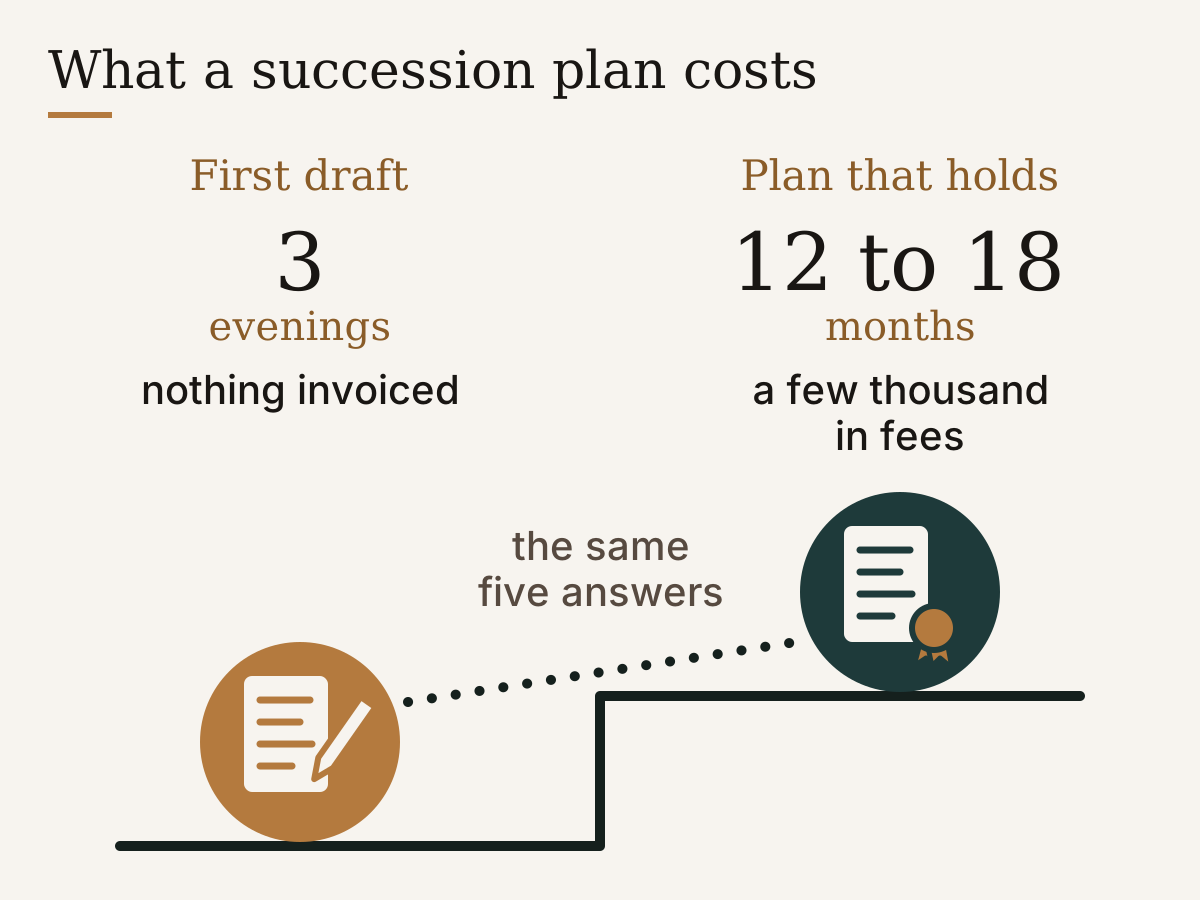
At the cheap end, a succession plan is three evenings at the kitchen table and not a single invoice. At the other, twelve to eighteen months alongside your daily work and a few thousand to a few tens of thousands in fees, in euros or francs. That’s the honest range: a first draft at one end, a version that holds at the other.
Business succession planning means writing down five answers on one page: who will own the company, who will run it, from what date, on what terms, and what happens if the first option falls through. Until those answers are on paper, you have an intention, not a plan. The first draft is yours to write this month. Making it hold is where the months and the fees go, more of both for a larger company.
The bill, answer by answer
Each answer takes an evening or less to write. It costs money only once someone puts a figure on it or turns it into a document others can act on.
| What you write | Your time | Money, once you make it hold |
|---|---|---|
| Who will own it: a name, or “nobody yet” | Part of an evening | A shareholders’ agreement, drafted by a lawyer or notary: a few thousand |
| Who will run it: a name, or who carries the day-to-day meanwhile | An evening, and one frank conversation | Nothing, unless no name comes to mind: then a deputy to hire, one manager’s salary a year at your market’s level |
| From when: a date, or a range of years | An hour | Nothing. The date sets the rest of the calendar |
| On what terms: a price range; how it’s paid (cash, instalments, a part tied to results); your role afterwards, how long and as what | An evening | A valuation by an accountant or adviser: a few thousand to around twenty thousand. A tax estimate: a few thousand at most |
| If the first option fails: the second route, and the emergency version | An evening | A power of attorney and a will: a few hours of a lawyer’s or notary’s time |
| All five | Three evenings; then 12 to 18 months for the version that holds | Nothing; then a few thousand to a few tens of thousands |
Two terms in that table, in plain words. A shareholders’ agreement is the written agreement between the owners on who can sell to whom, and at what price. A power of attorney is the written authorisation you give someone to sign for the company. The bill for the sale contract itself comes later, at the sale.
The tax estimate is a few hours of your accountant’s time. What the tax authority takes depends on the country, on what you pass on (the shares, or the business itself) and on how you hold the company.
Both versions carry the same five answers. A draft guides you; a plan that holds can be signed and acted on.
A first draft, with a question mark
Take a case I’ve made up. An electrical installation company with 18 people and revenue around 3 million. The owner is 59. His daughter, 31, has worked there for four years, and he has never known whether she wants to take over.
On his page, the first line reads “my daughter?”, question mark included. That’s already useful: the first two answers hang on a conversation he hasn’t had, which costs nothing but nerve. If she says yes, the page names who runs the vans and signs the quotes while she learns to run a company; handing a business to your children starts with that question. If she says no, the fifth line becomes the main road.
The date matters more than it looks. In the mandates I run, a sale to an outside buyer takes twelve to twenty-four months from decision to signature. A handover to a child or a manager, who must learn to run the company and find the money to buy it, is prepared more like three to five years ahead. If he writes “at 62”, the family route has to start this year.
From this month to the day it’s used
This month, the five answers on one page. Within twelve to eighteen months, the version that holds: value in figures, tax estimated, documents read by your lawyer and accountant. Every year, one evening of rereading: a line changes (the date, a name, the price), the rest stands. Then the day itself, when the first route or the second gets used.
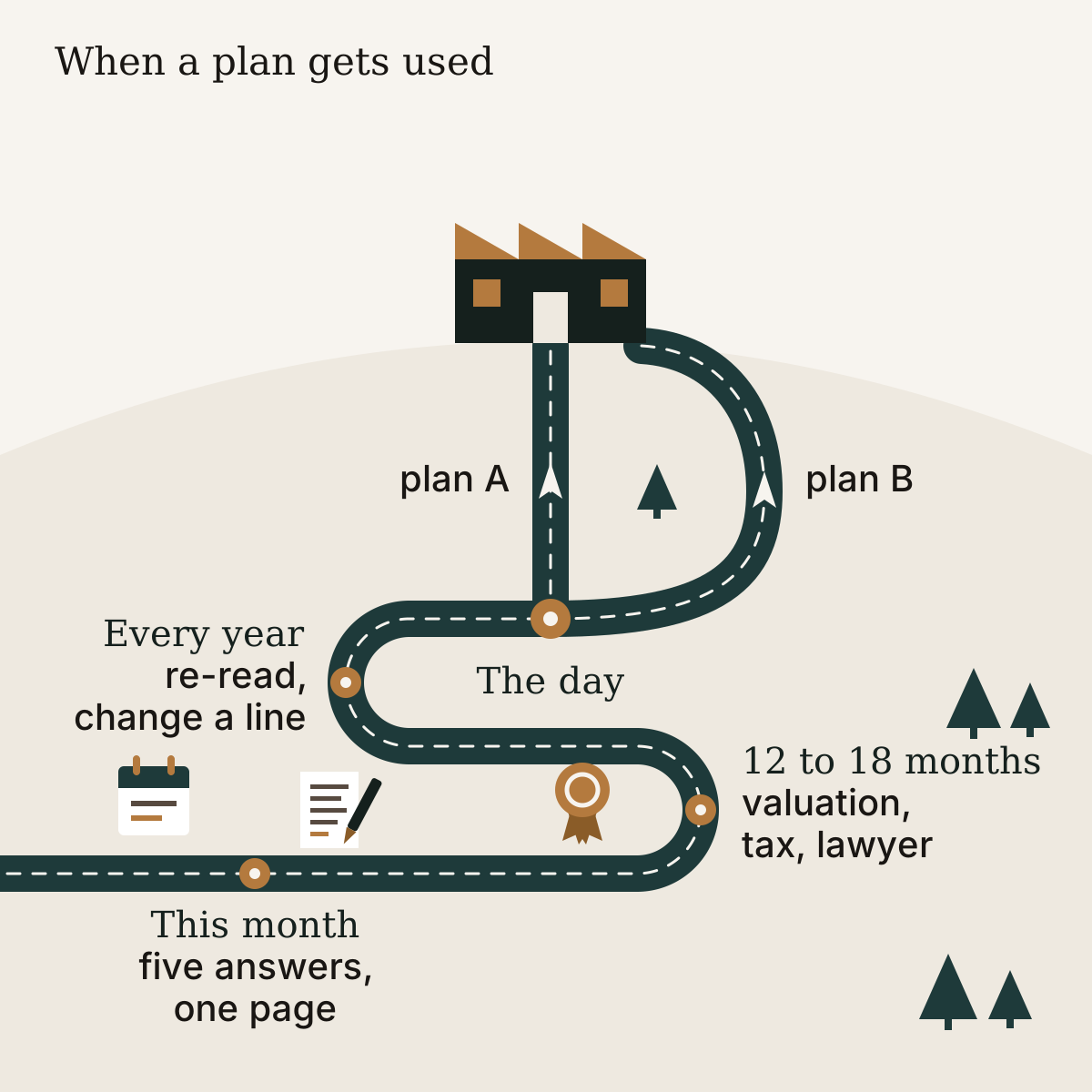
That yearly evening is the cheapest line on the bill. Skip it, and the page may still name a manager who left two years ago.
The emergency half costs little
The fifth answer has two halves. One is the second route if the first closes: the child says no, the manager leaves, the buyer pulls out. The other is the emergency version: who signs for the company tomorrow if you’re in hospital, and who gets the shares if you die. Picture Friday’s supplier payments with nobody allowed to approve them.
A power of attorney and a will are drafted in a few hours. A will written entirely by hand, dated and signed, is valid without a notary; in Switzerland and Germany, for example, the law says so. Elsewhere, ask your lawyer or notary which form counts. What costs is not having them: see what must exist before you’re suddenly unavailable.
What the blank page costs
In my experience, an owner with nothing written ends up selling on someone else’s calendar: a health scare, a letter from a buyer, a partner who wants out. Pressed for time, that seller says yes sooner to the first offer, gives up more on the part of the price paid after the sale, and promises the buyer more about the state of the company. No table shows that bill.
Strong buyers also spot a company that still depends on its owner, and walk away or lower the price. So prepare the handover before looking for whoever takes it. Starting early doesn’t mean selling early. It means never having to sell under pressure.
The five answers are yours to decide. Running what follows (the valuation, the lawyer, the bank, the timing) can be handed to someone else, so you stop being your own project manager.
One warning for the evening you sit down. The line you leave blank won’t stay blank. Someone else’s calendar will fill it in.
Sources
End of the article.