

How does a business transfer of ownership work? What you still decide between signing and closing

Ownership passes in two steps, signing then closing. In between you still run the company, to the buyer’s list. What to agree before you sign.
The day you sign the sale of your company is rarely the day it changes hands. In the mandates I conduct, a few weeks to three months usually lie between the two, and the gap stretches when the buyer’s financing or an authority’s approval is slow to come.
So how does the transfer of ownership actually work? In two steps. At signing, the contract binds you and the buyer: the price, your promises about the company, the conditions still to be met. At closing, the shares or the assets pass to the buyer and the price is paid to you, on the same day, one against the other. In between, you’re still the owner and you still run the company. But you’ve promised to run it as usual and to ask the buyer’s written consent for anything out of the ordinary. What protects the sale is a list of those decisions, drawn up before you sign, and a window kept short.
Signing day: everything promised, nothing handed over
Signing feels like the end. You’ve read the last draft, the pens come out, someone may open a bottle. Yet the company’s bank signatures still carry your name the next morning, and so does the share register. Everything that matters has been promised; nothing has moved.
Signing binds you, but under a contract built this way it transfers nothing yet. In Germany, for example, the law itself keeps the two apart for shares in a GmbH, the country’s everyday limited company. The promise to transfer and the transfer itself are two separate acts, each recorded by a notary.
What you’ve promised sits in the business transfer agreement as a whole: the price and how it’s paid, your warranties, and the conditions precedent, what closing waits for. Typically that means the buyer’s financing, and the consent of a landlord or a customer whose contract requires it when the owner changes. Sometimes an authority must approve the deal, and depending on the country and the type of company, the deed may need a set form, for example before a notary.
Who gains or loses from the company’s results in the meantime is a question the contract should answer, and one to put to your lawyer if the draft is silent. In Switzerland, for example, the law on sales has a starting point: benefit and risk, the gains and the losses, pass to the buyer when the contract is concluded. The parties can agree otherwise, and special circumstances can change it too. Where the contract depends on a condition precedent, they pass only once that condition is met.
The weeks in between: your company, run to someone else’s list
From the morning after signing, the company is still yours, and you run it to a list you’ve agreed with someone else. The contract calls these ordinary-course covenants, promises to run things normally. In practice they say two things. Carry on as you always have. And for anything out of the ordinary, ask the buyer first, in writing.
What counts as out of the ordinary is written into the contract, with its own thresholds. Hiring or dismissing a manager. Signing or ending a large contract, or changing a key one. An investment above a set amount, a new loan, a dividend. Pay rises outside the usual cycle. Settling a dispute.
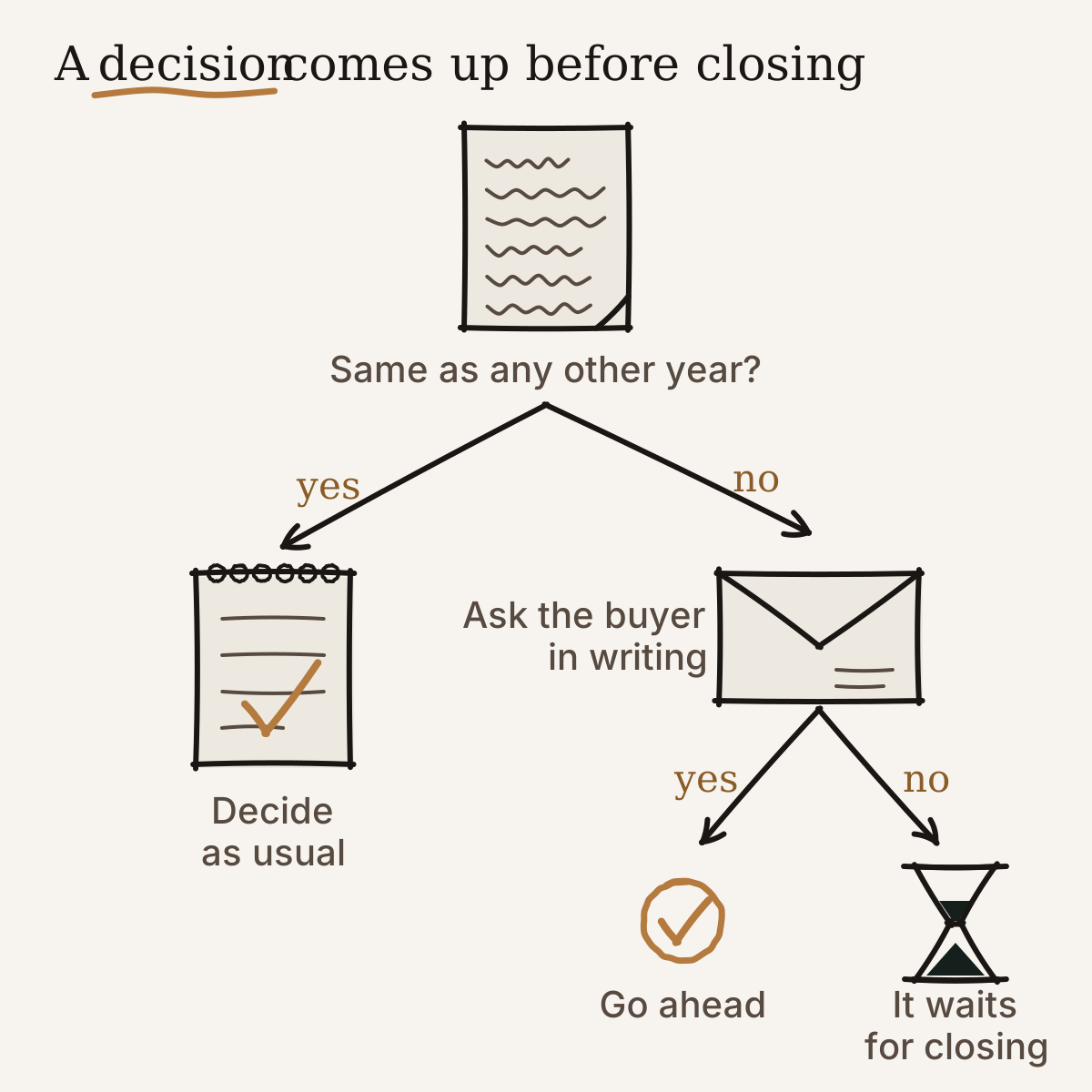
The list that protects you is your own, and you build it before signing. Open your calendar for the months ahead and look for what will land in the window: the annual pay round, a tender you mean to answer, a lease up for renewal, a machine near the end of its life, a hire you’ve already planned. Each one gets settled in the contract. Either it’s authorised in advance, or it goes to a named person at the buyer, who has an agreed number of days to reply. If the answer is no, the decision waits for closing, and then it’s the buyer’s. A consent clause with no name and no deadline leaves you waiting by the phone.
Imagine a plastics moulding firm of about thirty people; a case, not a client. The contract is signed in May, closing is set for the end of June. Three weeks in, a material dryer fails, and its replacement costs more than the threshold in the contract. The owner calls the buyer’s named contact, who says yes the next day. That same week, he wants to hire a technical sales rep he’s been courting since the spring. This time the buyer asks to meet the candidate first. Both answers are reasonable. Neither one is the owner’s alone any more.
Inside the company, very little changes on the surface. The sale isn’t announced before closing unless you decide otherwise, and the circle who knows stays the one that negotiated, widened only where the contract or your country’s rules on informing staff require it. What you tell your people, and when, is settled before you sign. The rest of the staff see the same owner taking the same decisions, a little more slowly. If you want to think through which decisions you keep and which you hand to someone else during a sale, do it before this window opens.
One caution about the window, though. Running the company as usual means running it. An owner who freezes every decision for fear of breaching the contract hands over a company that has stood still since the day you signed, and that isn’t what the buyer signed for either.
Why a short window protects the sale
Every week between signing and closing is a week in which something can happen. A customer leaves, a key person resigns, a month comes in below plan. Each of those becomes a question from the buyer, and sometimes the opening of a renegotiation. Meanwhile you carry the company with less freedom than you’ve ever had.
Many contracts also hold a material adverse change clause, the buyer’s exit if something grave happens. What counts as grave is negotiated, line by line, and it’s worth reading that definition with a long window in mind. Against the opposite risk, a deal that drifts, the contract sets a long-stop date: after it, either side may walk away. Without one, a sale can sit half-done for months.
Shortening the window mostly happens before signing. Ask for the third parties’ consents early: a letter from the landlord can then sit in the file on the day you sign. Ask the buyer to have the financing file complete by then too. In my mandates, the windows that stretch are the ones waiting on an approval or on a bank.
Closing day: everything passes at once
Closing is the day of checks. Each condition is ticked off against the contract: financing confirmed, consents received, the deed in the required form. Only when the last box is ticked does anything move.
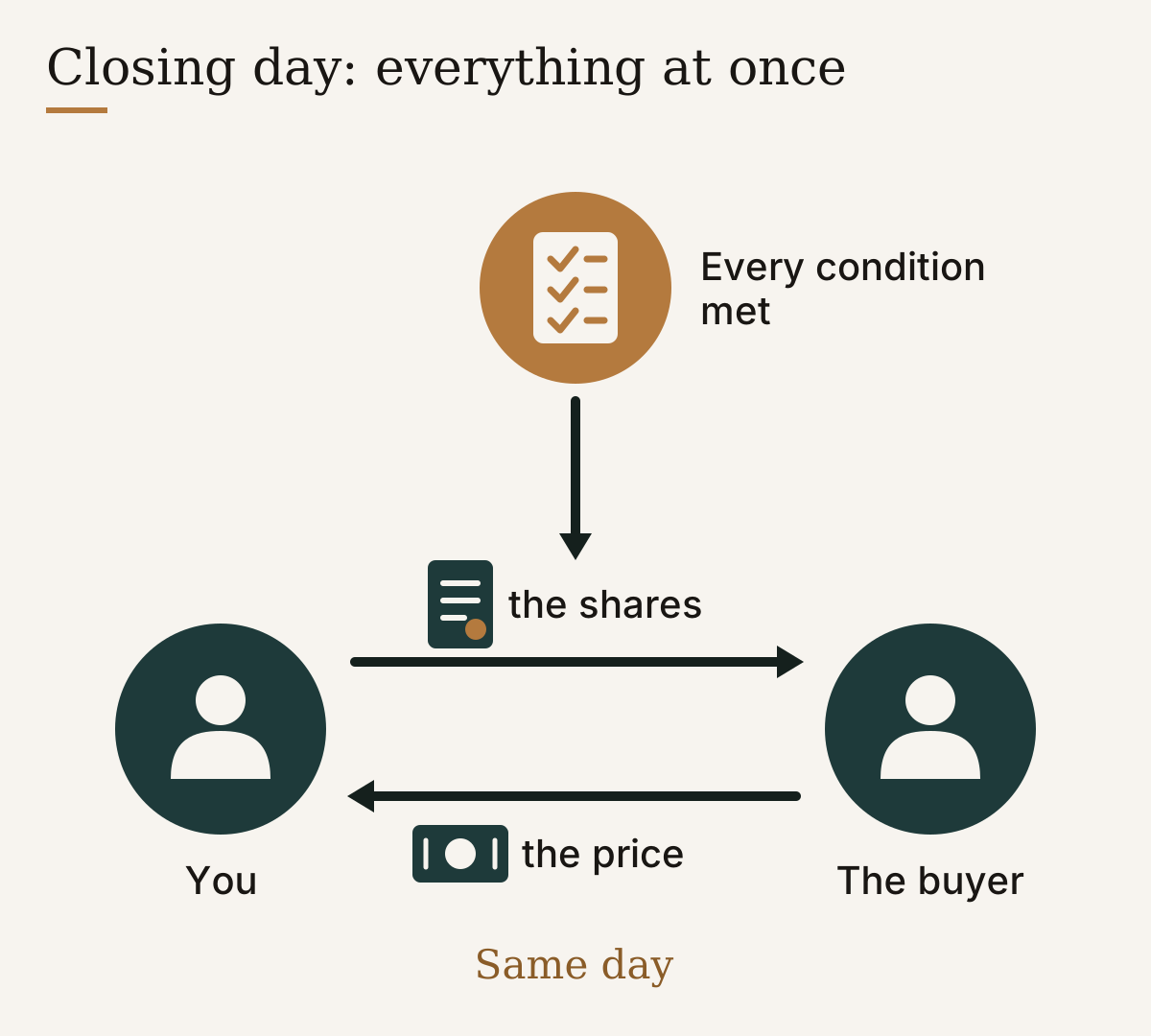
Then it all passes together. The shares, or the assets, go to the buyer; the price comes to you, the same day, one against the other. Board members sign their resignations, the registers are updated, the bank signatures change, and someone hands over the keys. Most of the day goes on checking documents and waiting for the bank to confirm that the payment has arrived.
The price can still move after that. It may be adjusted on accounts drawn up at the closing date, and the working capital figure can shift it either way. Or it may have been frozen at an earlier date, what the contract calls a locked box. And the next morning the handover period after closing begins, with you in whatever role you agreed.
Sources
End of the article.


