

Can my company make me retire? What your partners can decide when nothing is written

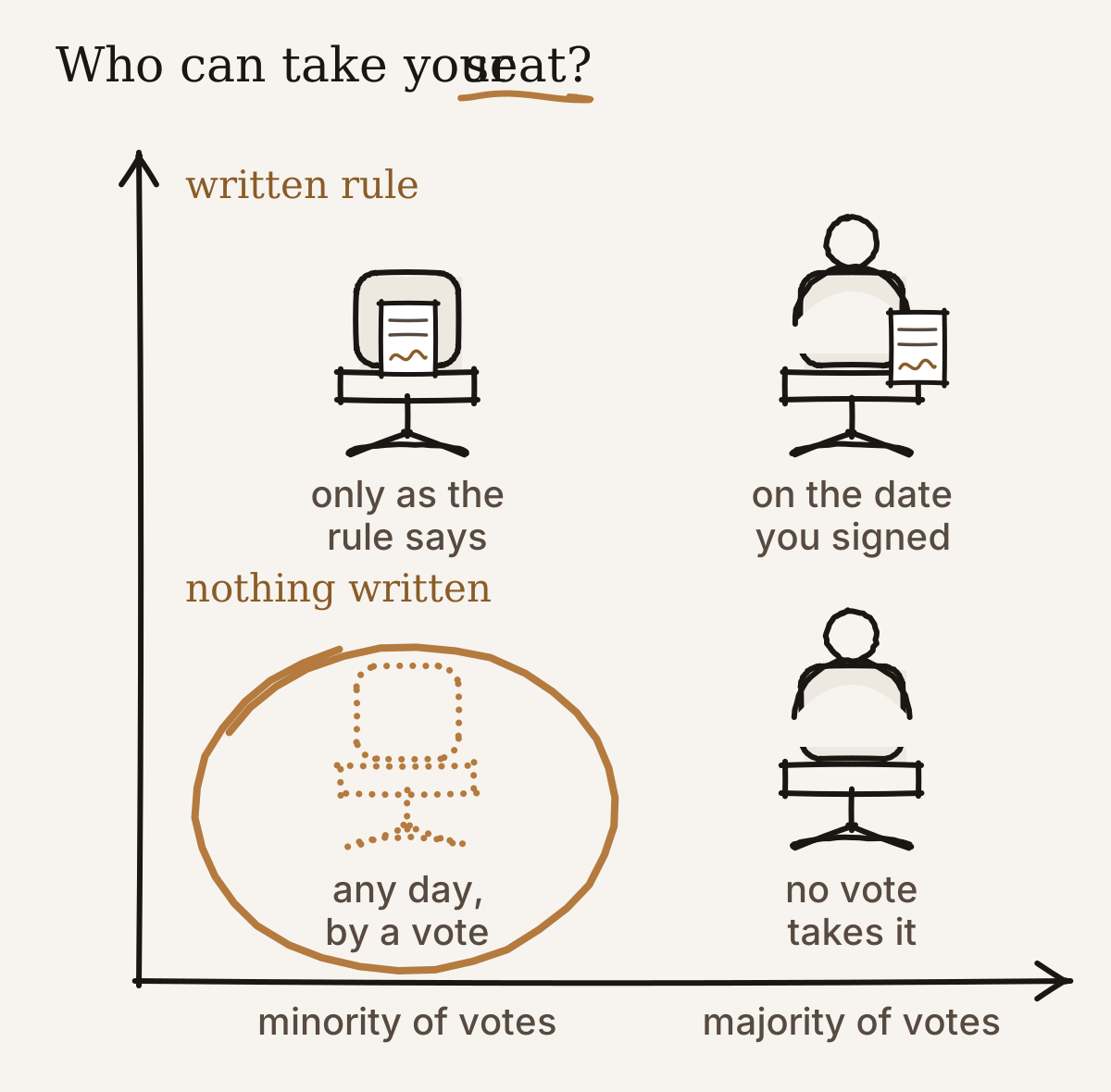
Hold a majority of votes and nobody can vote you out. Without it, your partners can, any day, but your shares stay yours. What’s written decides the rest.
Retiring from a company you own with partners covers two departures that follow different rules. One is leaving the managing director’s chair, with its salary and its signature. The other is leaving the capital, which means selling your shares. When owners ask whether their company can make them retire, they mean the first.
So, can it? That depends on two things and nothing else: who holds the majority of the votes, and what is written. If you hold that majority, nobody can vote you out of management against your will. If you don’t, the partners who do can remove you from management by a vote, without giving a reason, from one day to the next. In Switzerland and Germany, for example, company law says so in almost those words. Elsewhere, ask your lawyer whether a removal needs a reason. That vote doesn’t touch your shares. They stay yours, with their dividend and their vote. A written rule can tilt all this either way, whether it sits in the articles (the company’s basic rulebook) or a shareholders’ agreement (a contract between the partners). It can protect a minority manager, or bind a majority owner to a date they once accepted.
Five questions that settle it
Answer these before you speak to anyone, in this order.
| Question | If yes | If no |
|---|---|---|
| Do you hold the majority of the votes? | No vote can remove you | Whoever holds it can remove you any day |
| Is your exit from management written down? | The written date or rule applies | The vote decides, when it suits the majority |
| Does a removal need a reason? | They must show a serious cause | No reason is required |
| Is there a buyout clause for your shares? | Price, buyer and timing are known | Your shares stay with you, with no exit price |
| Does your contract set notice or compensation? | A removal costs what the contract says | Ask your lawyer what you’re owed |
Who holds the majority of the votes
Founder, chairman, the name painted on the van: none of that weighs anything at a shareholders’ meeting. Votes do.
Imagine a services firm, invented for the purpose, owned by three partners with 40, 30 and 30 per cent of the shares and votes. The founder holding 40 per cent is 64, the other two are both 50. Nothing is written about when anyone leaves management. Together the two younger partners hold 60 per cent of the votes, enough to vote him out as managing director at their next meeting. He’d keep his 40 per cent of the capital, dividend and votes. He’d have no role, no office and no salary.
A majority also works one step removed, through the board that appoints the managers. In Switzerland, for example, board members of an unlisted company are elected for three years unless the articles say otherwise, six years at most. Every re-election is a fresh vote, carried by a majority of the votes represented at the meeting unless the articles set another bar. The board in turn can dismiss the managers it appointed at any time.
That’s why the majority owner is safe from this question, and only from this one. No vote can retire you. Then again, nobody has settled your own date, or what becomes of your shares the day you go. Left unwritten, that returns later as a conflict between partners, or as a sale under pressure. Stepping back from management while keeping your shares is a route worth planning on its own terms, and it works best when you choose the date.
Whether anything is written
A written rule can fix four things that otherwise stay open. The date or the age at which each founder leaves management. Whether removing someone before that date needs a reason. How their shares are then valued, who buys them, and over how many years the price is paid. And what they keep in the meantime: the dividend, perhaps a board seat, a right to see the figures.
In the cases I handle, the question “can they push me out?” almost always arrives once the understanding between the partners is already damaged. By then the answer lies in the votes, not in the conversation. An agreement that exists but stays vague on these four points doesn’t help much either, and what loose drafting ends up costing usually shows on exactly this kind of day.
Whether a removal needs a reason
Under the Swiss and German default rules quoted above, it doesn’t. A written rule can change that, and for a minority manager it’s often the clause that matters most. It can limit removal to good cause, meaning a serious and provable reason. In Germany, for example, the articles of a GmbH, a private limited company, can allow a managing director’s removal only for good cause. The law cites gross breach of duty or an inability to manage properly.
Whether your shares have an exit price
A vote at a shareholders’ meeting removes a person from an office. It doesn’t move a share from one hand to another. Only your signature does that: a buyout clause (an agreed promise to buy), an option (a right to buy, agreed in advance), or a sale you agree to.
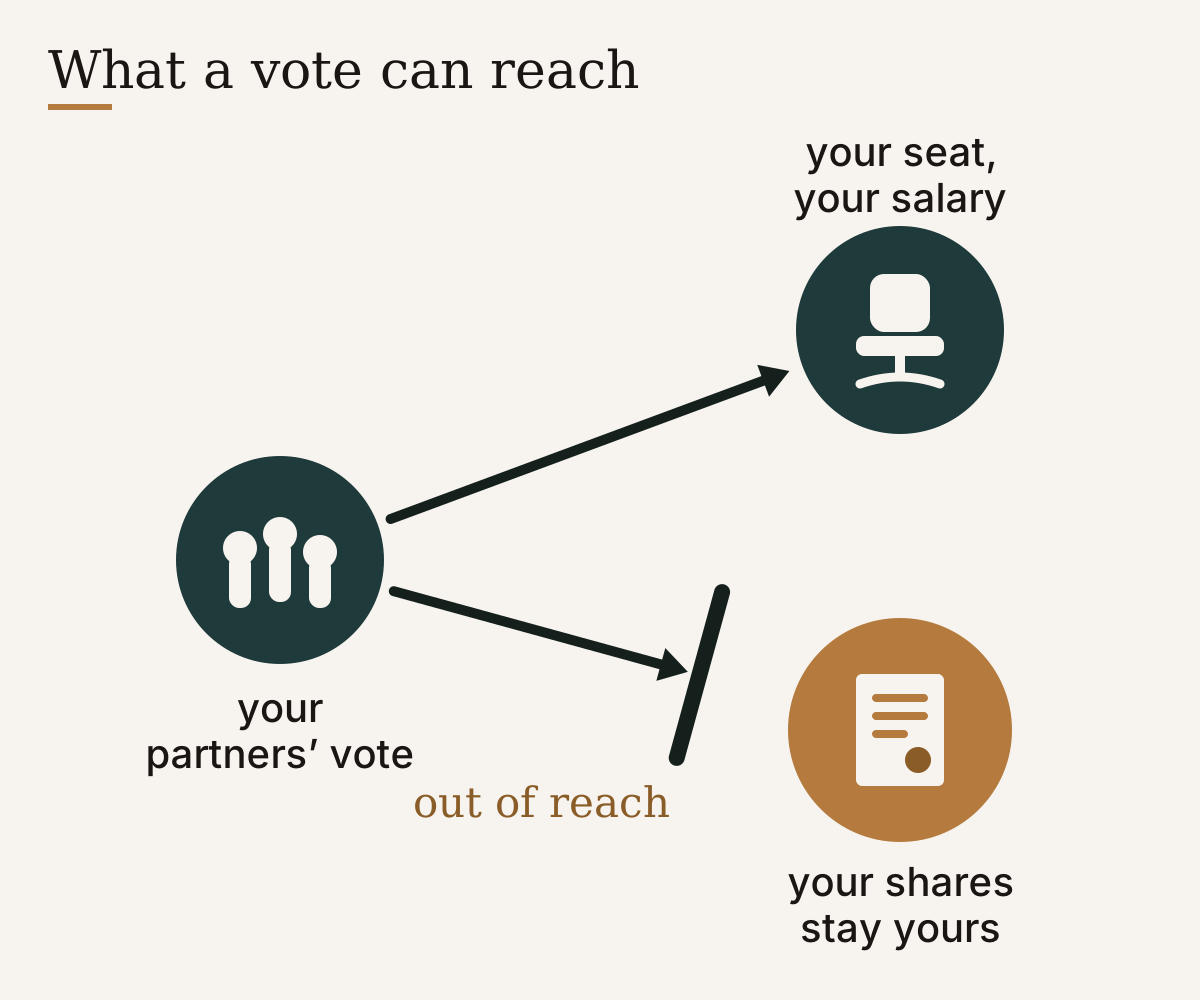
That protects you, and it also leaves you stranded. The partners who removed the 64-year-old founder can’t take his 40 per cent. Yet without a clause, nobody has agreed a price or a buyer for it either. He owns a large minority stake in a company he no longer runs, alongside two people who have just voted him out.
Whether your contract sets notice or compensation
Losing the office doesn’t cancel what your employment or service contract still owes you. The Swiss and German texts mentioned above say so in so many words: claims for compensation under existing contracts survive the removal. So reread your contract for notice period and compensation. It sets the price of a removal for the company; the votes decide whether the removal happens.
What to do this week
Get out the articles, and the shareholders’ agreement if there is one. Look for who elects the management and by what majority, whether there’s a clause on age or length of term, and whether there’s a buyout clause. Then read your own contract for notice and compensation.
After that, put two questions to your lawyer. “Here, where we are, does a removal need a reason?” And: “What would the company owe me if it happened?”
The moment to fix the rule is while everyone gets along and nobody has an age in view yet. Negotiated cold, a departure rule costs one meeting around the table. The same rule negotiated hot costs a conflict. If the real disagreement between you is about selling rather than about who runs the place, that’s a different fork with its own four routes.
Who should do what
If you hold the majority and nothing is written, set your own date, and the fate of your shares, before someone else asks you for it. Your partners can’t vote you out, but they’ll still be there the year you decide to go.
If you’re in the minority and nothing is written, negotiate a written rule now: a date, the reasons a removal would need, a buyout priced by an agreed method. Otherwise accept, with open eyes, that your seat depends on the others’ goodwill.
If a rule already exists, whatever your share, reread it this month. On the day it’s tested, it will count for more than your percentage.
Sources
End of the article.


