

What does it mean to hand over a business? What changes hands, and what stays in your name
Handing over a business moves the company to a buyer. The guarantees, leases and leasings you signed yourself stay yours: what releasing each one costs.
Handing over a business moves the company to the buyer. Your name stays on the papers you signed personally for it. Getting it off costs little in fees: a few hours of a lawyer’s time, sometimes a transfer or registry charge, rarely more than a few thousand euros or francs. In time, it costs two to three months, most of them the bank’s. Skipping it can cost the full amount you once guaranteed, years after someone else took the keys.
So what does it mean to hand over a business? You transfer its ownership to someone else, for a price or, within a family, sometimes as a gift. Either the company’s shares change owner, or the business itself passes, asset by asset. What changes hands is what belongs to the company: its machines, its customers, its team, the contracts it signed in its own name. In an asset sale, the buyer picks among them. What stays is everything you signed personally to keep the company going: a guarantee to the bank, a lease, a car on leasing, a mortgage on your house. Each is a contract between you and someone else; the buyer was never party to it, and it stays yours until that someone lets you go. So each release has to be agreed and written into the sale contract.
What leaves with the company, and what stays with you
For twenty years, you and the company have shared one signature. The bank asked for yours behind the credit line, the landlord wanted a person behind a young limited company, the leasing firm found it simpler. Nobody kept a list, because nobody needed one.
A share sale changes nothing on those papers. The company keeps its loan, and your signature keeps standing behind it, now for an owner whose decisions you no longer control. Whether you sell the shares or the assets changes what the buyer takes, never what you signed.
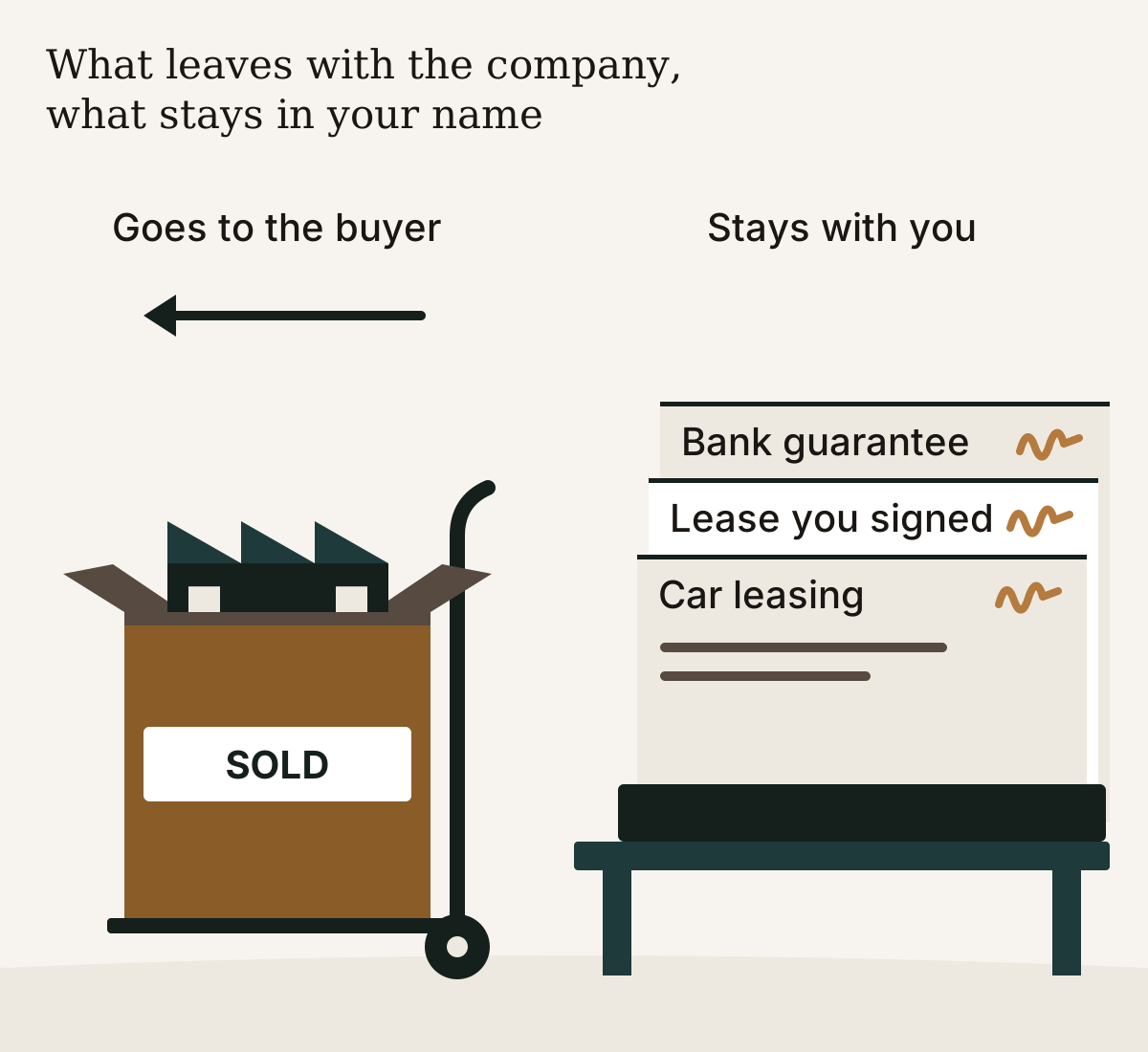
In the sales I conduct, the owner’s first list is almost always too short. The bank guarantee is on it. The lease signed before the company existed often isn’t, nor the van leased in the owner’s own name, nor the guarantee a wholesaler asked for in exchange for longer payment terms. The mortgage on the family house behind the credit line gets forgotten: it was signed at the kitchen table.
Three sources make the list complete. Ask each bank, in writing, for every guarantee or pledge it holds for the company’s credit, in your name or a family member’s. Read each lease and leasing contract for the name on the signature line. Then empty your own drawer.
What each release costs
The real price is what the other side asks in exchange for letting you go, and that bill lands mostly on the buyer.
| What you signed | Who must say yes | What they usually ask in exchange | What it costs, roughly |
|---|---|---|---|
| A guarantee for the company’s loan or credit line | The bank | The buyer’s own guarantee or pledge, or the loan repaid the day the sale completes | Small fees; the real cost is part of the price held back, or the loan repaid out of it |
| A business lease in your name | The landlord | The buyer’s accounts, often a new deposit of a few months’ rent | The buyer’s deposit replaces yours; an hour or two of a lawyer’s time |
| A car or machine on leasing in your name | The leasing company | A credit check on the buyer and a transfer fee, or buying the contract out | A transfer fee usually in the hundreds; a buyout close to what’s left to pay |
| A guarantee to a supplier | The supplier | The buyer’s guarantee, or shorter payment terms | Often a single letter |
| Your house or savings pledged to the bank | The bank | The same as for the guarantee | Notary or registry fees, small next to the loan |
Behind every line sits the same mechanism: whoever holds your signature has to agree to swap it for someone else’s. For a debt in your own name, a loan or the instalments of a leasing, the law spells it out; in Switzerland, Germany and Austria, for example, a new debtor takes your place only if the creditor agrees, and elsewhere it’s a question for your lawyer. Until that yes arrives, the buyer can only promise to pay in your place. That promise is worth what the buyer is worth.
Even a yes doesn’t always free you on the spot. In Switzerland, for example, a tenant of business premises can pass the lease to a successor with the landlord’s written consent, and the landlord may refuse only for good cause. The former tenant still stays liable alongside the newcomer until the lease ends or could be terminated, for two years at most.
When the bank won’t decide before closing, the day the sale completes, the contract carries the risk instead. The sale can be made conditional on the release. Part of the price can wait in escrow, money parked with a third party, until the release arrives. Or the buyer promises in writing to repay whatever you are later made to pay. The first protects you best; the third is only as good as the buyer’s balance sheet.
Who has to say yes, and how early
In my mandates, the bank is the slowest yes. Its credit committee wants to see the buyer’s accounts and financing plan before it lets go of your guarantee: count two to three months. Landlords take one to two months, leasing companies four to six weeks, a supplier two to four.
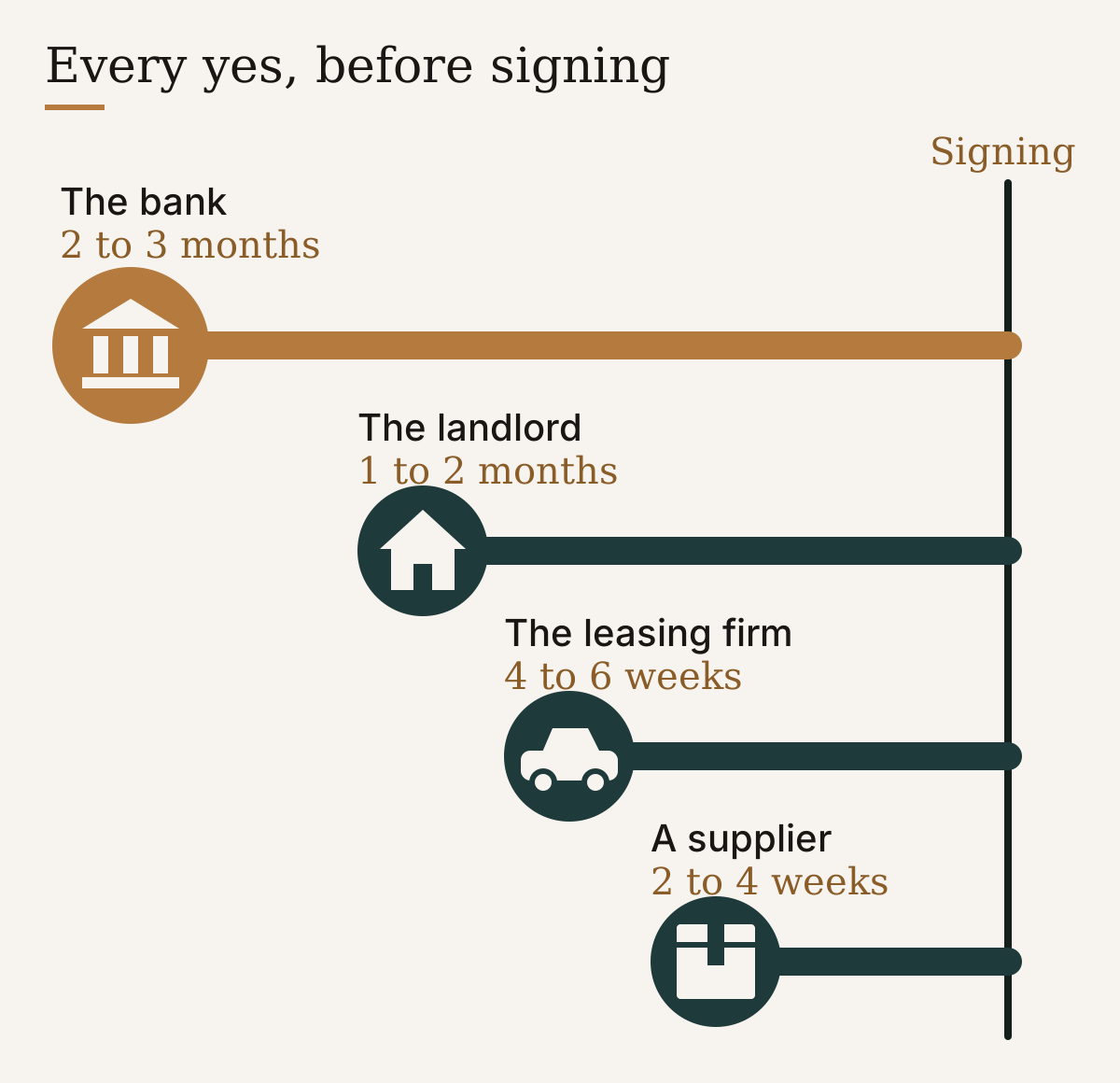
All of them have to land before you sign. A release that isn’t agreed by then turns into a promise in the contract instead of a fact. So your list goes to the buyer with the first draft of the business transfer agreement, not after the price is agreed. A buyer who learns at the last minute that his own guarantee must replace yours has every reason to reopen the price, and it changes how he finances the deal. Five yeses on five calendars, chased while you still run the company, is a job in itself; it doesn’t have to be yours.
The line nobody asked about
Imagine a joinery of about twenty people; a case, not a client. The owner, 63, sells her shares. The guarantee to her main bank is released at closing, as agreed. A second guarantee isn’t on the list: 300,000 euros, signed years earlier at another bank for a credit line opened for one large order, never closed and unused since.
The new owner draws it in full to pay for a move. Two years later the company fails, and the second bank writes to her at home for the full 300,000. She hasn’t set foot in the workshop since the sale.
Most guarantees I see cover whatever the company owes that bank, up to a cap, new borrowing included. Only the cap limited her bill.
Her list would have taken an afternoon, and one letter to every bank the company had ever worked with. The second bank’s letter took two years to arrive.
Sources
- Swiss Code of Obligations (CO), Art. 175, 176 and 263SwitzerlandFedlex (opens in a new tab)
- German Civil Code (Bürgerliches Gesetzbuch, BGB), § 414 and 415Germanygesetze-im-internet.de (opens in a new tab)
- Austrian Civil Code (Allgemeines bürgerliches Gesetzbuch, ABGB), § 1405AustriaRIS (opens in a new tab)
End of the article.


