How much is a small business worth? What its buyer can repay

Roughly what a buyer can borrow against its profit, plus their own money. How to work out that ceiling, and what to do if your price sits above it.
The multiple in a valuation report, the number it multiplies your profit by, won’t set the price of your company. A bank you’ll never set foot in will, once it has your buyer’s file on the desk.
So how much is your small business worth when you sell it? Roughly what its buyer can borrow against the company’s profit, plus the money they bring themselves. That ceiling often sits well below the figure in the report, and you can work it out yourself on one sheet of paper.
Start with who buys. In the small companies I see change hands, the buyer is almost always a single person: an employee, a manager from a competitor, now and then an outsider to the trade. They have savings and they borrow the rest. Their bank doesn’t lend against the price you ask; it lends against the profit, what the business earns each year. And it asks one dull question. Once the new owner has paid themselves a salary, is what’s left enough to cover the repayments?
In the deals I see, banks want an acquisition loan paid off out of profit within about five to seven years. Which puts the ceiling of your price at roughly this: the buyer’s equity, meaning the money they put in from their own pocket, plus a few years of the company’s profit after a manager’s salary. Anything above that line has to come from somewhere else.
Run the sum yourself this evening. Take the last three years’ profit. Add back what you paid yourself, then take off what a hired manager would cost to do your job; what remains is profit after a manager’s salary, the figure a lender actually reads. Strip out one-offs, like the insurance payout after a burst pipe. Take off what the business must spend each year just to keep going, a new van or machine included. Multiply what’s left by four or five, not the full five to seven years, because interest and a bad year eat the rest. Then add what you think a realistic candidate could bring.
Picture a heating-installation firm of nine people, invented for the sake of the sum. After a manager’s salary it clears 150,000 a year, in whatever currency you count in. The valuation report says 1.1 million. The candidate is the foreman, with 120,000 saved. His bank will lend what that profit repays in about five years, less interest and a margin for a bad year: call it 600,000 to 650,000. That puts the ceiling at around 750,000. The report and the foreman are some 350,000 apart, and no amount of goodwill across the kitchen table closes that.
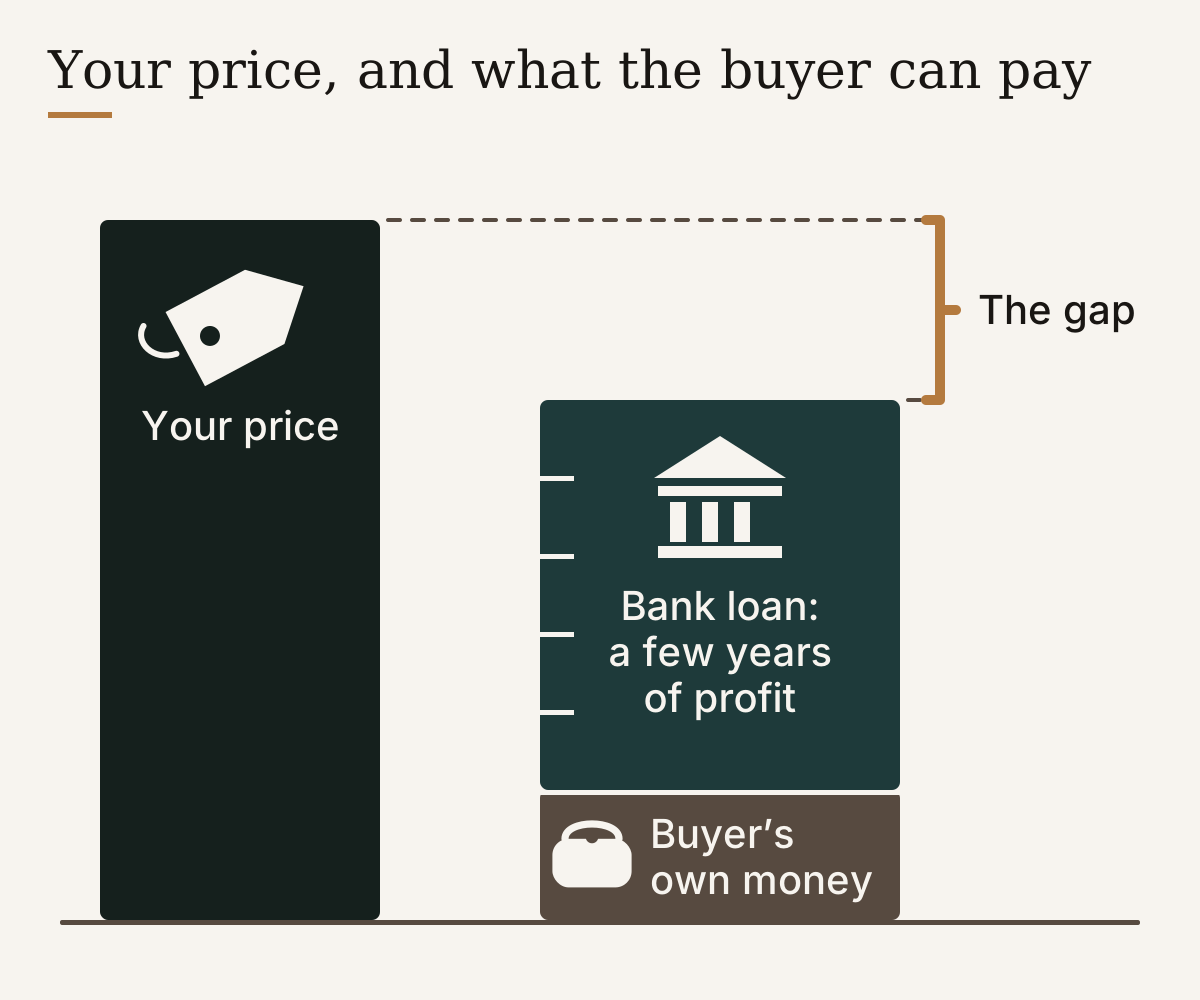
The first objection is the report itself. A multiple tells you what the company would be worth to an investor who already has the money. The price is what a real buyer can pay, and the two meet only when the profit is large enough for the bank. I’ve written separately about what a multiple leaves out. Here it’s enough to see that the foreman’s bank starts from the profit, not the multiple.
Then comes the buyer with deep pockets: a group or a larger competitor with its own cash, who doesn’t need a bank at all. For a small business they’re rare, and they turn up on a timetable of their own, which has nothing to do with your age or your back. Yet their finance people run the same sum as the foreman’s banker.
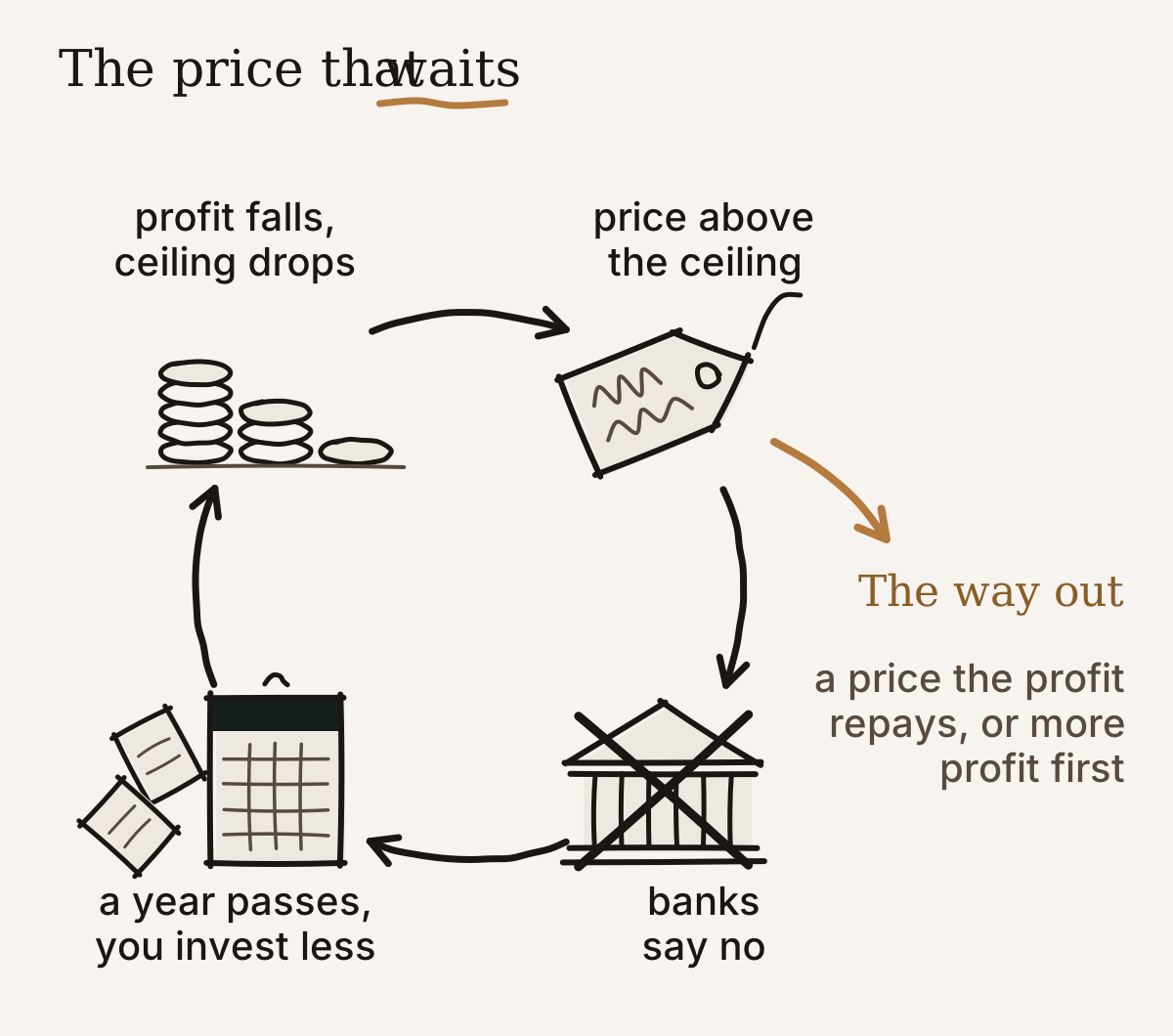
The last objection costs the most: “I’ll wait for the buyer who has the money.” What I’ve watched is a loop. The price stays above the ceiling. Each candidate goes to a bank, and each bank says no. A year passes. You invest less, because why buy a new van for somebody else, and you get tired. The profit slips, and since the ceiling is built out of profit, it drops too. The gap you were waiting to close has reopened.
When your price sits above the line
Short of cutting the price, you have three honest ways out.
You can lend the gap yourself. That’s a seller loan: part of the price you collect over several years, paid out of the company you no longer run. It turns you into a creditor of your former business, and the buyer’s bank will usually ask for its own loan to be repaid before yours. Read what a seller risks by lending to the buyer before you offer one.
You can tie the gap to future profit with an earn-out, a later payment that depends on how the company does after you’ve gone. If you believe the report’s figure, this is where you can bet on it: the payment comes only if the profit does.
Or you can raise the profit before you sell. It’s the slow road, and the one I’d look at first if you have the time. It takes two or three completed financial years that the buyer’s bank will read, because a profit that appears in the last six months before a sale doesn’t count for much with a lender. Those years are also when you get your numbers into a shape a buyer can trust.
Before you name a price, though, do one thing. Ask your own bank what it would lend a stranger to buy your company, and whether, where you are, a public guarantee could back part of that loan for the buyer. The answer will probably disappoint you. Better to hear it from your own banker now than through your buyer’s banker later.
End of the article.